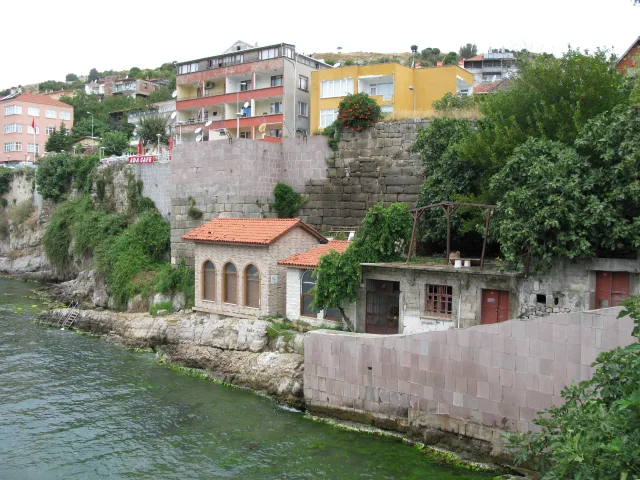
A visit to Cumalıkızık can begin with a colourful façade and continue with a harder question: how does a house connect everyday life with the street? This guide distinguishes recorded history, architectural interpretation and practical suggestions. The proposed walk is not a surveyed accessible route. Keep the people behind the façades in view: a doorway may lead to a private home, while a shop remains somebody’s workplace.
- Province / district
- Bursa / Yıldırım
- Focus
- Domestic space, rural work and modern conservation
- Suggested pace
- Short observations with rest breaks
The rural connection in Bursa’s story
UNESCO inscribed the eight-component property in 2014 under criteria (i), (ii), (iv), (vi). Cumalıkızık’s endowment revenues supported Orhan Ghazi’s complex.
Turn that relationship into a visiting question: what kinds of production and income sustain a city’s public institutions? A doorway cannot answer this alone, but it can connect domestic space with a complex encountered in Bursa. Do not assume that the historical arrangement describes every household’s present economy.
Back to contentsHayat, courtyard and floors: beyond the façade
The Culture Portal describes generally three-storey houses of stone, timber and earth. The hayat connects courtyards, stores and stairs; winter rooms lie below the summer floor. Some entrances pass through an outer courtyard, others open from the street into the hayat. Upper windows have latticework or projections; double doors use walnut and forged iron. These features do not establish identical plans.
From a public street, follow the thresholds between outside and inside. Here, hayat names a domestic space as well as carrying the ordinary Turkish meaning of life. If an authorised interior is available, compare its plan with the exterior. Otherwise, leave unseen rooms unexplained: a projecting upper floor cannot establish their current use.
Back to contentsThe mosque square: use and repair
The cultural inventory dates Cumalıkızık Mosque to the seventeenth century: chestnut timber without a dome, with an Ottoman prayer space to the west and school to the east. It records roof renewal and removal of the dividing partition following the 1940 earthquake, and minaret renewal in 1973. Its present appearance does not represent one construction moment.
Consider the square as shared space with several purposes. People attending worship follow a different timetable from sightseeing groups. If entry is appropriate, follow the attendant’s guidance and avoid obstructing prayer or circulation. Record what you see, then compare it with documentation. Weathered timber is not, by itself, a dating method.
Back to contentsModern conservation has its own history
A ministry response published by Parliament in 1997 records the village’s urban and natural conservation designation on 14 March 1981, and registration of protected immovable properties on 14 October 1990. Street improvement appears in the 1997 investment programme; planned allocations or work do not establish completion.
These records add a modern layer to the visit. An old-looking environment reflects later maintenance and decisions as well as inherited material. When you notice a repaired door or altered surface, ask what problem the intervention addressed and whose needs it served. Conservation should not be understood as one finished event.
Back to contentsLook for work behind a museum object
The municipality’s report of 22 June 2015 documents the ethnographic museum’s reopening after renewal. It credits villagers and the agricultural development cooperative in the museum’s formation, and describes agricultural tools and household objects.
Confirm current access before arranging a visit. Choose one object and ask what task it performed, whose use is documented and what remains unknown. Display does not prove that the same method continues today. Compare the object with the scale of a house outside. A museum selects a story; it cannot represent every family equally.
Back to contentsBuild a short walk around one question
For a half-day outline, allow separate stages for orientation near the village entrance, domestic architecture along public streets, and a cultural stop whose current admission arrangements you have confirmed, followed by a break. This is a planning suggestion, not a duration promise. Decide where to turn back before extending the walk.
If a museum is closed, use the pause to compare observations. With children, choose one question at a time: what does a threshold separate, or where do materials change? If adding central Bursa, reserve a distinct travel block rather than treating both places as one continuous walk.
Back to contentsAsk about provenance at the table or stall
A meal or purchase can create an encounter, but an item sold here is not automatically made here. Ask about its maker, ingredients or materials. Confirm the price, portion and extra services before ordering, so both sides understand the transaction.
A conversation is an invitation, not an authenticity test. A busy seller may decline to explain their work. Ask before taking portraits and keep working areas clear. Buying from one business does not establish a benefit to every resident. Avoid reducing local life to a single costume, food tradition or expected manner.
Back to contentsMovement, return travel and dated images
Assess stone paving and narrow passages against conditions on the day. If someone needs mobility support, ask about the drop-off point, rest opportunities and entrance steps at the chosen building. A short distance may still require considerable effort. Arrange return transport before the final stop.
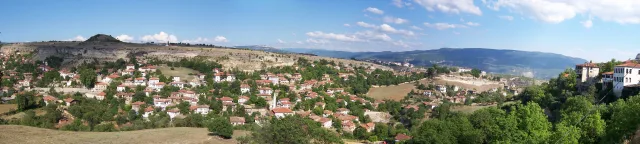
The photograph here dates from 27 January 2013; it cannot establish today’s façades or businesses. Use it to begin a comparison. Observe from public space without leaning against private doors or entering gardens. Keep separate notes on what you saw and what a source says; an unanswered question is preferable to invented certainty.
Back to contentsA timeline of life, work and history
- Early 14th century
An urban and rural system
UNESCO’s historical framework, not a precise foundation date for the village.
- 17th century
Mosque dating
The cultural inventory’s date; later repairs require separate consideration.
- 1981
Conservation designation
The 1997 ministry response retrospectively records the decision of 14 March.
- 2014
World Heritage inscription
The joint Bursa and Cumalıkızık property entered UNESCO’s list.
- 2015
Museum renewal
The municipal report dated 22 June documents the ethnographic museum’s reopening.
Watch and listen: a visual reading path
Use this selection alongside the analysis above. Supported YouTube publications can be watched on this page after you choose to load their player. The publisher’s rights and availability conditions apply; the player does not load or start automatically. Official publication links remain available as an alternative.
T.C. Kültür ve Turizm Bakanlığı / Bursa İl Kültür ve Turizm Müdürlüğü
Bursa: provincial culture and tourism introduction
Provincial introduction uploaded on 31 December 2015, offering archival Bursa context for a Cumalıkızık visit. It does not establish current village access or promise coverage of every house interior.
Watch the official publication ↗Questions and explanations
Can visitors enter every house?
No. A visible doorway does not grant entry. Use only premises that explicitly receive visitors, on their stated terms.
Is 1300 a founding date?
No. It is an approximate period marker.
Is Cumalıkızık inscribed alone?
No. It belongs to the joint property with Bursa.
Does the museum report establish current hours?
No. The 2015 reopening report is historical evidence. Check present visitor arrangements directly with the institution.
Sources, image rights and research method
This is original explanatory and analytical writing informed by the sources below. AI assisted research and drafting. Awards for people, teams and institutions are distinguished; dated results are not current rankings. Media links do not claim a licence to republish a video here. Use the publisher’s correction process if a fact is wrong.
- UNESCO: Bursa ve Cumalıkızık Dünya Mirası kaydı ↗ Source check: 2026-10-05
- Kültür Portalı: Cumalıkızık konut dokusu ↗ Source check: 2026-10-05
- Kültür Portalı: Cumalıkızık Camii envanteri ↗ Source check: 2026-10-05
- TBMM: Kültür Bakanlığının 1997 koruma cevabı ↗ Source check: 2026-10-05
- Bursa Büyükşehir Belediyesi: müzenin 2015 yenilenmesi ↗ Source check: 2026-10-05
- Kültür Bakanlığı WebTV: Bursa tanıtım filmi ↗ Source check: 2026-10-05