Visiting Göbeklitepe simply to tick off an age record misses its greater interest. The form of the stones, collective labour and traces of everyday life meet in a question: how did people organise themselves around major buildings? This guide explains what to look for, which interpretations researchers have revised and how to organise a day from Şanlıurfa. It distinguishes a visible carving from an interpretation of its meaning, and an archive photograph from a route that is open today.
- Location
- Haliliye, Şanlıurfa; near Örencik
- Period
- Pre-Pottery Neolithic, with several phases of use
- Heritage record
- UNESCO World Heritage, 2018; property 1572
- Visit preparation
- Check return transport, last admission and the open route separately
A sequence of use, not one construction date
UNESCO places the monumental structures within a broad 9600–8200 BCE framework in the Pre-Pottery Neolithic. That does not mean every building was erected in the same year. World Heritage inscription occurred in 2018: the age of the archaeology and the beginning of its modern heritage designation are different facts. Compare circular and rectangular arrangements without assuming that every structure was used in the same phase.
Lee Clare's 2020 research abstract explains how work in 2015–2019 and reassessment of earlier excavation records led to revised interpretations. The project's site account also describes several phases of use. A general period and the dating of one building operate at different levels of detail. Record the building name, shape and period explanation in a simple observation notebook. This makes a more useful comparison than repeating 'oldest' beside every photograph. Leave room for questions where the evidence does not provide an exact answer.
Back to contentsLooking at the pillars: head, arms, clothing and animals
The T shape is more than a structural capital. The research team relates arms, hands, belts and clothing details on some pillars to an abstract representation of the human body. Building D's large central pair is a well-known example in this discussion. Recognising an animal in a relief does not establish exactly what that image meant to a Neolithic community. Preserve the distinction between identifying a motif and explaining its cultural meaning.
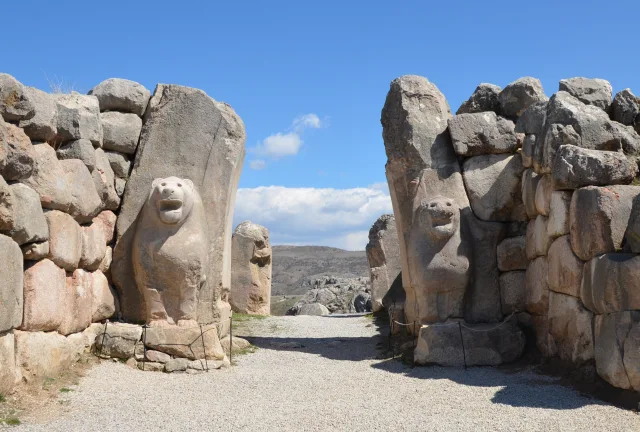
Change the scale of your attention: the overall building arrangement, the relationship between stones, then a detail on one surface. Looking from another permitted position can reveal a relationship that one quick photograph concealed. Our principal image is a 2019 view of Building F, not a photograph of Building D's central pair. Checking the structure's name in a caption is a small but important step towards understanding the site rather than mixing different buildings into an imaginary whole.
Back to contentsBeyond the temple-only story: everyday activity
Jonas Breuers's 2023 discussion of chipped stones explains why tool production and daily activity matter. Worked stone is not merely a scatter of broken fragments; it helps researchers investigate manufacturing and use. The article questions a reading of Göbeklitepe as only a separate cult place visited occasionally and supports interpretation as a settlement with a strong ritual component. This is a research interpretation grounded in finds, not a claim that every social practice has been reconstructed.
The change does not make the monumental buildings less important. It restores the surrounding activities to their story. Ask two questions during a visit: 'Where and how did people gather?' and 'How were this community's daily tasks carried out?' Both deserve attention. A promotional film, excavation account and museum reconstruction supply different kinds of information. Do not turn an effective slogan from one into a demonstrated scientific conclusion in another.
Back to contentsEvidence has limits: why exposing everything is not the aim
The research team's FAQ stresses that excavation irreversibly changes archaeological contexts. Recording where an object lay and its relationship to surrounding deposits can be as important as the object itself. Leaving parts unexcavated is therefore also a research and conservation choice, not simply a failure to discover more. A geophysical indication is not the same as an excavated building, and neither automatically means that a place is open to visitors.
This distinction changes how to behave on site. Leaving a permitted route for a photograph or moving a stone can damage relationships essential to interpretation. Read an object through its setting and explanation rather than drawing a sweeping conclusion from its shape alone. Saying that a symbol's meaning remains unresolved teaches more than supplying an invented certainty. A useful guide should be able to explain where direct observation ends and interpretation begins.
Back to contentsA day from Şanlıurfa: organise the return as well as arrival
Göbeklitepe is a rural destination requiring separate transport, not a street you reach by strolling around central Şanlıurfa. Distinguish the entrance and visitor-centre stage from the walkway around the archaeology. The project's visitor page describes a shuttle and walking connection; confirm how these operate on your chosen day. Finding an outward journey does not arrange the return. If using public transport, check the route, stop and final return service for that date rather than adopting an old blog timetable.
Our editorial suggestion is to allow a flexible window of at least two hours between arrival and departure, with travel time added separately. This is not an official tour duration or a promise of no queues. Begin with the overall plan and interpretation centre, then concentrate on a few structures from the permitted route. Discuss breaks and shuttle use in advance if visiting with children or people with different mobility needs. Prepare water, sun protection and suitable footwear; a protective canopy does not mean that the entire approach is shaded.
Back to contentsTickets, hours, the museum and Karahantepe are separate decisions
On checking the official visitor pages on 3 October 2026, their closing information differed: Muze.gov.tr showed 19:00 while Turkish Museums listed 17:30 in its winter schedule. We do not turn that discrepancy into one guaranteed closing time. Confirm last admission and shuttle arrangements for your date with Şanlıurfa Museum on +90 414 313 15 88. The combined product names Göbeklitepe and its visitor centre; do not assume that it automatically includes every city museum or Karahantepe.
Objects and reconstructions in Şanlıurfa Archaeology Museum help connect the buildings with material culture; distinguish a replica from an original structure. Karahantepe is not another entrance to this site: it requires a separate research and transport decision. Göbeklitepe's UNESCO designation does not extend automatically to every Taş Tepeler site. Giving this landscape and its museum context a considered day can be more rewarding than collecting a hurried list of place names. Enter your current admission and transport quotations in the budget tool; this guide does not supply an evergreen price list.
Back to contentsA timeline of life, work and history
- 9600–8200 BCE
UNESCO's monumental-structure framework
A broad period, not one construction day or an immutable end date for every phase of the site.
- 1960s
Surface survey
An Istanbul–Chicago university survey recorded the archaeological site; the monumental architecture was not yet recognised.
- 1994–1995
Recognition of the architecture and excavation
Investigations in 1994 were followed by excavation from 1995. Research did not end with a single moment of discovery.
- 2018
World Heritage inscription
Göbekli Tepe entered UNESCO's World Heritage List; the inscription date is not the age of the prehistoric structures.
- 2023
Reconsidering everyday life
The research team's chipped-stone account explains evidence supporting interpretation as a settlement with a strong ritual component.
Watch and listen: a visual reading path
Use this selection alongside the analysis above. Supported YouTube publications can be watched on this page after you choose to load their player. The publisher’s rights and availability conditions apply; the player does not load or start automatically. Official publication links remain available as an alternative.
T.C. Kültür ve Turizm Bakanlığı WebTV
Göbeklitepe: the Ministry's short English-language introduction
The official introduction dated 21 March 2019 helps viewers recognise the architecture. Promotional wording is not a substitute for current excavation interpretation or present opening arrangements. View on the Ministry's page; the video file is not republished here.
Watch the official publication ↗Questions and explanations
Is calling Göbeklitepe the world's first temple enough?
No. It is a familiar promotional description, but does not by itself explain settlement and everyday activity. This guide reads monumental and ritual structures alongside the project's developing settlement interpretation, without suggesting that every belief or symbol has been decoded.
Does the principal photograph show Building D?
No. It shows Building F, photographed by Dosseman on 22 September 2019. The structure and date determine what an image can illustrate; an archive view does not guarantee current access.
Why is there no single guaranteed closing time?
The official pages checked on 3 October 2026 gave different schedules. Confirm last admission and shuttle arrangements for your date with the museum on +90 414 313 15 88. A page's present open badge does not establish one closing time for every season.
Are the museum, Göbeklitepe and Karahantepe one place?
No. The city museum and the two archaeological sites are separate destinations. Relating a museum explanation to the scale of the buildings is helpful, but transport and admission coverage must be considered for each.
Does an accessibility icon guarantee step-free access everywhere?
No. Describe your needs and ask about surfaces, gradients, shuttle use and breaks between the entrance and specific viewing points. A general facility icon is not a guarantee of independent, step-free access to every excavation area.
Sources, image rights and research method
This is original explanatory and analytical writing informed by the sources below. AI assisted research and drafting. Awards for people, teams and institutions are distinguished; dated results are not current rankings. Media links do not claim a licence to republish a video here. Use the publisher’s correction process if a fact is wrong.
- UNESCO World Heritage Centre — Göbekli Tepe, 1572 ↗ Source check: 2026-10-03
- UNESCO Türkiye Millî Komisyonu — World Heritage inscription notice, 4 July 2018 ↗ Source check: 2026-10-03
- Lee Clare, DAI eForschungsberichte — 2015–2019 research summary, abstract (2020) ↗ Source check: 2026-10-03
- German Archaeological Institute, Tepe Telegrams — The Site ↗ Source check: 2026-10-03
- German Archaeological Institute, Tepe Telegrams — research FAQ ↗ Source check: 2026-10-03
- Jonas Breuers, Göbekli Tepe Research Project — Chipped Stones, 5 July 2023 ↗ Source check: 2026-10-03
- German Archaeological Institute — Visiting Göbekli Tepe ↗ Source check: 2026-10-03
- Kültür ve Turizm Bakanlığı, Muze.gov.tr — Göbeklitepe Örenyeri ↗ Source check: 2026-10-03
- Turkish Museums — Şanlıurfa Göbeklitepe, visitor facilities and seasonal information ↗ Source check: 2026-10-03
- Muze.gov.tr — Göbeklitepe site and visitor-centre combined ticket ↗ Source check: 2026-10-03
- Kültür ve Turizm Bakanlığı WebTV — Göbeklitepe short English film ↗ Source check: 2026-10-03