Muhsin Ertuğrul’s career explains how artistic institutions are built as much as it records a director’s productions. Rehearsal practice, support for Turkish playwrights, recognition of children as audiences and stages beyond a single city form connected parts of his contribution. Ask not only what he directed, but which working conditions he helped make lasting.
- Roles
- Actor, director and artistic administrator
- Institutions
- Darülbedayi, municipal theatres and State Theatres
- Research starting point
- The Muhsin Ertuğrul Collection at Atatürk Library
A director and administrator who began as an actor
Born in 1892, Ertuğrul entered the professional stage in 1909. Experience in Europe and the Soviet Union formed the international dimension of his theatre and film work. This movement is more usefully understood as an encounter with different production and rehearsal environments than as a simple story of copying foreign artists.
Beginning in acting may give a director insight into practical stage problems, but biographical origins alone cannot explain an artistic method. Consider what professional discipline makes possible: regular rehearsal, understanding a text and presenting a prepared whole to an audience. The administrator and practising artist meet in those conditions of production.
Back to contentsDarülbedayi, repertory and Turkish playwrights
His work at Darülbedayi and later leadership in municipal and state theatre affected the shaping of repertory as well as individual acting careers. The Culture Ministry’s account identifies encouragement of Turkish playwrights as a central contribution. Without the development of texts and the people able to stage them, even a permanent theatre can remain little more than a building.
A national theatre need not be built by excluding translated plays. Encounters between Turkish writing and an international repertory can develop language, performance and audience expectations. More concrete questions help explain historical debates: which work was selected, how was it translated and who performed it? These questions go beyond a simple opposition between domestic and foreign art.
Back to contentsEarly cinema and the limits of a stage comparison
His first film directed in Türkiye was İstanbul’da Bir Facia-i Aşk in 1922. Ateşten Gömlek followed in 1923, bringing Halide Edip’s narrative into another medium. Work with İpek Film and his final film, Halıcı Kız in 1953, span changing technologies. These productions need to be understood through their own resources rather than judged as if they possessed today’s technical possibilities.
The connection between theatre and cinema cannot be fully described as a filmed stage. Framing, camera position and editing can change an actor’s relationship with space. Viewers exploring this early work should also consider production circumstances and the condition of any surviving copy. Silent, sound and colour formats tell a story about infrastructure as well as aesthetic choices.
Back to contentsChildren and a cultural network beyond one city
His children’s theatre initiatives and contribution to regional stages belong to a wider effort to reach new audiences. Theatre for children is not simply an adult production shortened. Duration, clarity of language and the relationship between performer and spectator require their own consideration. The younger audience becomes part of cultural planning rather than an afterthought.
Establishing stages in different cities also goes beyond sending a famous performer on tour. Trained ensembles, a regular repertory and technical support make repeated local encounters possible. A history of the Republic’s cultural institutions should therefore include workers, touring routes and sustained production alongside the buildings that remain visible on a map.
Back to contentsReading the legacy beyond the commemorative name
Stages bearing his name and the Afife Awards’ Muhsin Ertuğrul Special Award are later commemorations. They are not competition prizes he personally won. The name is preserved, but books, periodicals and production documents open a deeper field of inquiry. The collection at Istanbul’s Atatürk Library provides an institutional starting point for that research.
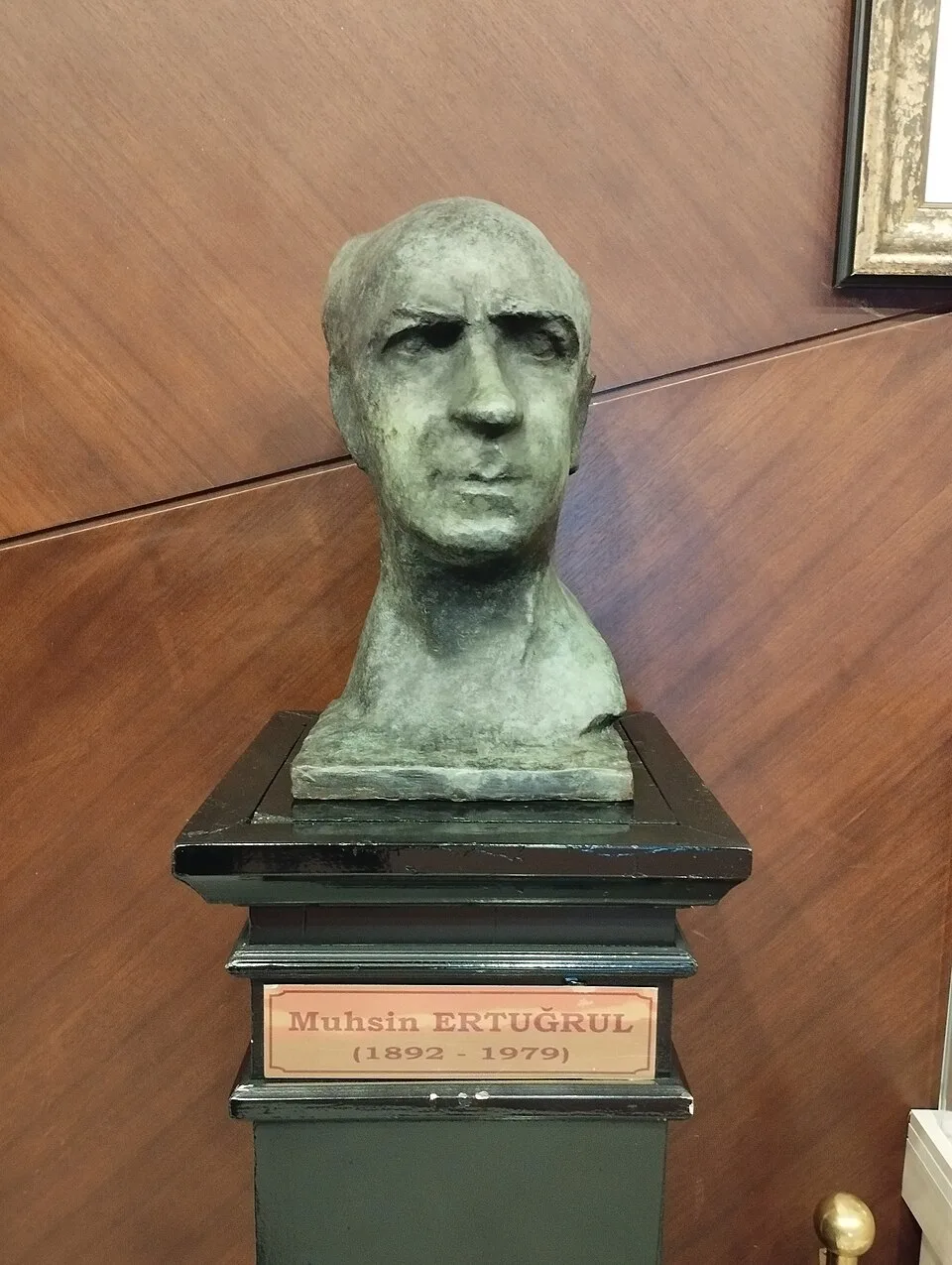
TRT’s Sinematograf programme introduces his international film practice, particularly work in the Soviet Union. Continue with the Afife Jale and Kenter dossiers to see the connections between access, education and institutions. Ertuğrul died in 1979. The photographed bust here belongs to subsequent public remembrance, not to a recorded moment of his own stage performance.
Back to contentsA timeline of life, work and history
- 1892
Birth
Born in Istanbul.
- 1909
Professional stage
Entered professional acting.
- 1922–1923
Early films in Türkiye
Directed İstanbul’da Bir Facia-i Aşk and Ateşten Gömlek.
- 1920s
International experience
European and Soviet work contributed to his stage and film practice.
- 1953
Halıcı Kız
His final film as director.
- 1979
Death
Died after a long professional career.
Watch and listen: a visual reading path
Use this selection alongside the analysis above. Supported YouTube publications can be watched on this page after you choose to load their player. The publisher’s rights and availability conditions apply; the player does not load or start automatically. Official publication links remain available as an alternative.
TRT 2
Sinematograf: Muhsin Ertuğrul’s film work
The broadcaster’s official historical programme examines his film work in the Soviet Union.
Watch the official publication ↗Questions and explanations
Was he only a theatre director?
No. Acting, early film production and institutional leadership belong in the same account. His cinema work should not be treated simply as an extension of a stage repertory.
Did he receive the award bearing his name?
No. The Muhsin Ertuğrul Special Award honours later generations of theatre practitioners in his memory. Commemoration and his own lifetime achievements are separate records.
Why emphasise children’s and regional stages?
The future of theatre does not depend only on adult audiences in major cities. Access for new age groups and different places helps create a cultural network supporting education and sustained production.
Sources, image rights and research method
This is original explanatory and analytical writing informed by the sources below. AI assisted research and drafting. Awards for people, teams and institutions are distinguished; dated results are not current rankings. Media links do not claim a licence to republish a video here. Use the publisher’s correction process if a fact is wrong.
- Kültür ve Turizm Bakanlığı — Muhsin Ertuğrul ↗ Source check: 2026-10-03
- İBB Atatürk Kitaplığı — Muhsin Ertuğrul Koleksiyonu ↗ Source check: 2026-10-03
- Atatürk Araştırma Merkezi — Devlet Tiyatroları ve Operası ↗ Source check: 2026-10-03
- TRT 2 Sinematograf — Muhsin Ertuğrul’un Sinema Çalışmaları ↗ Source check: 2026-10-03