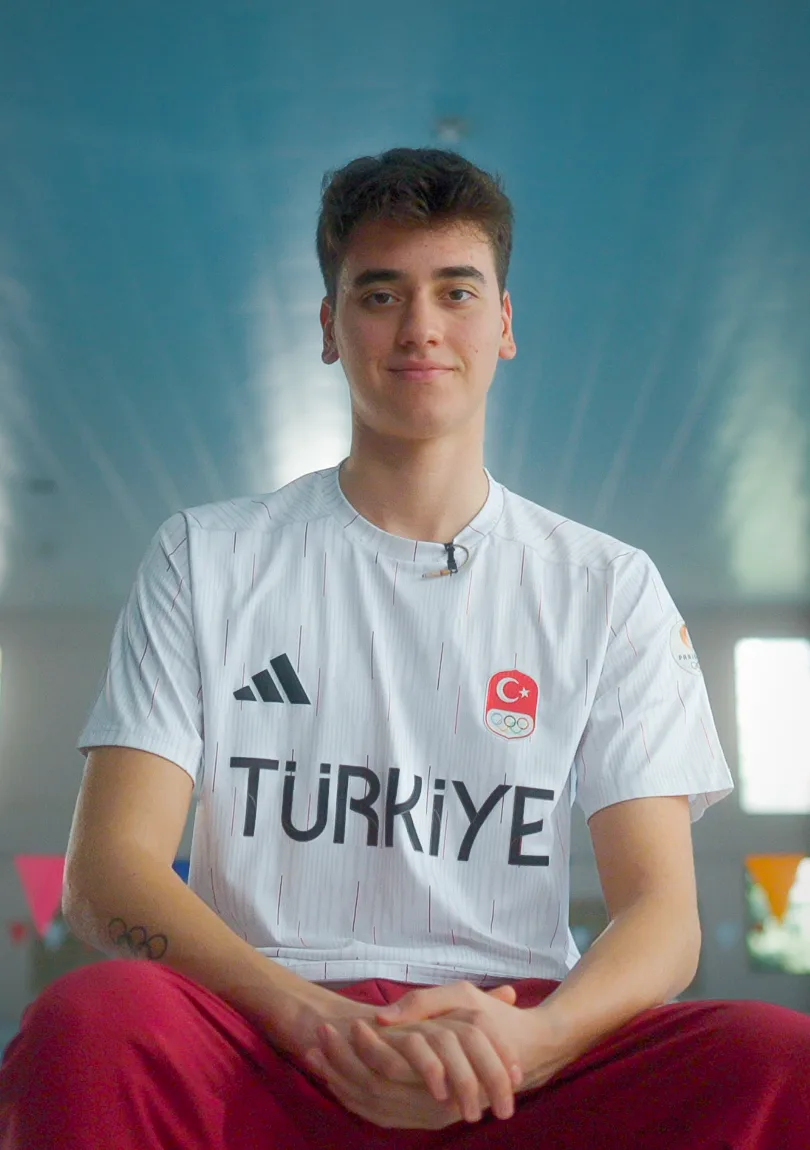
Kuzey Tunçelli’s emergence brought greater visibility to Turkish distance swimming. Early international results deserve to be understood within their own competitions rather than only as predictions about the future. A 1500m final depends on sustained pacing and repeated turns more than one fast start. This profile reads time, age category and pool length together to explain what those achievements actually measure.
- Principal stroke
- Freestyle
- Prominent distances
- 800m and 1500m
- Record distinction
- 25m / 50m pools
Two distances on the junior stage
Born in 2007, Tunçelli won 800m and 1500m freestyle gold at the Netanya 2023 World Junior Championships. Reading both events expands the biography beyond a single record. They share endurance demands, but pacing distribution and the timing of a closing acceleration do not have to be identical. Each race has its own competitive structure.
A junior title establishes international achievement within an age group. It is distinct from a senior world title. This matters particularly when following young athletes: naming the category correctly preserves the significance of their achievement while identifying the stage of development at which it occurred. Precision creates a stronger account than exaggeration.
Back to contentsWatching more than the final lap
In a distance race, follow cumulative time alongside individual splits. A very fast opening can affect later pace, while a cautious start may allow opponents to move away. Watch how gaps change across sections rather than simply identifying the current leader. The race then becomes a pattern of decisions sustained over the whole distance.
A turn is more than changing direction. The approach, push-off and return to stroke rhythm recur throughout the race. Their consistency contributes to a successful final. Technical viewing breaks the overall time into small but connected phases, revealing work that the excitement of a closing sprint can otherwise hide.
Back to contentsVilnius and Paris: separate performances
European Aquatics’ Vilnius 2024 footage records a 1500m junior world record of 14:41.89. The official World Aquatics Paris 2024 record subsequently lists 14:41.22 as a junior world and Turkish record. The two times and their images belong to separate races. Matching location and date prevents a video from being attached to the wrong performance.
A young swimmer entering a senior Olympic final has crossed into competition beyond his own age group. A junior record and an Olympic medal nevertheless remain separate concepts. Define each accurately rather than converting one into the other. This lets readers appreciate both development and the actual scope of the tournament result.
Back to contentsWhy 25m and 50m pools differ
World Aquatics lists Tunçelli’s 14:20.64 in the 2024 short-course world competition as a 25m-pool performance. Its lower time than the Paris 50m-pool result does not mean identical competitive conditions. Short course contains more turns and wall push-offs over the same distance, changing the technical structure of the race.
Pool length is therefore a fundamental part of a swimming statistic. Identical distance and stroke can appear in separate record tables according to the pool. Presenting a short-course time as a long-course record, or merging them into one ranking, misleads the reader. Follow the official 25m and 50m labels with the event and date.
Back to contentsAn unfolding career and further reading
Tunçelli defended the 1500m world junior title at Otopeni 2025, where World Aquatics records 14:48.81 in the final. Winning and swimming a personal best are different achievements. Strategy, opponents and the event’s circumstances can produce a successful championship performance at a different time. Not every important victory has to establish another record.
Continue with Boyacı to explore another distance, stroke and classification. Emre Sakcı’s breaststroke and short-course experience opens a further perspective on the variety within swimming. The purpose is not to construct one best-swimmer ranking, but to understand the movements and competition structures within which each career develops.
Back to contentsA timeline of life, work and history
- 2023
Two Netanya golds
World junior titles in 800m and 1500m freestyle.
- July 2024
Vilnius junior record
14:41.89 in 1500m freestyle; the official video shows this race.
- August 2024
Paris Olympic final
A 14:41.22 junior world record in 1500m freestyle.
- 2025
Defending the title
Otopeni world junior 1500m gold in 14:48.81.
Watch and listen: a visual reading path
Use this selection alongside the analysis above. Supported YouTube publications can be watched on this page after you choose to load their player. The publisher’s rights and availability conditions apply; the player does not load or start automatically. Official publication links remain available as an alternative.
European Aquatics
European Aquatics · Vilnius 2024, 1500m junior record
Follow pacing and turns across the distance. This is the 14:41.89 Vilnius swim, not the subsequent Paris performance.
Choosing to load the player connects to YouTube and shares technical data such as your IP address with Google. Autoplay is off. This choice does not change your cookie preferences. The publisher may restrict regional access or embedding; the official link below provides an alternative.
Questions and explanations
Is a junior world record a senior world record?
No. It is a category for age-eligible swimmers. Junior and senior records are separate; both can occur in one race, but one does not automatically establish the other.
Why can a short-course time look faster?
A 25m pool requires more turns and wall push-offs. That changes the technical race structure, so the time belongs to a separate record table from the same distance in a 50m pool.
Can a significant final be won without a record?
Yes. Winning requires finishing ahead of opponents, while a record requires beating a particular time. They are different measures of achievement; retaining a championship does not necessarily mean setting another record.
Sources, image rights and research method
This is original explanatory and analytical writing informed by the sources below. AI assisted research and drafting. Awards for people, teams and institutions are distinguished; dated results are not current rankings. Media links do not claim a licence to republish a video here. Use the publisher’s correction process if a fact is wrong.
- World Aquatics · Kuzey Tuncelli results ↗ Source check: 2026-10-03
- World Aquatics · Netanya 2023 junior finals ↗ Source check: 2026-10-03
- World Aquatics · Otopeni 2025 junior finals ↗ Source check: 2026-10-03