The 2010 FIBA World Championship was the tournament in which host Türkiye reached the final and won silver. If the achievement is remembered only through the last seconds against Serbia, the earlier rounds and collective work disappear. This dossier distinguishes that historical team from today’s squad and connects its route to the final with guard–big relationships and decisions omitted from short highlights.
- Competition
- 2010 FIBA World Championship
- Host
- Türkiye
- Result
- Silver medal
What does hosting change?
The tournament took place in Türkiye from 28 August to 12 September 2010. Hosting increases crowd support and public interest, but does not automatically win elimination games. Turnovers, foul trouble and an opponent’s effective attack still require solutions on the court, regardless of the atmosphere around it.
Its historical importance also lies in basketball entering everyday conversation. Many first-time followers encountered defensive systems and late-possession choices through the national team. The event deserves to be read as an experience of watching sport as well as an entry in a medal table.
Back to contentsBefore the tournament: Tanjević and captain Türkoğlu
FIBA’s preparation report identifies Bogdan Tanjević as head coach and Hidayet Türkoğlu as captain. The Bormio camp concentrated on conditioning before more detailed work approaching the tournament. This was a preparation account published before competition, not a retrospective explanation written after the medal had been won.
Fitness and organisation answer different questions: one concerns repeated physical effort, the other who should cover which space at the same moment. Captaincy does not mean handling the ball on every possession or leading the scoring in every game. Keeping those distinctions in view makes preparation a problem of shared work, rather than a story about the talent of one star. A training report should not be read as evidence that a later medal was already inevitable.
Back to contentsThe Ankara group test: İlyasova against Greece
The 76–65 win over Greece came at Ankara Arena. Ersan İlyasova scored 26 points and made all six of his three-point attempts. FIBA’s report also describes Ömer Aşık’s finishes inside and Ender Arslan’s contribution. The game offers a concrete meeting of different player tasks, alongside an exceptional shooting night.
Consider an outside shot together with a threat near the basket. Defenders moving towards the shooter may leave room inside; staying inside may give the shooter time. This is a framework for reading basketball, not a claim that Greece made an identical decision on every possession. Exceptional accuracy in one match should not become a supposed career average. The group stage deserves attention as separate contests presenting defensive problems, rather than merely a waiting room for the final.
Back to contentsFrance: sharing responsibility in a 2–3 zone
Türkiye won the round of sixteen against France 95–77. FIBA names Ömer Onan, Kerem Tunçeri, Ender Arslan and Sinan Güler at the front of the 2–3 zone. Türkoğlu scored 20 points and Güler 17; Türkiye generated 21 points from French turnovers. Here the connection between defence and attack has a measurable match contribution.
The numbers in a 2–3 zone describe two front positions and three behind them, not five motionless defenders. Naming four players does not place all four in the front line simultaneously. As the ball moves between wings, responsibility must also move. Delaying a pass in front and protecting the basket behind should complement one another. When a turnover launches a break, follow the teammate opening a running lane or receiving the pass on time as well as the player who recovered the ball. A one-game measure should not become a summary of the whole tournament.
Back to contentsSlovenia: a different defensive answer
The Slovenia quarter-final finished 95–68. The report records a man-to-man response after an early 10–6 deficit, and three-pointers by Tunçeri and Onan. İlyasova scored 14 first-half points; ten Turkish players had scored by the end of the third quarter. This history is more varied than carrying one defensive label from the France game into every later match.
A zone organises responsibility around spaces; man-to-man begins with player matchups, although both require help. Assess a change through where it sends the ball, not just its name. Several scorers do not prove equal playing time or identical jobs. They do, however, invite a reading beyond a single star’s total, towards different tasks within a rotation. This distinction also prevents an easy assumption that a successful defensive arrangement must work unchanged against the next opponent.
Back to contentsThe semi-final was longer than one basket
The semi-final against Serbia ended 83–82. Kerem Tunçeri’s late lay-up took Türkiye into the final; FIBA’s report also records the defence of Serbia’s remaining attempt. The decisive attack and the defence that followed were separate parts of the same ending, both necessary to preserve the result.
When watching the final possession, look beyond its finisher. The inbound, defensive direction, opening lane and diminishing time shaped the decision. Rather than presenting the basket as the inevitable fulfilment of a perfect plan, consider how structure and an immediate opportunity can work together.
Back to contentsThe relationship between guards and bigs
The game provides a useful way to examine a guard driving towards the basket in relation to a big player’s position. Defence moving towards the ball can open a pass; defence staying back can create finishing space. A screen does more than obstruct an opponent: it gives a teammate decision-making time.
A big player’s contribution also extends beyond scoring. Rebounding, rolling after a screen, protecting space and managing fouls affect the same rotation. A complete recording makes these tasks more visible than a last-second clip. The player finishing a possession is not always the player who made it possible.
Back to contentsRemembering players: tournament roles and career biographies
In 2010, Aşık averaged 6.9 rebounds and Tunçeri 4.0 assists per game. Captain Hidayet Türkoğlu and Ersan İlyasova, whose scoring stood out against Greece, have separate biographies among the related dossiers below. These names are not presented as a complete roster. Use a player’s page and the team history as complementary perspectives, not alternatives to each other.
A player biography travels between seasons and clubs; a tournament dossier places people working together during particular weeks on one timeline. Use the two scales without confusing them: examine a match responsibility first, then the longer career. Captaincy, scoring and defensive duties answer different questions about contribution. A player’s subsequent success should not explain every earlier possession, either: doing so can hide the opponent and teammates who shaped the moment.
Back to contentsA different examination in the USA final
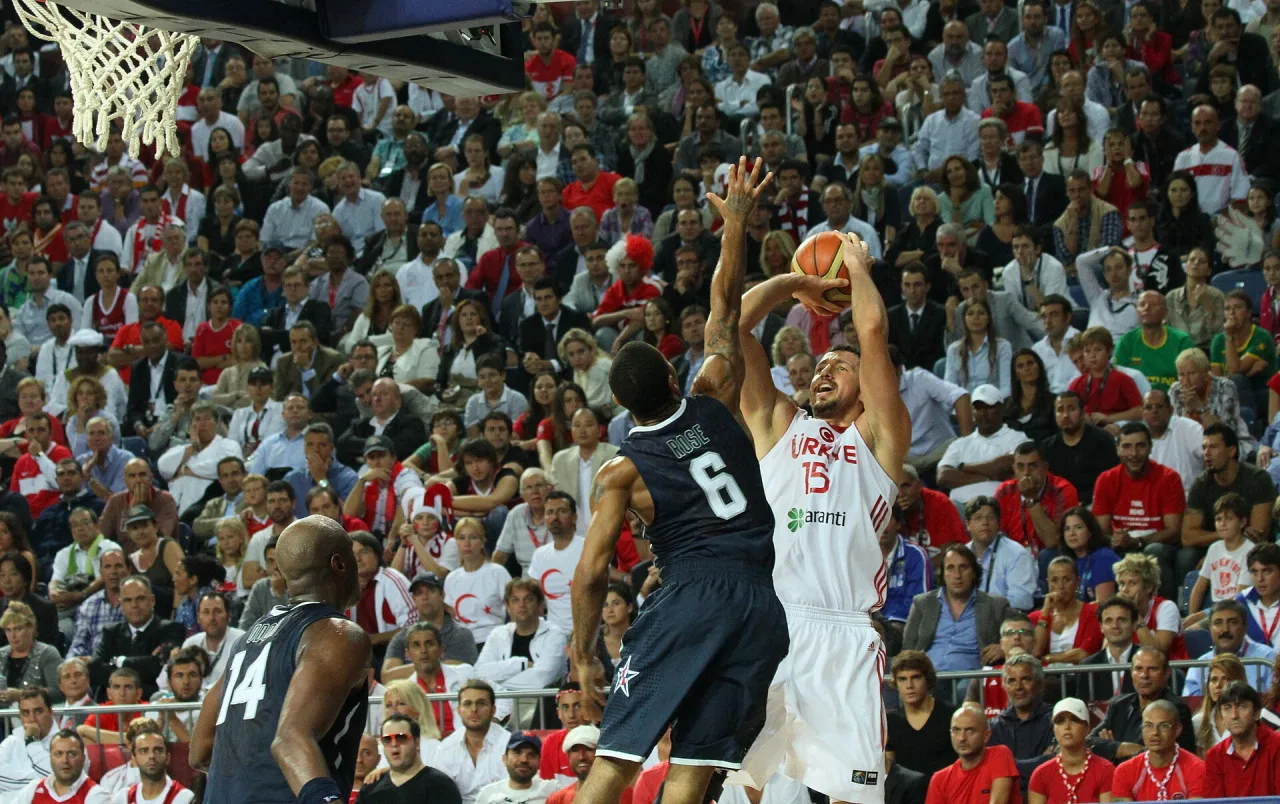
The USA won the final 81–64, leaving Türkiye with silver. Defeat in the last game does not erase the significance of a first world medal. Equally, treating the final as a continuation of the semi-final’s emotion obscures a different opponent and different problems on the court.
Against opponents playing faster or exploiting greater space, a turnover can become more expensive. Watch where the offence becomes constrained, how quickly players recover defensively and which shots are selected. These questions offer a more concrete reading than explaining defeat entirely through morale or crowd support.
Back to contentsA specific final opponent: Kevin Durant
The University of Texas athletics report dated 12 September 2010 records Kevin Durant’s 28 points in the final and his selection as tournament Most Valuable Player. This is not a comparison that devalues Türkiye’s silver. It identifies the attacking challenge in the final through a named opponent and a specific contribution.
Reading a leading scorer means considering the shot and the space that enables it. Sending a second defender may free another attacker; declining that help may make the individual matchup decisive. Those choices can be examined without denying the opponent’s skill or assigning an entire defeat to one Turkish player. Explaining the value of the medal run and leaving the final’s unresolved problems visible are compatible tasks. This dossier is a history of a particular tournament, not a ranking of present-day national teams.
Back to contentsConnecting 2010 with a wider basketball history
The Mehmet Okur and İbrahim Kutluay biographies open different chapters of Turkish basketball’s international club experience. Linking to them does not assert that each player belonged to the 2010 tournament squad. A career dossier and the roster of a particular national team are different kinds of information.
Reading women’s basketball through Işıl Alben prevents national basketball memory from being reduced to the men’s 2010 result. Start with one complete quarter of the semi-final and then examine the changing score. Historical squad and sponsor names should not be used as current selection or ticket information.
Back to contentsA timeline of life, work and history
- 2010 · before the tournament
Bormio preparation
The camp report separates conditioning from subsequent work on playing details.
- 28 August 2010
The tournament begins
The world championship hosted by Türkiye opened with the group stage.
- 31 August 2010
Group game against Greece
İlyasova’s outside shooting highlighted a group contest combining different player tasks.
- September 2010
Progress through elimination rounds
The knockout stages after the groups formed the hosts’ route to the semi-finals.
- 5 September 2010
France: round of sixteen
Pressure from the zone made the transition into attack especially visible.
- 8 September 2010
Slovenia: quarter-final
A different defensive response and scoring across the rotation formed another part of the route to the final.
- 11 September 2010
Semi-final against Serbia
The 83–82 result delivered a first world final and guaranteed the country’s first medal in the event.
- 12 September 2010
World silver
Türkiye finished second after the USA won the final 81–64.
Watch and listen: a visual reading path
Use this selection alongside the analysis above. Supported YouTube publications can be watched on this page after you choose to load their player. The publisher’s rights and availability conditions apply; the player does not load or start automatically. Official publication links remain available as an alternative.
FIBA Basketball
Türkiye–Serbia 2010 semi-final: full game
Use FIBA’s full replay to understand the last seconds in the context of the preceding game.
Choosing to load the player connects to YouTube and shares technical data such as your IP address with Google. Autoplay is off. This choice does not change your cookie preferences. The publisher may restrict regional access or embedding; the official link below provides an alternative.
Questions and explanations
Was Lithuania Türkiye’s semi-final opponent?
No. Türkiye played Serbia and won 83–82. The official match record, rather than an incidental reference in a later account, establishes the pairing.
Does the Okur link place him in the 2010 squad?
No. It leads to the wider international history of Turkish basketball. Inclusion in a biography collection does not imply participation in every national tournament roster.
Why is the full game more useful than highlights?
Highlights select dramatic moments. A complete recording reveals fouls, defensive adjustments and the preparation of attacks, explaining the last basket alongside the earlier parts of the match.
Did the team use the same defence throughout?
The France report describes a 2–3 zone; the Slovenia report describes a man-to-man response. These examples caution against giving the whole tournament one tactical label, without claiming to document every possession.
Does a scoring total capture a player’s full contribution?
No. Making a pass difficult, protecting space or giving a teammate decision time is different work from finishing an attack. Reading responsibilities alongside the scoring table is more useful than treating one total as the whole contribution.
Where can I read more about this team’s players?
Open the related Hidayet Türkoğlu and Ersan İlyasova biographies. The team page covers a particular tournament; a person’s dossier follows a longer career. These links are neither a current squad announcement nor a complete tournament roster.
Sources, image rights and research method
This is original explanatory and analytical writing informed by the sources below. AI assisted research and drafting. Awards for people, teams and institutions are distinguished; dated results are not current rankings. Media links do not claim a licence to republish a video here. Use the publisher’s correction process if a fact is wrong.
- FIBA · 2010 competition results ↗ Source check: 2026-10-03
- FIBA · Türkiye–Serbia semi-final report ↗ Source check: 2026-10-03
- FIBA · 2010 final report ↗ Source check: 2026-10-03
- FIBA · Bormio preparation ↗ Source check: 2026-10-04
- FIBA · Greece group report ↗ Source check: 2026-10-04
- FIBA · France knockout report ↗ Source check: 2026-10-04
- FIBA · Slovenia quarter-final report ↗ Source check: 2026-10-04
- FIBA · Schedule ↗ Source check: 2026-10-04
- Texas Athletics · 2010 final ↗ Source check: 2026-10-04
- FIBA · Leaders ↗ Source check: 2026-10-04