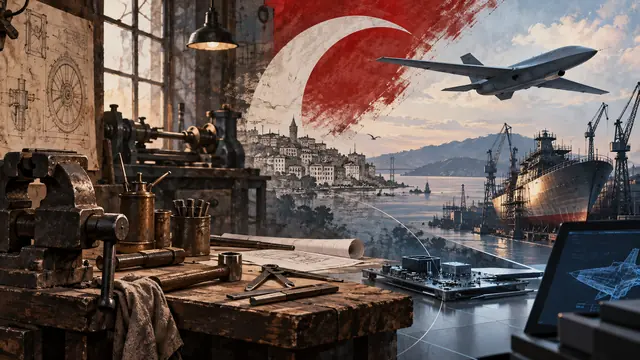
Reading ROKETSAN solely through product names obscures its laboratories, people and research relationships. This dossier follows the institutional history of defence production through public, dated cases. It distinguishes space-programme ambitions from recorded events and provides neither operational guidance nor instructions for constructing weapons.
- Institution
- ROKETSAN
- Reading focus
- Institutional history, research, education and public records
- Scope
- Not a technical production or operational manual
1988: an institution takes shape
The company's history records its foundation by a Defence Industries Executive Committee decision on 14 June 1988. The same timeline places TR-122's entry into inventory in 1996 and KASIRGA's in 1998. These selected dates distinguish the establishment decision from later product stages. The purpose here is not to reproduce every model in a technical catalogue, but to make institutional development visible over time; the manufacturer's own milestones are not an independent ranking of military success.
Back to contentsLaboratory services from 1991
ROKETSAN's environmental-testing record dates the laboratory's beginnings to 1991 and TÜRKAK accreditation to 2012. It describes mechanical and climatic testing for civil and military customers. Foundation, accreditation and service scope are distinct; a laboratory's existence does not approve every product for every condition. This historical record explains industrial infrastructure, not an independent verification that every accreditation document remains valid in 2026.
Back to contentsThe institutional path into space
The MUFS record traces the programme through a 2012 decision, the centre's establishment in 2015 and SSB commissioning on 29 October 2018. The public authority and developing company have different roles. Building a communications satellite, developing a sounding rocket and placing a satellite in orbit are distinct activities. The page's 2026 launch ambition is not presented here as a completed orbital mission.
Back to contents2020: test and target
The company announcement dated 13 November 2020 reports a liquid-fuel sounding-rocket test on 29 October; later in the same text it sets a 2025 ambition for a micro-satellite. A reported test result and a future timetable therefore have different statuses within one document. A sounding flight does not amount to operating a satellite in orbit. The announcement's enthusiastic language is part of its historical context, but is not, by itself, evidence that the later ambition was achieved.
Back to contents2020: a management transition
The company announcement of 1 July 2020 records Selçuk Yaşar's retirement and Murat İkinci's appointment as general manager. It states that Yaşar had worked at the company since its founding year and that İkinci came from STM. The transition makes movement of people between institutions visible. This account explains the change documented on that date; it does not turn an old appointment announcement into a current list claiming that every management position remains unchanged today.
Back to contentsThe academy: different learning audiences
ROKETSAN Academy's record describes training for 1,939 students who passed the preliminary-design stage of TEKNOFEST 2024. The same page also presents employee-learning platforms and supplier training. Students, employees and suppliers are different audiences. This distinction reveals several routes through which institutional knowledge is shared, rather than reducing industrial skills to a headcount. Reported participation does not establish employment admission or a professional degree; the dossier does not reproduce technical practical instructions from the training.
Back to contentsTEKNOFEST 2024: a public learning setting
The organiser's announcement of 5 January 2024 identifies ROKETSAN's coordinating role, a competition spanning different educational stages and travel-accommodation support for finalists. This creates an engineering-learning setting beyond the factory, where student teams present ideas at a shared event. A competition differs from accepting a product into military service. The official film in the viewing selection introduces this educational setting; competitors' design details and rocket-construction instructions are outside the scope of this historical dossier.
Back to contentsUniversities and research relationships
The company's partnerships page lists universities under SAYP protocols and names Gazi, Sabancı, METU and İzmir Institute of Technology in the 2244 Industrial Doctorate Programme. Undergraduate graduation projects with Bilkent represent another educational stage. These cases distinguish training researchers from delivering a product. Period-dependent project counts are not repeated here as today's totals; instead, the named forms of cooperation explain the connection between industry and higher education, without claiming every collaboration produced a deployed system.
Back to contentsWhat a management policy records
ROKETSAN's policy document treats quality, employee health, environment and energy management together, and includes civil-sector products where its infrastructure is appropriate. Industrial history therefore involves more than delivery counts. Declared commitments show how an organisation intends to be managed; they are not evidence that every outcome has been independently audited. The policy is used here as the company's own statement, not presented as an externally awarded distinction for environmental performance or proof that every stated target has been achieved.
Back to contentsFoundations, projects and partnerships
- 1988
Foundation
The company's recorded foundation date is 14 June.
- 1991 / 2012
Laboratory and accreditation
The company record distinguishes inception from accreditation.
- 2018
MUFS commissioning
The project record dates SSB commissioning to 29 October.
- 2020
Management transition
The 1 July announcement records the Yaşar-to-İkinci transition.
- 2024
Final results
The organiser announces the competition rankings on 23 September.
Official films and dated records
Use this selection alongside the analysis above. Supported YouTube publications can be watched on this page after you choose to load their player. The publisher’s rights and availability conditions apply; the player does not load or start automatically. Official publication links remain available as an alternative.
TEKNOFEST
Rocket Competition
The organiser's official film introducing its 2024 educational competition, not footage of the company's 1988 foundation or an independent product-performance test.
Choosing to load the player connects to YouTube and shares technical data such as your IP address with Google. Autoplay is off. This choice does not change your cookie preferences. The publisher may restrict regional access or embedding; the official link below provides an alternative.
Questions and explanations
Is this a product catalogue?
No. Institutional history, laboratories and learning relationships are central; technical construction and operational use are not described.
Does accreditation approve every product?
No; a laboratory has a defined testing scope.
Is a target a completed event?
No; a target is not a completed mission.
Why link to other company dossiers?
Comparison clarifies the roles of platform manufacturers, component companies and service providers. It helps readers understand industrial history without assigning every responsibility in a programme to a single logo.
Sources, image rights and research method
This is original AI-assisted explanatory writing based on public records, not a claim of personal observation or independent field investigation. Institutional announcements retain their context; a contract, research objective or promotional film does not prove completed deployment or military superiority. AI illustrations are not presented as real products or archive photographs. Videos are not downloaded or republished as files; publication links and permitted players are used. Report a possible error through the correction channel with its source.
- Roketsan — Tarihçe ↗ Source check: 2026-10-05
- Roketsan — Çevresel test ↗ Source check: 2026-10-05
- Roketsan — MUFS ↗ Source check: 2026-10-05
- Roketsan — 2020 duyurusu ↗ Source check: 2026-10-05
- Roketsan — Yönetim geçişi ↗ Source check: 2026-10-05
- Roketsan — Akademi ↗ Source check: 2026-10-05
- TEKNOFEST — 2024 yarışması ↗ Source check: 2026-10-05
- Roketsan — Araştırma ortakları ↗ Source check: 2026-10-05
- Roketsan — Yönetim politikaları ↗ Source check: 2026-10-05
- TEKNOFEST — Final duyurusu ↗ Source check: 2026-10-05
- TEKNOFEST — Resmî film ↗ Source check: 2026-10-05