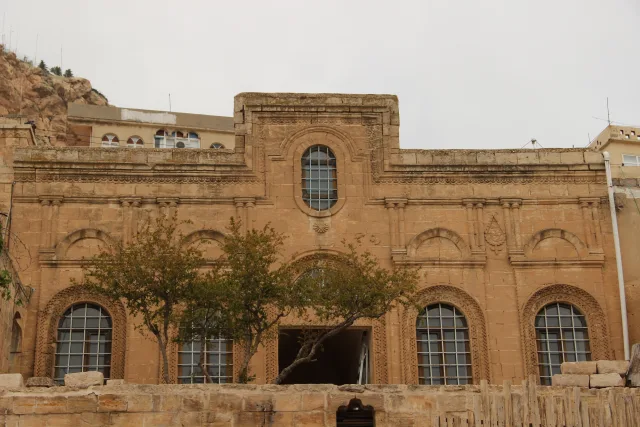
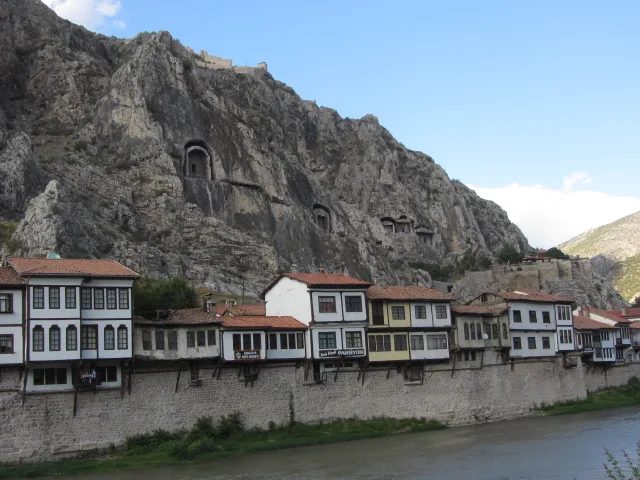
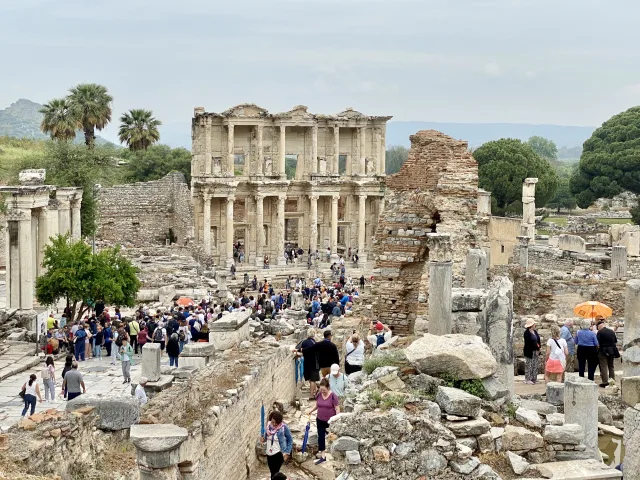
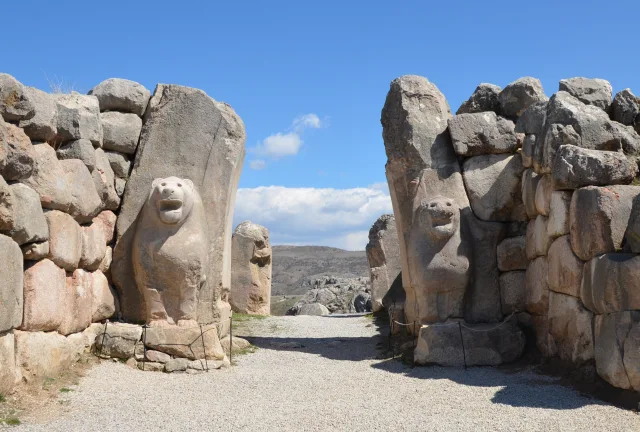
Kaleiçi does not compress the whole province of Antalya into one postcard. It offers a manageable scale at which to explore the relationship between a city's past and its present. A gateway, an upstairs domestic arrangement and a view towards the harbour open three different questions: whom does a city welcome, how do people organise home life, and what work does the waterfront make possible? This guide connects selected stops rather than treating a long checklist as an achievement. Its routes are editorial planning frameworks, not surveyed step-free itineraries or promises about how long a visit takes.
- Scope
- Kaleiçi and selected nearby civic-memory stops, not the whole province of Antalya
- Historical layers
- Hellenistic beginnings, a Roman gateway, a Seljuk minaret, domestic architecture and Republican public spaces
- Visit choice
- Hadrian's Gate–Hesapçı axis or square–harbour setting; no measured duration or step-free guarantee
- Transport record
- The 21 July 2026 nostalgia-tram statement is a dated record; current services require reconfirmation
From Attaleia to a living neighbourhood
The provincial cultural directorate associates the foundation of Attaleia with Attalos II of Pergamon. Yet the Kaleiçi visible today cannot be read as the residue of a single founding moment. Different governments, repairs and uses overlap in the same setting. The material in a wall and the function of a house may answer questions about entirely different periods.
Begin by separating the scale of major urban transformations from the small signs visible in a street. Consider the relationship between entrance, houses and waterfront before spending longer with one building. This gives an observed detail a meaningful setting without claiming that a short visit has explained an entire neighbourhood. A modest but clear question is more useful than trying to label every surface immediately.
Back to contentsHadrian’s Gate: monument and movement
Hadrian’s Gate is associated with the emperor's visit in AD 130. Approach it as a monumental expression of arrival rather than only a photographic backdrop. Its three openings invite attention to the relationship between decoration and passage. The surrounding street and every neighbouring stone cannot consequently be assigned the same date.
Pause in an appropriate public area without obstructing people, and consider the structure from both sides where access permits. After the overall view, choose one decorative detail and separate what the information panel says from what you can personally observe. If changes in level or temporary arrangements affect your movement, studying the gateway from an upper level remains worthwhile. Seeing an architectural monument does not require negotiating every narrow opening.
Back to contentsA minaret and a domestic sofa ask different questions
The Governorate's cultural record identifies Yivli Minaret as a 13th-century Seljuk work. Looking at the minaret together with surrounding buildings draws attention to the presence of worship and learning in the city. Do not apply one date, one function or one access permission to every part of a building group. Name, historical use and present use deserve separate attention.
For domestic architecture, ask instead how a threshold separates street and family life. The Governorate describes upper rooms connected through a sofa, a shared domestic circulation space. A projecting upper storey or window can be considered an external sign of that arrangement. Learn about interiors in a cultural institution that permits visits rather than pressing against a private doorway. The comparison is both more informative and more respectful of a living neighbourhood.
Here, sofa does not mean a couch: it refers to a shared interior circulation space connecting rooms. When looking at a street façade, ask where the entrance is, how the upper floor relates to the outside and how a courtyard separates domestic life from the street's gaze. These questions shift attention from decorative surfaces to the organisation of use. Returning to the street after visiting a museum house gives the comparison between monumental and everyday architecture a clearer basis.
Back to contentsRepublican memory and the question of conservation
A Kaleiçi visit need not end with the Roman or Ottoman period. Municipal records identify the opening of Hüseyin Gezer’s National Ascension Monument in Cumhuriyet Square on 19 May 1965 and the creation of Karaalioğlu Park during 1940–1945. A monument, square and park invite thought about how public remembrance and ordinary recreation share a modern city.
The Governorate records conservation designation for Kaleiçi and the inner harbour in 1972; the provincial directorate records a FIJET restoration award in 1984. An award does not make every subsequent intervention beyond question. Adaptation to a new use brings preservation and use into the same discussion. Ask what happens to historic material, everyday neighbourhood needs and the visitor economy, rather than treating a freshly restored frontage as a complete explanation.
Back to contentsA museum house is not an untouched past
The Suna and İnan Kıraç Kaleiçi Museum includes a house and the former Aya Yorgi building, with scenes such as coffee hospitality and wedding preparation. The provincial directorate describes renewal during 1993–1995. A display is a deliberate interpretation of the past, not evidence that every household once lived in the same unchanging manner.
Antalya Museum's early collection history began in Kaleiçi in 1922, while Atatürk's arrival in Antalya on 6 March 1930 opens a separate route into recent history. Decide what a museum visit should explain: domestic life, civic memory or regional archaeology. A historical collection description does not establish that a particular gallery is open today. Confirm the institution's current entrance arrangements and available sections before making it essential to the itinerary.
Bring your own questions to the display: who prepared the hospitality, where was a guest received, and which space was used for a ceremony? An object's label may not answer them all. Recording the information given on a panel separately from your own interpretation makes a museum visit more meaningful than simply collecting photographs.
Back to contentsCulture does not belong only to the past
Antalya Culture and Arts describes Kaleiçi House, at the Uzunçarşı and Kırkmerdiven intersection, as a cultural centre in use since 2017. Such a venue shows how a restored house can acquire a new public role through exhibitions, discussions or music. An institution's archive of past events does not establish what will be on display when you visit.
Check a dated programme before adding a contemporary cultural stop. Once inside, consider what question an exhibition asks about Antalya, rather than simply photographing the building. If no programme can be verified, continue with an exterior architectural reading instead of building the whole day around an assumed opening. Creative production is a useful way to read the neighbourhood as a present place rather than a frozen historical stage set.
Back to contentsTwo visit frameworks: monumental axis or harbour setting
For a monument-led visit, consider starting at Hadrian’s Gate and following Hesapçı Street towards the Hıdırlık setting; the municipal dossier describes that street connection. Add the Kaleiçi Museum on Kocatepe Street only after confirming visitor arrangements. Then balance another monument with a pause around Karaalioğlu. This sequence is a suggestion about subjects to connect, not a timed tour or a measured walking-distance claim.
A harbour-led option begins with Cumhuriyet Square and the Yivli area, then considers Kaleiçi House around Uzunçarşı before the waterfront. Kırkmerdiven is a named connection, not a reason to require everyone to use steps. Visitors who cannot negotiate stairs should keep the harbour descent optional and verify any alternative with the operator. Decide the return arrangement first. A cultural visit ending at the upper level is a complete visit; descending to the water is not a test of success.
Back to contentsDo not plan today from an old transport photograph
An Antalya Ulaşım statement dated 21 July 2026 announced a temporary pause in nostalgia-tram services and buses on the same route. That dated statement does not prove the same arrangements continue on a later day. Neither an old tram photograph nor passenger rules still available online guarantees a running service. Check the operator's current notices for both the starting point and the return.
Discuss where to meet if separated, opportunities to rest and the need to get back uphill, not only the intended arrival time. Reassess surfaces in sunny or wet conditions. Seeing a boat at a pier is not a reservation. Treat a boat outing as a separate service, with its price coverage and return clarified with the provider. A neighbourhood walk, a sightseeing cruise and swimming are different plans and should not silently be bundled into one promise.
Back to contentsA timeline of life, work and history
- Hellenistic period
Attaleia’s urban beginning
The official provincial record associates the foundation with Attalos II; later buildings are not reduced to that single moment.
- AD 130
Hadrian’s visit
The imperial visit associated with the gateway offers a starting point for reading monumental arrival.
- 1930–1965
Recent history and public memory
The 1930 Atatürk visit, 1940–1945 park creation and 1965 square monument are distinct Republican layers.
- 1972–1984
Conservation and restoration
Conservation designation and the later restoration award are separate turning points.
- 2017
A house used as a cultural centre
AKS Kaleiçi House’s cultural role opens a further subject of contemporary production in the neighbourhood.
Watch and listen: a visual reading path
Use this selection alongside the analysis above. Supported YouTube publications can be watched on this page after you choose to load their player. The publisher’s rights and availability conditions apply; the player does not load or start automatically. Official publication links remain available as an alternative.
GoTürkiye · Türkiye Tourism Promotion and Development Agency (TGA)
Turkish Riviera: GoTürkiye regional promotional film
An official external viewing link for the wider Mediterranean coast. Not a Kaleiçi-focused history documentary or current transport record. Its selected promotional scenes do not promise an identical experience for every visitor; the footage is not republished on this site.
Watch the official publication ↗Questions and explanations
Can I treat the nostalgia tram as a guaranteed return option?
No. The 21 July 2026 temporary-pause statement is a dated record. Reconfirm later services, routes and return arrangements with the operator.
Must a short visit finish every landmark?
No. Select two main themes, such as gateway and museum or square and harbour. Careful attention to one building can be more explanatory than collecting photographs at many stops.
Do museum-house scenes show life preserved without change?
A display interprets the past. Distinguish restoration and curated scenes from historical use; a model scene cannot establish identical everyday life across the whole neighbourhood.
Does the harbour photograph provide current boat or access information?
No. The 2011 photograph is a dated city view. Confirm boat services, stairs or alternative passages for your own travel date.
Sources, image rights and research method
This is original explanatory and analytical writing informed by the sources below. AI assisted research and drafting. Awards for people, teams and institutions are distinguished; dated results are not current rankings. Media links do not claim a licence to republish a video here. Use the publisher’s correction process if a fact is wrong.
- Antalya Directorate: Kaleiçi ↗ Source check: 2026-10-05
- Antalya Governorate: Kaleiçi ↗ Source check: 2026-10-05
- Antalya Metropolitan Municipality: Kaleiçi landmark dossier ↗ Source check: 2026-10-05
- Antalya Directorate: Suna & İnan Kıraç Kaleiçi Museum ↗ Source check: 2026-10-05
- Antalya Directorate: museums and archaeological sites ↗ Source check: 2026-10-05
- Antalya Culture and Arts: Kaleiçi House ↗ Source check: 2026-10-05
- Antalya Ulaşım: 21 July 2026 public statement on Nostalji Tramvayı ↗ Source check: 2026-10-05
- Antalya Ulaşım: operator notices ↗ Source check: 2026-10-05
- GoTürkiye TV: Turkish Riviera regional promotional film ↗ Source check: 2026-10-05