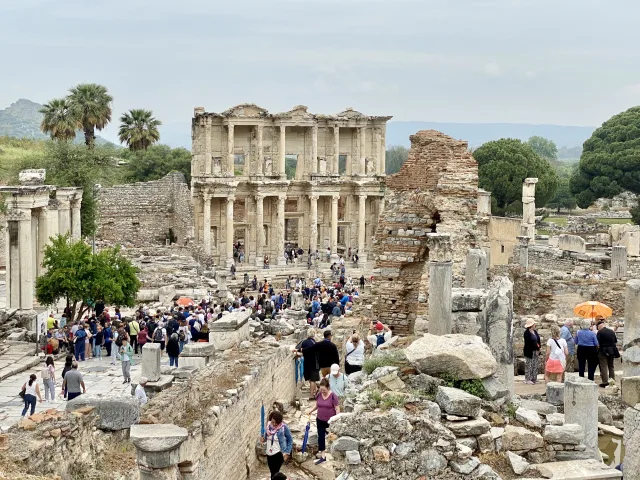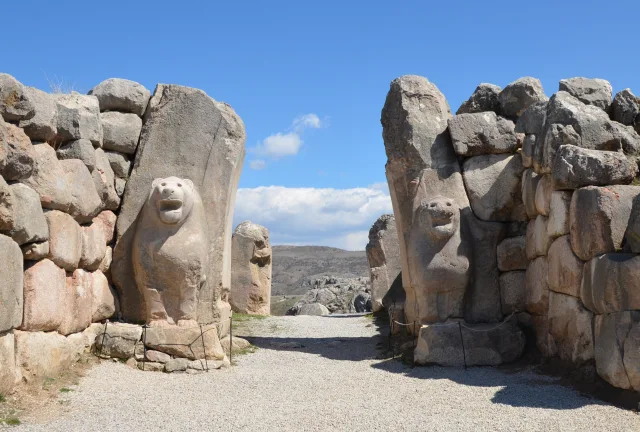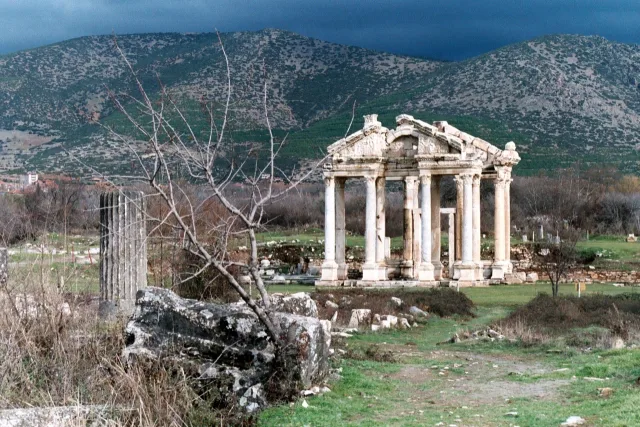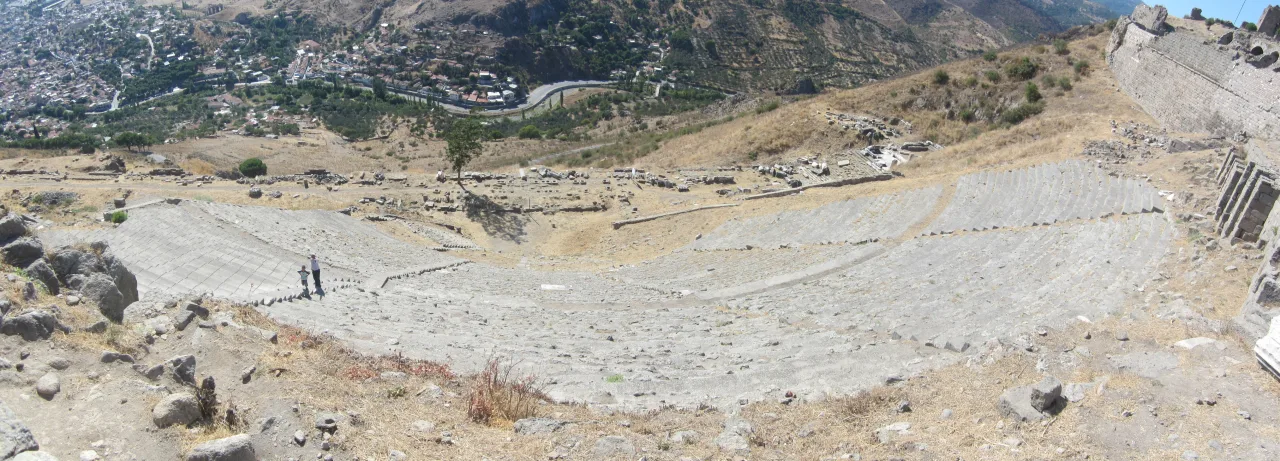
Bergama, in İzmir province, presents ancient Pergamon alongside the successive ways later communities occupied the same terrain. The relationship between the high acropolis and the plain below is the key to the visit. Royal visibility on the hill, a separately located healing sanctuary and later urban streets did not serve identical purposes. Treating Bergama as a single archaeological enclosure therefore misses its most interesting contrasts. This guide helps you select two main experiences for a day or use a second day for the museum and living town.
- Province / district
- İzmir / Bergama
- Important distinction
- The acropolis, Asklepion and Red Hall are separate areas
- Reading key
- Topography, different functions and later reuse
A capital designed through terraces
Hellenistic Pergamon turned steep ground into part of its urban design through terraces and monuments. From the acropolis, view the plain as more than scenery: visibility from a distance connected architecture with political presence. The theatre’s slope, seating and sightlines offer a concrete way to ask how builders worked with difficult ground.
Choose two scales of observation instead of rushing between ruins: the general arrangement from above and construction details at close range. Distinguish surviving ancient material from later conservation interventions where information allows. Reaching the acropolis by a transport option does not establish that every stair or slope inside the site is suitable for every visitor.
Back to contentsAsklepion and historical ideas of healing
The Asklepion was a healing and sacred complex associated with the cult of Asklepios. Its spaces encourage questions about the historical relationships between water, movement, rest, sound and religious practice. Ancient healing traditions should not be equated with present-day evidence-based medicine or offered as contemporary treatment advice. The subject here is medical history and its architectural setting.
The official Turkish Museums film provides a focused introduction. During a visit, choose a passage, open space or water-related feature and consider how people were guided through the complex. Comparing Asklepion with the acropolis makes two different experiences clearer: one organised through political representation, the other through the search for healing.
Back to contentsThe Red Hall and museum widen the chronology
The Red Hall illustrates transformation from a Roman structure associated with Egyptian deities to subsequent religious uses. It shows why one name or one community cannot explain an entire building’s history. Changes in fabric, additions and surrounding living streets should be considered together rather than reduced to a single picturesque façade.
At Bergama Museum, compare objects from different excavation areas by reading their locations and dates. A beautiful object becomes more informative when its original setting is known. An urban walk past later commercial and religious buildings continues the story beyond antiquity. Working shops and active worship spaces retain their contemporary purposes; a visitor’s wish for an uninterrupted photograph is not their governing function.
Back to contentsBuild a day around a clear question
For an architectural day, make the acropolis and museum your main choices. For medical history, combine Asklepion with the museum. Visitors using two major open-air areas in one day should account for transport and a substantial rest. A meal or market break in the town can make the second part of the visit more manageable.
On a second day, visit the area omitted before, then connect the Red Hall with the town centre. Completing every component of the UNESCO property in one day is neither necessary nor a useful measure of success. Nearby points on a map are not necessarily reached through the same entrance. Check current gates, admissions and return arrangements for each chosen stop.
Back to contentsSlopes, heat and misleading expectations
Open terrain calls for water, sun protection and a steady walking pace. Theatre steps and terrace edges need additional consideration for visitors with limited mobility or discomfort at heights. Vehicle access and access within a monument are separate questions: specify the intended section when asking an operator for advice.
Do not expect the Great Altar’s complete sculptural programme standing in Bergama. UNESCO’s 2014 decision explicitly distinguishes an altar no longer present in situ; its location, foundations and historical role remain meaningful. Museum displays, transport operations and conservation closures can change. An old travel photograph does not prove present access to the same place.
Back to contentsA timeline of life, work and history
- 3rd century BCE
Attalid capital
Pergamon’s monumental arrangement developed through Hellenistic planning that used the relationship between hill and plain.
- 133 BCE
Transfer to Roman rule
A new political setting reused earlier structures while adding further public and religious functions.
- 1936
Museum opening
The official museum record dates the opening of the present museum building to 30 October 1936. Its collection connects excavations in the town and surrounding area.
- 2014
World Heritage inscription
UNESCO inscribed a multi-layered cultural landscape, not simply the ancient monuments on the summit.
Watch and listen: a visual reading path
Use this selection alongside the analysis above. Supported YouTube publications can be watched on this page after you choose to load their player. The publisher’s rights and availability conditions apply; the player does not load or start automatically. Official publication links remain available as an alternative.
Turkish Museums
Bergama: ancient healing and medical history
The Asklepion introduction linked by the official museum programme. Historical therapies are not contemporary medical advice.
Choosing to load the player connects to YouTube and shares technical data such as your IP address with Google. Autoplay is off. This choice does not change your cookie preferences. The publisher may restrict regional access or embedding; the official link below provides an alternative.
Questions and explanations
Is Asklepion inside the acropolis?
No. Plan the healing complex as a separate stop, not the next room of a hilltop visit. Transport between them and the conditions of two open-air areas require their own time and energy allowances.
Is the complete Great Altar here?
No. Expecting the entire monumental sculptural arrangement on site is inaccurate. The altar’s position and historical purpose still matter. Before visiting, distinguish the surviving site and foundations from objects displayed in other museums.
Can I combine Bergama and Ephesus in one day?
Being in the same province does not make them one compact local route. Road travel and walking through two large archaeological areas reduce time for interpretation. Unless circumstances demand otherwise, separate days with museum connections make a more informative programme.
Sources, image rights and research method
This is original explanatory and analytical writing informed by the sources below. AI assisted research and drafting. Awards for people, teams and institutions are distinguished; dated results are not current rankings. Media links do not claim a licence to republish a video here. Use the publisher’s correction process if a fact is wrong.
- UNESCO: Bergama çok katmanlı kültürel peyzajı ↗ Source check: 2026-10-03
- Turkish Museums: Bergama ve tıp tarihi ↗ Source check: 2026-10-03
- Turkish Museums: Bergama Müzesi ↗ Source check: 2026-10-03
- Bergama Belediyesi: 2023–2028 alan yönetim planı ↗ Source check: 2026-10-03