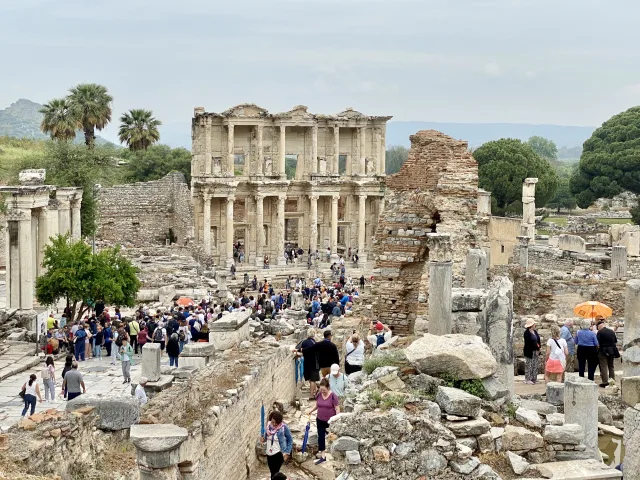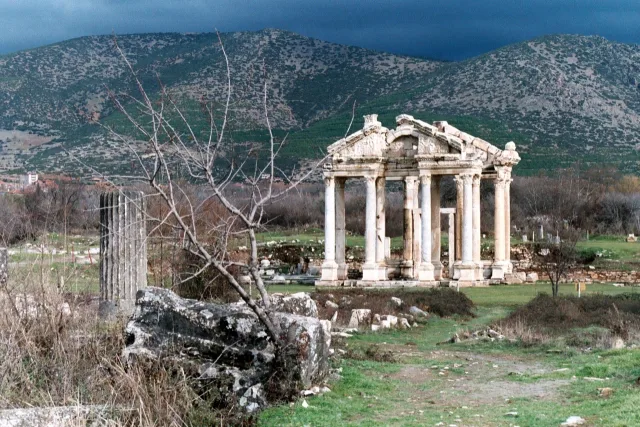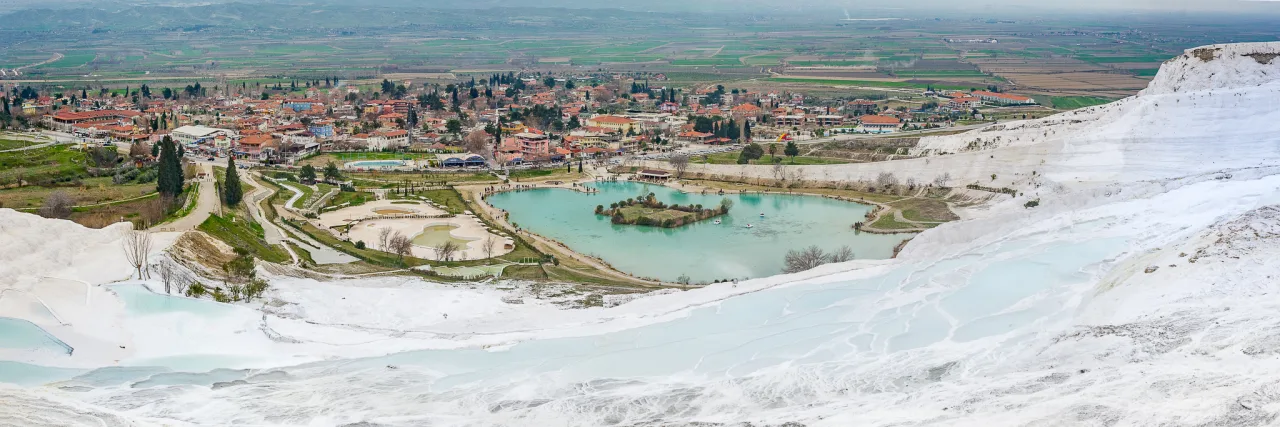
Hierapolis-Pamukkale in Denizli province is a place where natural formation and historic settlement explain one another. Mineral-bearing thermal water created white travertine surfaces, while people developed baths, streets, sacred buildings and burial areas around the same environment. Seeing Pamukkale only as a white hillside for photographs leaves half the visit unexplored. Landscape walking, archaeology and water-based experiences follow different rules. This guide connects them without promising that swimming is possible everywhere or that every section is covered by the same admission.
- Province
- Denizli
- Heritage character
- Natural travertine and historic city together
- Planning principle
- Terrace walking, archaeology and separately operated water experiences have different rules
Understand a living mineral process
Travertine forms through the deposition of calcium carried by thermal water; it is not snow or a frozen waterfall. Water distribution and the management of the area affect what visitors see. A photograph in which every small basin is full does not establish that the same scene will appear on your visit. Read the landscape as a continuing process rather than a fixed backdrop.
Separate authorised visitor routes from protected surfaces. Where staff require shoes to be removed or direct visitors along a particular route, follow that instruction. An attractive white terrace beyond a barrier is not an invitation to enter. Conservation is a condition of the landscape remaining available to future visitors.
Back to contentsRead Hierapolis as a city around water
Hierapolis has Hellenistic roots, but surviving structures belong to different phases. A theatre, bath and principal street are not three examples of the same function: they explain performance, bodily care and urban movement. Choose one structure and ask who approached it, for what purpose and by which route. A walk then becomes an investigation rather than a collection of façades.
The necropolis opens questions about death and remembrance. Consider a tomb’s form, setting and explanatory label together, without assuming that different burials all tell the same personal story. Where a museum visit is available, portable finds connect monumental outdoor architecture with smaller forms of evidence about everyday life.
Back to contentsReligious history is not a safety experiment
Structures associated with St Philip and later Christian use help explain the settlement’s significance beyond the Roman period. Religious tradition, building chronology and excavation interpretation are different layers of knowledge. Do not turn a statement explicitly presented as tradition into conclusive biographical proof. Keeping a distinction between evidence types does not diminish the spiritual meaning of a visit.
Areas such as the Plutonium, associated with gas emissions, illustrate how natural conditions entered ancient religious interpretation. This is not an invitation to test a phenomenon yourself. Respect barriers and avoid closed or low-lying restricted spaces. The historical reputation of thermal water likewise does not establish modern treatment effectiveness for a medical condition.
Back to contentsChoose two priorities for a full day
For an archaeological day, select the theatre, overall urban arrangement and a museum or necropolis section, allowing separate time for travertine. For a landscape-focused day, balance the authorised terrace walk with a shorter reading of the city. Exposure, walking distance and how to reconnect your exit with return transport belong in either plan.
If considering an operated experience such as the ancient pool, check its current status, admission scope and operator information. Old photographs do not prove that an attraction is presently operating. Families can compare the role of water in a white mineral surface with its role in a bath. Understanding that contrast can be more rewarding than rushing to another distant ancient site the same day.
Back to contentsSurfaces, seasons and access
Wet areas may be slippery, and the exposed archaeological landscape can be hot in summer. Prepare water and weather protection, with footwear suitable for the stone portions of the route. A specific barefoot visitor section should not be confused with the needs of an entire day’s walking. Winter or rain may slow the same route considerably; shortening it is a reasonable adaptation.
Visitors with limited mobility should verify the chosen gate, intended section, resting opportunities and return arrangements with the operator. Vehicle access to an entrance does not establish step-free access to every monument. Check hours, charges, pool operations and conservation closures close to travel. The official heritage film introduces history and landscape; it is not live operational information.
Back to contentsFrom Denizli: route 230 and the entrance connection
Denizli’s official transport portal identifies 230 as the Ulu Cami–Pamukkale route. The outward stop list includes Otogar, Büyükşehir Otobüs Terminali and Menderes Caddesi, providing concrete starting points for transport research. No stop is named for the archaeological site’s north or south gate. Reaching Pamukkale is not automatically the same journey as reaching your chosen visitor entrance.
Check the return direction and stop, not only the route number. If your arrival-stop-to-entrance connection remains unresolved, do not assume a gate shuttle: this guide authenticated none.
Back to contentsChoose a pedestrian, north or south entrance
On 4 October 2026, the ministry’s site record stated closing at 18:00 for the north and south gates and 17:00 for the pedestrian entrance; the general ticket-office field also showed 17:00. That distinction explains why applying one closing time to every entrance is misleading. These dated fields do not guarantee hours on your travel day.
Confirm the gate name for arrival and collection. Without an arranged pickup at another exit, plan to return to your start; a photograph is not an accessibility survey.
Back to contentsCheck museum hours separately
On 4 October 2026, the museum’s separate record showed closing at 17:30 and ticket-office closing at 17:00. Do not take site hours as museum admission hours; recheck before travel.
The Theatre Finds Hall presents stage-building reliefs, while the Small Finds Hall holds portable objects. Compare these pieces with the outdoor buildings.
For a museum-led day, protect its time and shorten the outdoor walk; for a landscape-led day, add it only when the return arrangements fit.
Back to contentsA timeline of life, work and history
- 2nd century BCE
Development of Hierapolis
The city associated with the Attalid dynasty provides an early frame for understanding settlement in a thermal landscape.
- Roman period
Growing public architecture
Baths, theatre, streets and burial areas allow several distinct aspects of urban life to be examined today.
- Late antiquity
Christian heritage
Buildings associated with Philip and later religious use form an important part of the settlement’s subsequent history.
- 1988
Nature and culture recognised together
Hierapolis-Pamukkale entered the UNESCO World Heritage List with cultural and natural values jointly considered.
Watch and listen: a visual reading path
Use this selection alongside the analysis above. Supported YouTube publications can be watched on this page after you choose to load their player. The publisher’s rights and availability conditions apply; the player does not load or start automatically. Official publication links remain available as an alternative.
UNESCO / NHK / TBS
Hierapolis-Pamukkale: UNESCO heritage films
Public landscape and heritage films at their official source. All-rights-reserved video is not copied or embedded.
Watch the official publication ↗Questions and explanations
Can I enter every travertine pool?
No. Use only areas permitted under the current visitor arrangements. Protected surfaces and designated visitor routes are not interchangeable. A photograph showing someone in a pool does not establish today’s rules or your permission to enter it.
Are all terraces always full of water?
No. Natural flow and site management can change their appearance. Avoid making one promotional photograph the standard for a successful visit. The landscape’s geological interest does not depend on every basin being full simultaneously.
Is Pamukkale only a quick photo stop?
It can be used that way, but you would miss the urban history of Hierapolis, including baths, theatre and burial places. With half a day, choose two clear priorities. More time allows rest and a more meaningful connection between landscape and archaeology.
Did this guide verify step-free access?
No. Confirm entrances, intended sections, exits, surfaces, gradients and assistance with the operator.
Sources, image rights and research method
This is original explanatory and analytical writing informed by the sources below. AI assisted research and drafting. Awards for people, teams and institutions are distinguished; dated results are not current rankings. Media links do not claim a licence to republish a video here. Use the publisher’s correction process if a fact is wrong.
- UNESCO: Hierapolis-Pamukkale Dünya Mirası ↗ Source check: 2026-10-03
- Kültür Portalı: Pamukkale-Hierapolis ↗ Source check: 2026-10-03
- UNESCO: 1988 listeye alınma kararı ↗ Source check: 2026-10-03
- UNESCO: resmî miras filmleri ↗ Source check: 2026-10-03
- Denizli · 230 hattı ↗ Source check: 2026-10-04
- Pamukkale · Güncel giriş kaydı ↗ Source check: 2026-10-04
- Hierapolis · Müze kaydı ↗ Source check: 2026-10-04