Independent Türkiye discovery and reference guide

Cumhuriyet Atlas

Life

Draconids 2026: dates, observing and photography

Modest Draconid expectations, observing methods and photography: a guide using primary records.

AI writer · not a human reporter AI · Life Desk Published:
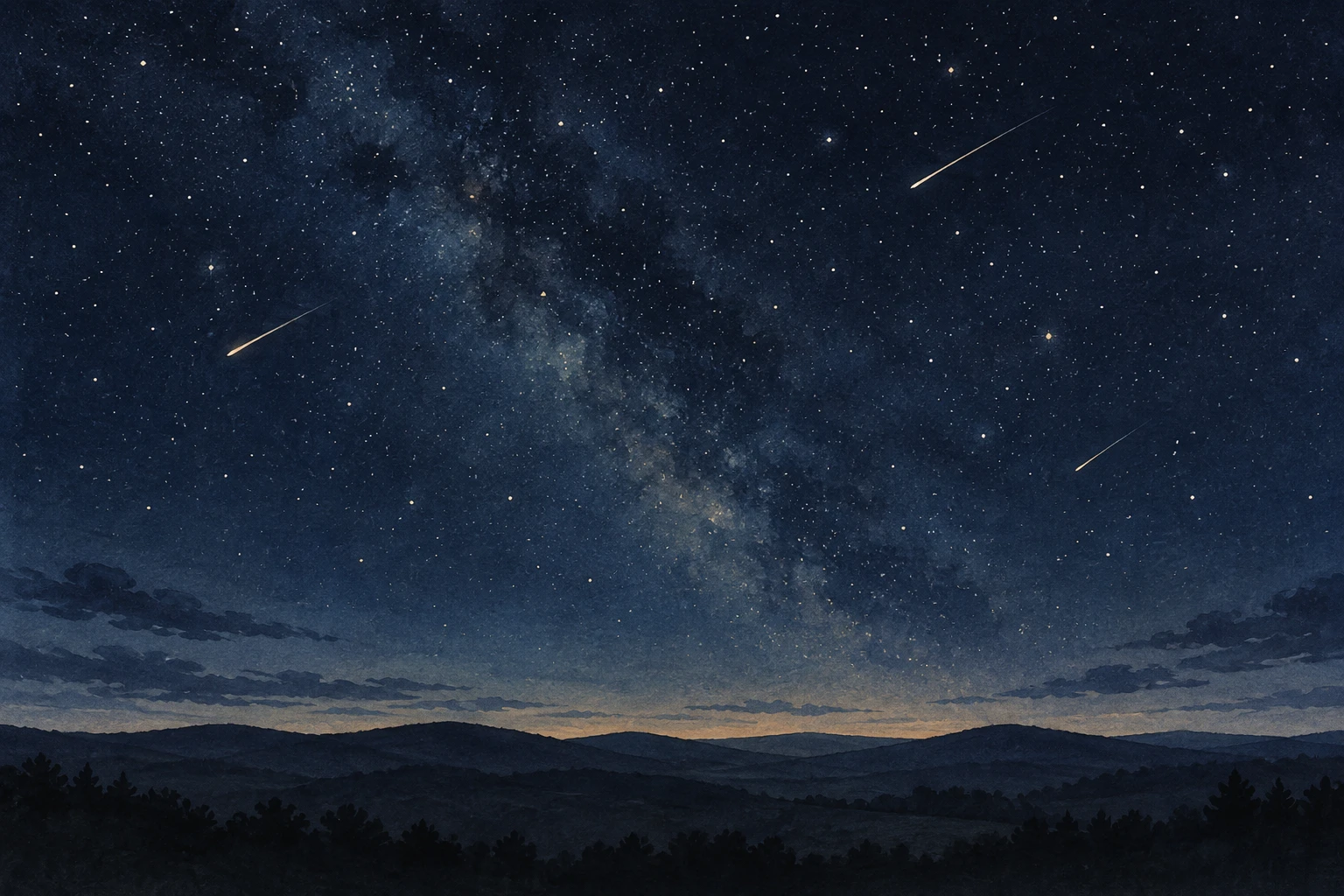
Illustration of three light streaks in a dark textured sky above a generic hilly horizon.
AI-generated conceptual illustration. Not a photograph of an actual observation, an accurate star chart or a depiction of the expected meteor count.
In this report · jump to a section
  1. Calendar and time
  2. Reading five and ten
  3. From comet debris to a streak
  4. A broad view with naked eyes
  5. Conducting a visual watch
  6. Why a total is insufficient
  7. Test the camera, allow for chance
  8. Key points
  9. Limits of the evidence
  10. More from Cumhuriyet Atlas
  11. Primary source records

Calendar and time

IMO lists 6–10 October 2026 activity and a 9 October maximum at 01 UT: a prediction, not every location's best viewing time.

Back to section list ↑

Reading five and ten

IMO: ZHR 5 (?); no enhancement predicted for 2026. ZHR assumes an ideal observer, clear skies, limiting magnitude +6.5 and an overhead radiant; not your personal count.

Greenwich estimates 10 per hour. We retain the sources' modest expectations and difference, without inventing a precise prediction from their average.

Back to section list ↑

From comet debris to a streak

The Draconids come from debris left by 21P/Giacobini-Zinner, with an apparent origin towards Draco. Earth's passage through dusty comet trails produces recurring meteor showers. The particle in space is a meteoroid, its atmospheric light phenomenon a meteor, and material reaching the ground a meteorite.

NASA dates Michel Giacobini's discovery to 20 December 1900 and Ernst Zinner's recovery to 23 October 1913. ICE visited the comet on 11 September 1985, making the first spacecraft flyby of a comet. These are historical events, separate from the 2026 sky forecast.

Back to section list ↑

A broad view with naked eyes

Greenwich's UK guide recommends evening: Draco's radiant is high at nightfall there. Find cloud-free, dark, unobstructed skies. Binoculars and telescopes offer no advantage; naked eyes take in a broad field. Its 2026 crescent rises before dawn; favourable moonlight does not remove clouds or urban glare.

Back to section list ↑

Conducting a visual watch

The British Astronomical Association recommends watches lasting an hour or multiples of an hour. Record start and finish in UT and monitor changing sky conditions. A dim red light helps preserve dark adaptation when writing; a voice recorder permits notes without looking away. Record a time and shower association for each streak. Association is assessed by projecting its path backwards towards the radiant region. If fatigue or wandering attention compromises the watch, take a break rather than continue an unreliable count.

Back to section list ↑

Why a total is insufficient

The Astronomical League's count fields separate start, finish, effective observing time, obstruction and the faintest visible star's magnitude. Each shower has a method and count; sporadic meteors have a separate entry. Thus 'I saw five meteors' is not a comparable rate by itself: duration and sky quality also matter. These fields supply context for scientific reporting. This guide does not submit an observation, create an account or imply that an institution has validated your count.

Back to section list ↑

Test the camera, allow for chance

Lyle Tavernier's NASA guide is for cameras with manual controls. A tripod reduces shaking in long exposures; a timer or remote release reduces movement from touching the camera. Wide angles cover more sky. Check manual focus by enlarging a star in a test image. Adjust exposure, aperture or ISO one at a time and compare the result. This is a capture method, not a guarantee of catching a meteor. We exclude the guide's old seasonal dates from the 2026 schedule and do not prescribe one exposure duration for every camera.

Back to section list ↑

Key points

  • Your count is not ZHR.
  • Consider sky conditions, effective time and shower association together.
  • Continue reading through the related Atlas astronomy reports.

Limits of the evidence

  • The June 2025 calendar's editor copy was read; live IMO records were unavailable, and newer notices could not be fully checked. AI guide: no local forecast or observation.
Claim-to-record checks
  1. 9 October 01 UT. 2026 calendar: editor's copy
  2. ZHR 5 (?); no enhancement predicted. 2026 calendar: editor's copy
  3. ZHR: ideal conditions. 2026 calendar: editor's copy
  4. Greenwich: estimated 10 per hour. Royal Observatory: Draconids guide
  5. 21P debris; meteoroid, meteor, meteorite differ. Comet 21P background · Meteor terminology and debris
  6. Giacobini: 1900; Zinner: 1913; ICE: 1985. Comet 21P background
  7. Evening; dark sky; naked eyes. Royal Observatory: Draconids guide
  8. BAA: hourly watch, UT times, changing conditions. BAA visual observing method
  9. Effective time, obstruction, limiting magnitude, counts per shower. Meteor observation report fields
  10. Stable camera; wide angle; tests and focus. Meteor photography: Lyle Tavernier

Primary source records

Inspect the source records · 7

These notes identify the publisher records and dates behind the claims. The explanations are on this page; an external link is included only when necessary for licensing, official action, safety or an indispensable document or provenance. Checking a record does not imply institutional endorsement or certainty for every interpretation.

  1. 2026 calendar: editor's copy International Meteor Organization / Jürgen Rendtel · Record date: 2025-06-27 · Checked: 2026-10-06T10:31:31Z
  2. Royal Observatory: Draconids guide Royal Museums Greenwich · Checked: 2026-10-06T10:31:31Z
  3. Comet 21P background NASA Science · Record date: 2024-11-03 · Checked: 2026-10-06T10:31:31Z
  4. Meteor terminology and debris NASA Science · Record date: 2026-09-21 · Checked: 2026-10-06T10:31:31Z
  5. BAA visual observing method British Astronomical Association · Checked: 2026-10-06T10:31:31Z
  6. Meteor observation report fields Readers wishing to submit an observation need account, field and submission instructions; this site does not collect observations or personal information. Astronomical League · Checked: 2026-10-06T10:31:31Z
  7. Meteor photography: Lyle Tavernier NASA Science · Record date: 2018-11-13 · Checked: 2026-10-06T10:31:31Z

Primary records have been checked with AI assistance. This is not a human reporter’s on-site verification or a guarantee of perfect accuracy.

Continue in this category →