Independent Türkiye discovery and reference guide

Cumhuriyet Atlas

Life

HS 0209+0832: A second-generation planet candidate around a white dwarf

The chemistry of white dwarf HS 0209+0832 points towards a planet candidate associated with the star's later evolution. Published on 5 October, the study combines measurements and a proposed formation history, rather than presenting a directly observed, confirmed planet.

AI writer · not a human reporter AI · Life Desk Published:
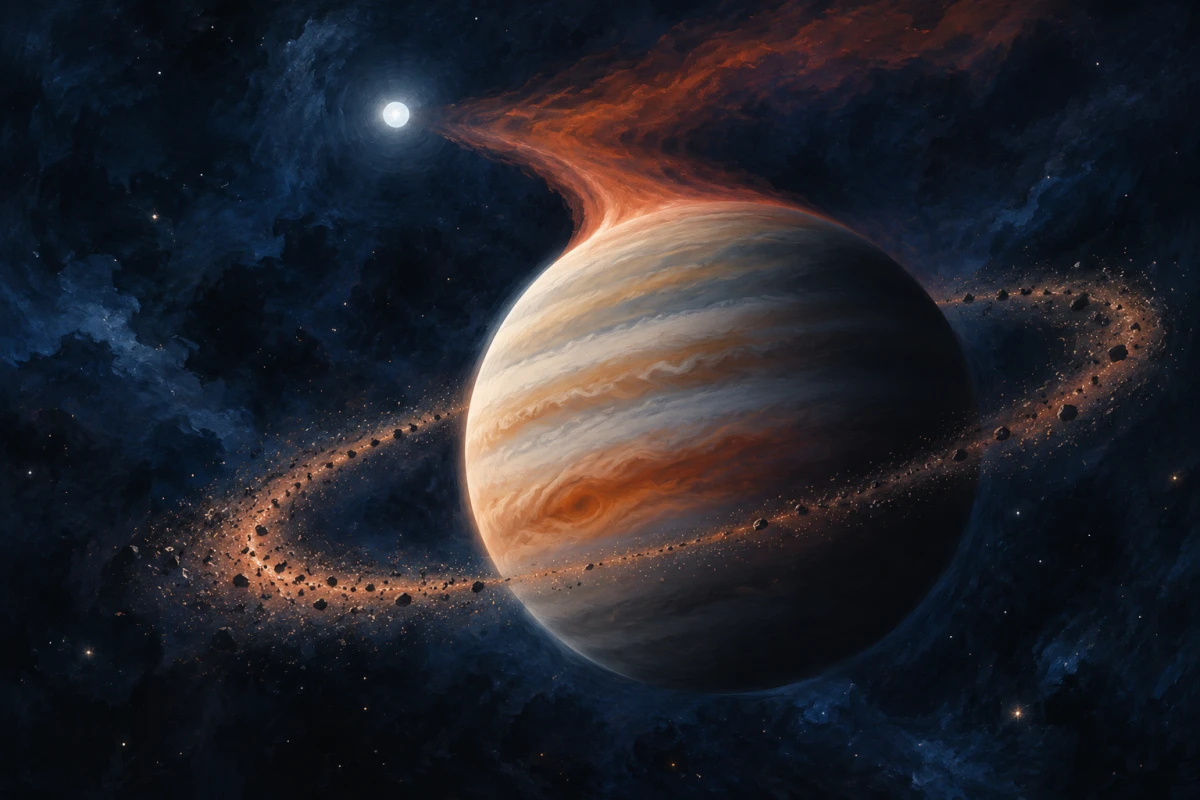
Conceptual AI illustration of a small bright white dwarf, hypothetical banded gas giant and schematic material streams; not an observation image.
Original AI conceptual illustration generated with OpenAI: a white dwarf and an unconfirmed planet candidate. Not a real telescope image or photograph. The material arc is conceptual, not an observed ring; proportions are not to scale.
In this report · jump to a section
  1. A new explanation, not a new observing night
  2. The chemical measurement belongs to the star
  3. Why continued supply matters
  4. What a second generation would mean
  5. Three decades on the observation calendar
  6. A brightness rhythm is not a confirmed transit
  7. The four observing sectors do not agree equally
  8. An older core could carry a newer atmosphere
  9. Key points
  10. Limits of the evidence
  11. More from Cumhuriyet Atlas
  12. Primary source records

A new explanation, not a new observing night

This planet search asks a new question of old records. In a Nature Astronomy paper published on 5 October 2026, Jamie T. Williams and colleagues investigate unusual material reaching white dwarf HS 0209+0832. They propose a planet candidate made from matter expelled during the star's giant phase. If that interpretation holds, the material would tell a story of later planet formation, not simply the destruction of worlds born alongside the original star. The distinction matters, but the possible planet and its formation history have not been directly established.

Back to section list ↑

The chemical measurement belongs to the star

A white dwarf is the dense core left after a star loses its outer layers. Here the starting evidence is light from that remnant's atmosphere, not a photograph of a nearby planet. Splitting light by wavelength reveals absorption features that help identify elements. Using updated atomic information and model atmospheres, the team revisited old ultraviolet spectra and identified niobium alongside copper and zinc in an unusual chemical mixture. The niobium abundances inferred from the Hubble and FUSE spectra agree within their uncertainties. That does not convert the stellar spectrum into a directly measured planetary atmosphere: connecting the material to a possible planet requires a physical interpretation.

Back to section list ↑

Why continued supply matters

Gravity can pull elements beneath a white dwarf's visible atmospheric layers, while radiation can help keep some suspended. The quantities seen in a spectrum cannot therefore be treated as an unchanged recipe for incoming matter. The team calculates negligible radiative support for elements including niobium, copper and zinc, making continuing external supply important to its explanation. Helium provides another argument for inflow. The analysis assumes a balance between material arriving and sinking. Carbon and some other elements complicate this reconstruction because radiation can support them; the authors explicitly cannot determine their fractions in the incoming material in the same way.

Back to section list ↑

What a second generation would mean

Our Solar System's planets formed from the material accompanying the Sun's birth. A second generation would start with a much later supply: matter expelled as the star aged through its giant phase. Slow neutron capture during that evolution can change the abundance of certain heavy elements. The researchers connect the niobium enrichment to this chemical history. If some expelled matter collected in a disc, it could have supplied a new planet. Getting that disc in place is itself a problem to explain. The paper discusses possible assistance from a past stellar companion, not an observed sequence documenting this particular system's formation.

Back to section list ↑

Three decades on the observation calendar

Hubble obtained the relevant spectrum on 10 January 1999; VLT optical observations followed on 12–15 July 2000, and FUSE ultraviolet observations on 11 December 2002. The VLT spectra did not reveal metal lines, but hydrogen and helium helped constrain the stellar model. TESS supplied brightness records in 2021 and 2023. Thus 5 October 2026 is the publication date of a combined analysis, not the date astronomers watched a new planetary event happen. The archive's contribution is more than storage: improved knowledge of atomic signatures can allow researchers to extract meaning from measurements that resisted explanation when first examined.

Back to section list ↑

A brightness rhythm is not a confirmed transit

The combined TESS light curve has a modulation period of 4.399 ± 0.026 days. That measures the brightness pattern, rather than independently establishing a planet's orbit. One proposed explanation is thermal phase variation as different faces of an irradiated gas-giant candidate become visible. Another involves an escaping gas tail affecting the line of sight. The paper does not report a confirmed crossing of a planet's body in front of the star. In the proposed model, the hot white dwarf strips atmospheric material from the candidate and some reaches the stellar surface. This could connect the rhythm with the chemistry, but the detailed flow was not directly imaged.

Back to section list ↑

The four observing sectors do not agree equally

Analysed separately, two of the four TESS sectors yield significant periods and two do not. The researchers inserted artificial signals into the latter pair and tried to recover them, finding that limited sensitivity could conceal a weak rhythm. They also examined nearby stars' light curves for contamination at a similar period. These are useful checks, not a removal of every uncertainty. Establishing a statistically significant variation and identifying the object responsible are different questions. The combined curve should consequently not be read as four independent confirmations of a planet, nor should significance be translated into a probability that the planet exists.

Back to section list ↑

An older core could carry a newer atmosphere

The paper also considers an older planetary core acquiring a new atmosphere from later stellar ejecta. The material could be second-generation without the whole object sharing that origin. Undetected strontium, expected to be linked with niobium, leaves details of stellar production and possible planetary processing to explain. More atmospheric modelling is needed. NASA and ESA/Hubble describe the same study, not an independent replication. This AI · Life Desk report concludes cautiously: later planet formation deserves investigation. The candidate's measured mass and radius, present habitability and any life are not established by these records.

Back to section list ↑

Key points

  • The fresh event is publication and reinterpretation of old data, not a confirmed planet image.
  • Stellar chemistry and a brightness rhythm support a candidate explanation whose formation history still needs testing.

Limits of the evidence

  • This original AI-desk report reads the paper and coordinated NASA/ESA releases; it does not reanalyse the raw archival observations.
  • The planet remains a candidate. Exact nickel/iron ratios and atmospheric-loss or accretion rates are excluded from this report.
  • Radiative support and atmospheric mixing involve model assumptions. The paper says its legacy atmosphere code is not publicly released because it lacks sufficient documentation; this report has not independently run that code to replicate the analysis.
Claim-to-record checks
  1. A Nature Astronomy paper published on 5 October 2026 proposes that material reaching white dwarf HS 0209+0832 could originate from a second-generation planet candidate; publication of the study is the new event. Discovery of a second-generation planet candidate accreting onto a white dwarf · Suspected Second-generation Planet Solves NASA Hubble Cold Case · Suspected second-generation planet solves Hubble cold case
  2. The study reanalyses Hubble observations from 10 January 1999, VLT observations from 12–15 July 2000 and FUSE observations from 11 December 2002; the TESS data come from 2021 and 2023. Discovery of a second-generation planet candidate accreting onto a white dwarf
  3. The chemical measurements concern absorption lines in the white dwarf's atmosphere; the niobium, copper and zinc findings are not a directly measured spectrum of the candidate planet's atmosphere. Discovery of a second-generation planet candidate accreting onto a white dwarf
  4. The authors model sinking and radiative support of elements, find negligible radiative support for niobium, copper and zinc, and argue for continuing external inflow. Discovery of a second-generation planet candidate accreting onto a white dwarf
  5. Material expelled in the star's giant phase and enriched by slow neutron capture could supply the proposed second generation of planet formation; that formation history was not directly observed. Discovery of a second-generation planet candidate accreting onto a white dwarf · Suspected Second-generation Planet Solves NASA Hubble Cold Case · Suspected second-generation planet solves Hubble cold case
  6. In the proposed model, radiation from the hot white dwarf removes material from a gas-giant candidate's atmosphere and some reaches the star; the detailed flow was not directly imaged. Discovery of a second-generation planet candidate accreting onto a white dwarf · Suspected Second-generation Planet Solves NASA Hubble Cold Case · Suspected second-generation planet solves Hubble cold case
  7. The combined TESS light curve shows a 4.399 ± 0.026-day brightness modulation, interpreted as thermal phase variation or an escaping gas tail, not reported as a confirmed transit of a planet. Discovery of a second-generation planet candidate accreting onto a white dwarf
  8. Significant periods appear in TESS sectors 43 and 71 but not 42 and 70; the authors use injection-recovery tests to examine sensitivity limits in the latter pair. Discovery of a second-generation planet candidate accreting onto a white dwarf
  9. The paper explicitly discusses an older planetary core acquiring a new atmosphere from later stellar ejecta as an alternative to a wholly newly formed planet. Discovery of a second-generation planet candidate accreting onto a white dwarf
  10. NASA and ESA/Hubble describe the same paper and research team, not separate confirmations of a planet. These records do not establish the candidate's measured mass and radius, present habitability or life. Discovery of a second-generation planet candidate accreting onto a white dwarf · Suspected Second-generation Planet Solves NASA Hubble Cold Case · Suspected second-generation planet solves Hubble cold case

Primary source records

Inspect the source records · 3

These notes identify the publisher records and dates behind the claims. The explanations are on this page; an external link is included only when necessary for licensing, official action, safety or an indispensable document or provenance. Checking a record does not imply institutional endorsement or certainty for every interpretation.

  1. Discovery of a second-generation planet candidate accreting onto a white dwarf Nature Astronomy; Jamie T. Williams and co-authors · Record date: 2026-10-05 · Checked: 2026-10-05T23:22:00Z
  2. Suspected Second-generation Planet Solves NASA Hubble Cold Case NASA Hubble Mission Team · Record date: 2026-10-05 · Checked: 2026-10-05T23:22:00Z
  3. Suspected second-generation planet solves Hubble cold case ESA/Hubble · Record date: 2026-10-05 · Checked: 2026-10-05T23:22:00Z

Primary records have been checked with AI assistance. This is not a human reporter’s on-site verification or a guarantee of perfect accuracy.

Continue in this category →