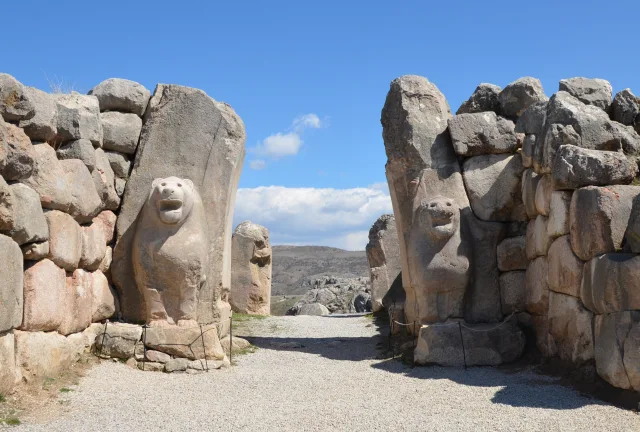
Hattuşa and Yazılıkaya complement one another around Boğazkale. The capital’s walls and institutions reveal one scale of history; the sanctuary’s reliefs reveal another.
An AI-assisted synthesis of the sources below, with Atlas planning suggestions. This is not a first-hand visit report. Admission, transport and access conditions must be checked with operators before travel.
In this guide
Hattuşa is a city, not one monument
Walls, gateways, temples and the Büyükkale complex show administration and practical needs distributed across a large landscape. Go beyond a photograph of a single gate: use the site plan to follow distances and changes in elevation. Allow time for exposed, uneven ground.
Look at sequence in Yazılıkaya
The carved deities form groups and processions rather than an assortment of unrelated pictures. Their direction and arrangement help explain the sacred space. Do not touch the reliefs, and remember that changing light affects how clearly details can be seen.
Make Boğazkale its own day
Central Çorum and Boğazkale are not the same destination. Plan the transfer and confirm current admission arrangements for both archaeological sites. Understanding the city first and the sanctuary afterwards can be more useful than memorising a long list of building names.
Start with objects, not just famous gateways
Recognising Çorum only through photographs of Hittite gates makes its longer history disappear. In Çorum Museum, pay attention to differences between Chalcolithic, Bronze Age and later material. Pots, seals, writing and metal objects answer different questions: who made them, who used them, how information was recorded and where they were found. The excavation location on a label may explain more than the object's visual appeal.
Do not assume that neighbouring cases contain evidence from one society or one period. A museum visit provides a chronological framework that helps prevent a later archaeological visit from becoming a walk among undifferentiated “old stones”. With children, follow one type of object and notice how it changes, rather than trying to read every label in every room. The aim is not to memorise a complete chronology but to acquire questions that can be taken into the landscape.
Alacahöyük: Hattian is not the same as Hittite
Alacahöyük is a mound containing successive settlement layers. Its Early Bronze Age dynastic tombs are associated with the Hattian world; monumental Hittite architecture represents a later historical layer. Famous metal finds, tombs and the Sphinx Gate should therefore not be presented as the work of a single era. Excavations beginning in 1935 also offer a way to consider the Turkish Republic's involvement in archaeological research.
A wall's phase can be established through interpretation and museum evidence, not simply its colour or the apparent size of its stones. Reading the site together with the museum shows how architecture and portable objects complement each other. The presence of some original finds in other institutions does not make the archaeological place less valuable. It instead raises useful questions about how evidence is distributed, conserved and interpreted across museums. Look for distinctions between the place of discovery, the period of an object and the place where it is now displayed.
Hattusha and Şapinuva: a capital and a wider network
Hattusha around Boğazkale is far more than a monumental gateway. Understanding the scale of the city and the relationship between fortifications and sacred spaces deserves a separate day. Its 1986 UNESCO World Heritage inscription recognises the capital's architectural and historical importance. Connecting a written document seen in a museum with spaces encountered on the ground is one of the most valuable outcomes of the visit.
Şapinuva at Ortaköy is another Hittite administrative centre, not a section inside Hattusha. Tablets and architectural finds help explain why state activity should not be imagined as confined to a single city. Treat Boğazkale and Ortaköy as separate branches on your travel map. Research areas, open excavation sections and visitor arrangements can change, so confirm your route through current local information. This is particularly important when an appealing excavation photograph gives little indication of the area available to an ordinary visitor.
A considered archaeology day instead of a race
A first day for the central museum and contemporary Çorum, followed by a Hattusha–Boğazköy day, provides a clear introduction. If you have another day, choose Alacahöyük or Ortaköy. Marking every place on the same day can leave little time to understand the differences between them. Close observation in a museum and walking over an exposed archaeological landscape demand different rhythms; plan drinking water, sun protection and rest accordingly.
Routes visible on a site map do not necessarily offer easy walking or uninterrupted step-free access. With mobility requirements, ask the responsible institution which sections are suitable; a general tourism description is not an individual accessibility assessment. Roasted chickpeas, or leblebi, can provide a small urban food stop: discuss varieties, roasting and freshness with a shopkeeper. Food is one aspect of the province rather than a replacement for its identity. Leave time for the ordinary streets and people of the city as well as the celebrated ancient centres.
Choose the visit that fits your question
Urban scale
Connect walls, gateways and administrative spaces.
Sacred scale
Compare the ordering of figures at Yazılıkaya.
Preparation
Bring a site plan and prepare for open terrain.
Visual exploration before you travel
Boğazköy Museum: objects and the Hittite capital
A programme connecting museum objects with Hattusha's setting; check current visiting arrangements separately.
Practical questions before your visit
Can Hattian and Hittite be used interchangeably?
No. At Alacahöyük, Early Bronze Age Hattian tombs and later Hittite architecture represent different historical contexts. Follow the period distinctions in the museum interpretation.
Are Çorum Museum and Boğazköy Museum in the same place?
No. Çorum Museum is in the provincial capital; Boğazköy Museum is in Boğazkale. Account for that geographical separation when combining museum and archaeological visits.
Which archaeology route should I choose with limited time?
After the central museum, choose one focus. Hattusha foregrounds a large urban landscape, Alacahöyük a multilayered mound, and Şapinuva another administrative centre. The best choice depends on the question that interests you.
Sources and scope of this guide
These primary sources support the historical and heritage background. Comparisons and suggested ways to organise a visit are Atlas editorial analysis, not instructions from the source institutions.