
Acarlar Longoz and Justinian’s Bridge reveal contrasting relationships with water. Seasonal flooding shapes one habitat; engineering makes a crossing possible in the other.
An AI-assisted synthesis of the sources below, with Atlas planning suggestions. This is not a first-hand visit report. Admission, transport and access conditions must be checked with operators before travel.
In this guide
What is a longoz?
A longoz is a forest subject to periodic flooding. Trees, waterside plants and water level need to be understood together. Do not expect identical scenery in every season, or assume that boating and activities mentioned in old descriptions remain authorised.
The name does not count the arches
The monumental bridge from Justinian’s reign has more than the five arches suggested by the name Beşköprü. Comparing a name’s history with the physical structure can be instructive. Read the long sequence of arches alongside waterways and landscape change.
Plan two different settings
Calculate access to the wetland separately from the bridge outing. Use designated platforms and paths in the protected area. At the bridge, choose permitted viewpoints rather than climbing, and respect conservation or restoration restrictions. Water connects the two subjects without making them neighbouring stops.
Taraklı: architecture and craft at street level
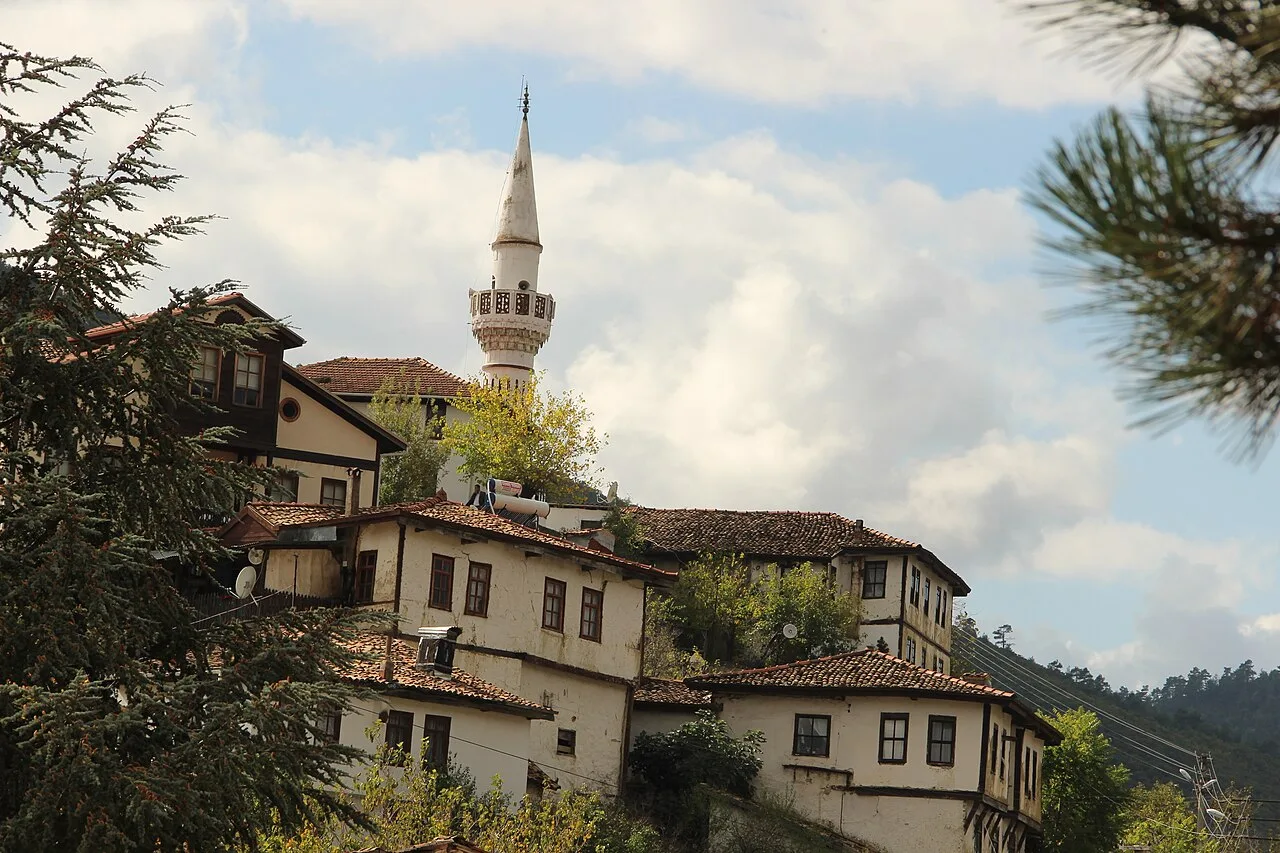
Taraklı is a historic settlement in southern Sakarya, not another version of a lakeside resort. Its relationship with the old Istanbul–Ankara route can be explored through houses and the market area. Membership of the Cittaslow network is better treated as an invitation to consider local life and conservation than a promise that every visit will be quiet. Weekend crowds and a special event can change the atmosphere of a small street.
Look beyond an attractive projecting upper floor. The slope of the street, the relationship between lower and upper-storey materials and the ways buildings meet their surroundings offer a more useful reading of architecture. Restoration and present-day businesses show how historic fabric is accommodated now; they do not establish that all interiors are original or publicly accessible.
Crafts such as comb and spoon making add a human dimension to the townscape. Ask permission before entering a working space and enquire about materials and production. A conversation with a maker can make a small purchase more informative than an object chosen simply because its label says “local”.
Adapazarı: commerce, migration and different communities’ skills
The provincial centre should not be reduced to a transit point for outdoor excursions. Around Uzun Çarşı, trade and craft connect. The tourism directorate treats copperworking, quilting associated with migration from the Balkans and Black Sea, and Romani mat-making around Sapanca and Abalı as distinct traditions. This is a reminder not to compress every local skill into a single origin story.
The place where a product is sold may not be the place where it was made. Ask how fibres are selected for a mat, how a copper surface is worked or how the fabric and filling of a quilt are chosen. These questions connect technique with use. Official cultural inventories can contain older workshop counts or descriptions that do not establish who is operating today; verify an individual visit directly.
Treat crafts as work and livelihood, not a picturesque backdrop. Asking to speak with a maker and deciding what you want to learn is more respectful than photographing people without permission. It also helps distinguish a genuinely made object from merchandise using a craft’s reputation.
Geyve and the southern districts: production and recent history
Geyve and Alifuatpaşa introduce another layer to a southern Sakarya route. The governorate’s account of Ali Fuat Cebesoy’s connection with the area provides a starting point for considering organisation during the National Struggle and the role of local centres. An anniversary monument, a museum display and a historical building need not date from the same moment. Distinguish the event being remembered from the construction or interpretation doing the remembering.
The district’s quince, apple, peach and cherry production also helps explain the agricultural landscape beside a road. A view of an orchard is not permission to enter private land or pick produce. A seasonal producer’s stall allows a visitor to ask about harvest periods rather than assume that supermarket availability describes local agricultural timing.
Choosing Geyve and Taraklı as a southern history-and-production day can be more coherent than adding them to a rushed shopping stop around Sapanca. This is an original route recommendation, not an advertised tour. Build it around actual road links, time at the stops and your return arrangements.
Lake, coast and uplands demand different preparation
Lake Sapanca, the Karasu–Kocaali Black Sea shoreline and the southern uplands have different water, elevation and safety conditions. A lakeside walk does not prepare someone for a route around Soğucak or another highland setting. A plateau name on a map does not establish road suitability for every vehicle, permission to camp or the safety of drinking from an untested spring.
Weather, fog and the available daylight belong in the planning stage. Beach warnings remain important even when the sea looks attractive in a promotional photograph. For an upland outing, confirm current local access and select an activity suited to the group rather than treating all green areas as interchangeable picnic grounds.
Tuzla Canyon near Taraklı is a technical environment. The official tourism directorate explicitly requires professional guidance and appropriate equipment. A short mapped distance is not evidence of an easy stroll through water and waterfall obstacles. We therefore do not present it as an independent family walk. For a one-day visit, a historic-town walk or a verified public lakeside route is a clearer choice. Reducing a plan to match permissions, weather and personal mobility is sound planning, not a lesser trip.
Choose the visit that fits your question
Ecology
See seasonal water as part of the forest.
Name and structure
Compare Beşköprü with the actual arches.
Conservation
Avoid unauthorised access to water or structures.
Visual exploration before you travel
Taraklı Tuzla Canyon — 2020 footage
Public 2020 footage linked by the official tourism directorate, illustrating a technical canyon environment rather than recommending an unguided crossing.
Sakarya İl Kültür ve Turizm Müdürlüğü / iktm54 · Watch the official publication ↗
Practical questions before your visit
Are Taraklı and Sapanca equivalent day-trip options?
No. Taraklı rewards attention to historic streets and craft; Sapanca offers a lake-centred setting. Travel between them and different visitor expectations matter. Choosing a main theme leaves time to understand a neighbourhood or shoreline instead of reducing both to hurried shopping and photographs.
Is Tuzla Canyon a short casual walk?
The official tourism directorate states that professional guidance and technical equipment are required. A short distance does not remove water, waterfall or passage difficulties. Do not plan a crossing without suitable expertise, preparation and assessment of conditions. Watching footage is not a substitute for technical competence.
Why include craft information in a travel guide?
It helps explain materials, the district of production and a maker’s labour. It separates a sales outlet from a working studio and shows how migration and different communities have shaped Sakarya’s culture. This is more useful than treating every object as evidence of one romantic, unchanging past.
Sources and scope of this guide
These primary sources support the historical and heritage background. Comparisons and suggested ways to organise a visit are Atlas editorial analysis, not instructions from the source institutions.