
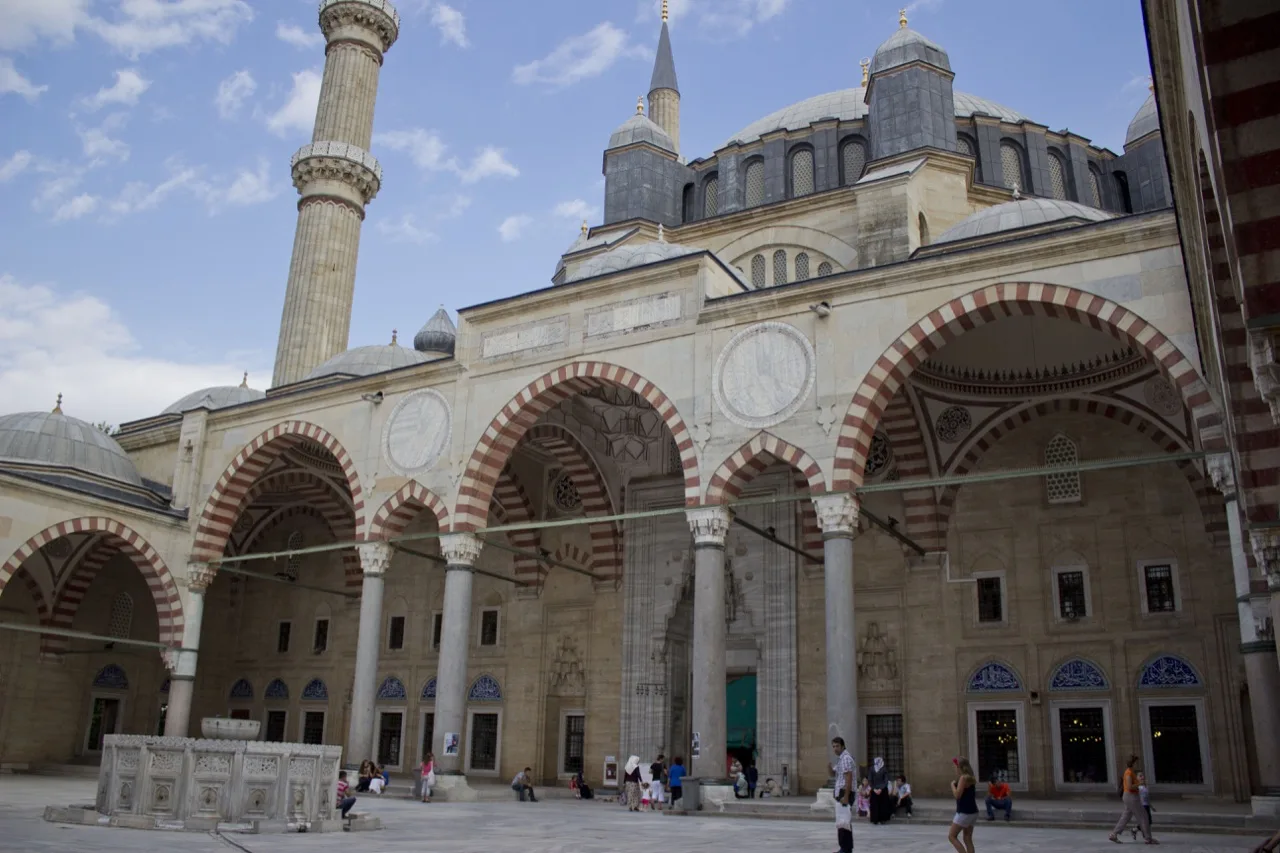
Instead of counting landmarks in Edirne, ask what their architecture was designed to do. Üç Şerefeli Mosque and the Bayezid II complex offer contrasting arrangements for worship, learning and care.
An AI-assisted synthesis of the sources below, with Atlas planning suggestions. This is not a first-hand visit report. Admission, transport and access conditions must be checked with operators before travel.
In this guide
A spatial experiment at Üç Şerefeli
The fifteenth-century mosque’s central dome and courtyard help explain developments in Ottoman architecture. Look beyond the minaret that gives the building its name to the broad organisation of the interior. A façade photograph alone cannot convey the plan.
Context at the Health Museum
The hospital and medical teaching functions of the Bayezid II complex introduce the institutional history of care. Historical accounts of music and water should not be presented as evidence-based treatment advice for today. Read the spaces alongside the museum’s explanations.
Different visiting rhythms
Respect worship and visitor arrangements in the mosque, and confirm current museum access. Allow separately for the journey to the complex beside the Tunca. Time spent understanding two plans can be more rewarding than racing through many architectural names.
Selimiye together with its surrounding institutions
Selimiye is not simply a four-minaret skyline: it is a complex bringing education, commerce and worship into one institutional setting. In Sinan's sixteenth-century design, consider how the central dome unifies space and how light affects the interior arrangement. UNESCO's 2011 inscription concerns the mosque and social complex, not the whole of Edirne. The monument's influence across the city and the boundary of the inscribed property are different ideas.
Looking for relationships between the covered market, courtyard and educational buildings can be more explanatory than spending only a few minutes beneath the dome. Observe without interrupting worshippers. Restoration and service arrangements may change, so do not assume every interior can be seen to the same extent on every date. Checking current access is part of preparing a thoughtful visit, particularly when older images show a view which may not be available during your trip.
Rivers, bridges and movement through the city
A riverside walk in Edirne helps reveal connections between the city and its surroundings. Read bridges as structures associated with commerce, travel and flood landscapes, not merely as scenery. When combining the centre, distant riverside points and museums, remember that a short line on a map does not describe actual walking demands or the effect of weather.
Uzunköprü spans the Ergene in the district of the same name; it is not one of central Edirne's river bridges. The fifteenth-century structure can be appreciated as an engineering response to a difficult crossing, not simply through its impressive length. Its UNESCO Tentative List record dates to 2015 and is not the same as World Heritage inscription. Conservation or repair arrangements may affect how it can be visited; do not assume unrestricted walking over the entire bridge. Understanding the geographical distinction first avoids a programme built around two places mistakenly imagined to be adjacent.
Enez: a separate day for coastal archaeology
Enez was known as Ainos in antiquity. The setting where the Meriç reaches the sea introduces the intersection of maritime, river and land routes. Changes caused by alluvial deposition demonstrate why an ancient port should not be judged only through its distance from today's shoreline. A wall fragment can be considered in relation to changing settlement and trade as well as defence.
Enez is not a brief extension of a museum visit in the provincial capital. Plan the Keşan and southern coastal direction separately. Archaeology, beaches and wetlands suggest different preparation, and proximity to the sea does not establish swimming permission or safe conditions at every point. Reading where museum objects were found helps connect surviving fragments with a larger city. The value of such preparation is that a modest visible ruin can acquire meaning without requiring the visitor to imagine a complete town unsupported by the surviving evidence.
Choose museums and make room for the living city
Edirne's museums do not all repeat one subject: urban history, Balkan history, ethnography and medical institutions open different questions. Choose through your interests rather than reputation alone. In a house museum, room arrangement and household objects may matter most; in an archaeological collection, provenance and period are central. Giving one collection detailed attention often produces more lasting knowledge than moving through several without a clear question.
A first day of central architecture and one museum, a second for riverside places or Uzunköprü, and an additional Enez focus provides a balanced framework. Connect food and shopping with the historic setting. Discussing ingredients, preparation and local production offers more than checking off a “famous taste”. Mosques, houses and markets remain living places, not empty stages. Around commemorations or busy event days, confirm access and movement arrangements separately and keep the plan flexible. Leaving space for an unplanned conversation or a longer rest can improve the visit without reducing its historical depth.
Choose the visit that fits your question
Architecture focus
Connect dome, courtyard and supports.
Institutional history
Compare spaces for treatment and teaching.
Slower visit
Leave time to understand both plans.
Visual exploration before you travel
Edirne Palace: history and place
A documentary introduction to the palace site; filmed areas do not guarantee current excavation or visitor access.
T.C. Kültür ve Turizm Bakanlığı · Watch the official publication ↗
Practical questions before your visit
Do Selimiye and Uzunköprü have the same UNESCO status?
No. Selimiye Mosque and its Social Complex have been inscribed on the World Heritage List since 2011; Uzunköprü has a Tentative List record from 2015.
Should Enez be added to a central walking day?
Enez is a separate southern district and coastal programme. Allocate separate time so architecture and museums in the capital do not become rushed stops.
How many museums should I choose on a first visit?
One main museum considered alongside surrounding buildings and streets is a good beginning. Your focus might be medical, urban, Balkan or archaeological history, and the choice should reflect that.
Sources and scope of this guide
These primary sources support the historical and heritage background. Comparisons and suggested ways to organise a visit are Atlas editorial analysis, not instructions from the source institutions.