
← Back to History of the Republic
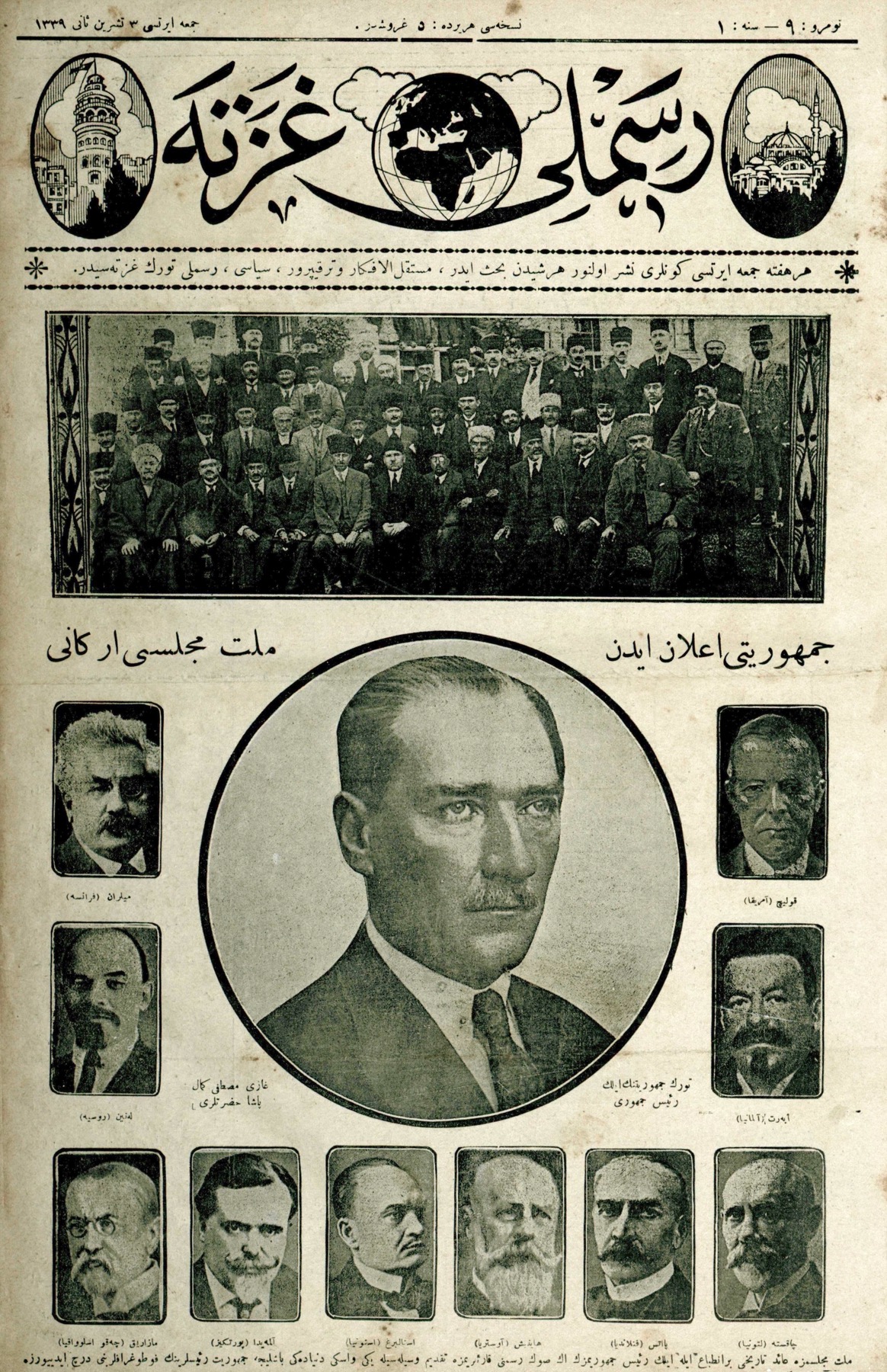
Resimli Gazete / Wikimedia Commons · Public domain ↗ Atatürk library · III
Reforms during Atatürk’s presidency
The Republic’s first fifteen years were not merely a list of separate laws but a broad—and at times forceful—effort to redefine relations among state, citizen and public life.
29 October 1923—10 November 1938Republic of Türkiye
The 3 November 1923 issue of Resimli Gazete reporting the proclamation of the Republic.
At a glance
- Unified education
- 3 March 1924
- Civil Code
- 1926
- New Turkish letters
- 1 November 1928
- Women’s parliamentary suffrage
- 5 December 1934
A reconstruction of institutions, not just a list of changes
The reforms of Atatürk's presidency reorganised sovereignty, law, education and everyday administration after the Republic emerged from war. Their purpose extended beyond a change in appearance: they redefined which institution could perform an action, what made a transaction legally valid, and how citizens dealt with the state. School management, marriage registration, electoral participation and a shop's measuring equipment therefore belong to different parts of one larger transformation. Treating them as a single ceremony conceals the administrative work on which each change depended.
Mustafa Kemal's political direction as president was decisive, but the Assembly enacted legislation, governments and specialists prepared it, and teachers, registrars, lawyers and local authorities put it into practice. The new order also interacted with debates about education and law inherited from the late Ottoman period. This guide separates adoption, publication and implementation rather than supplying one date for every stage. It explains historical arrangements; it is not a statement of all the rules currently applicable in Türkiye.
↑ Back to dossier contents3 March 1924 · New responsibilities for education and religious services
Three separate laws were adopted on 3 March 1924. Law 431 abolished the caliphate. Law 429 abolished the ministries of religious affairs and foundations and of the General Staff, while establishing a different administrative organisation. The Presidency of Religious Affairs, then called Diyanet İşleri Reisliği, was created within that arrangement to administer Islamic belief and worship services. Describing the legislation as abolishing all religion or all places of worship therefore misstates its scope. A ministry, a presidency and a military command structure are different forms of institution.
Law 430, the Unification of Education Law, placed educational institutions under the Ministry of Education's administration and supervision. The closure of the medreses followed through administrative implementation; teacher training, budgets, curricula and buildings remained practical requirements. Unification did not mean that every child obtained the same duration or quality of schooling on that day. The distinction between a unified legal authority and enough schools and teachers across the country is essential when assessing educational outcomes.
↑ Back to dossier contents1924, 1928 and 1937 · Three constitutional stages of secularisation
The Constitution adopted on 20 April 1924 established the republican system and national sovereignty, yet its original second article still identified Islam as the state's religion. The Constitutional Court's dated text records the removal of that provision by Law 1222 on 10 April 1928. This was a constitutional stage of secularisation: it is inaccurate to say that the original 1924 constitution already expressly described a secular state. Reorganisation of education and ordinary legislation and amendment of the constitutional text were connected, but were not the same legal acts.
On 5 February 1937, Law 3115 inserted republicanism, nationalism, populism, statism, secularism and reformism into Article 2. Secularism thereby became an explicitly stated constitutional characteristic. Institutional reorganisation, removal of the religious provision and the later insertion of the principle need to remain distinct. These measures were also carried out under one-party government. National sovereignty as a constitutional principle did not mean that today's model of pluralist electoral competition had already been completed. A careful interpretation distinguishes constitutional wording, the scope of rights and the way power was exercised.
↑ Back to dossier contents1925 · Hats and clothing: public symbols and legal scope
Mustafa Kemal's August 1925 visits to Kastamonu and İnebolu introduced the hat as part of a public explanation of clothing change. The Assembly subsequently adopted Law 671 on the Wearing of Hats on 25 November 1925. It concerned headgear, particularly that of Assembly members and public officials, and the adoption of the hat as general headwear. Its symbolic significance is clearer against an earlier setting in which clothing could publicly identify office, religious status and social position.
The 1925 statute must not be described as a general law prescribing every element of women's clothing. Law 2596, adopted on 3 December 1934, was a separate measure dealing with religious dress outside places of worship and ceremonies. Nor was the wider clothing transformation simply a fashion adopted spontaneously at the same speed by everyone. Political authority, public symbolism and ordinary habits were involved. A photograph of a person wearing a particular garment is evidence of that image's setting, not proof of the complete legal rule or of uniform practice throughout the country.
↑ Back to dossier contents30 November 1925 · Religious lodges, closure and cultural inheritance
Law 677 was adopted on 30 November 1925 and published on 13 December. The closure of tekkes and zaviyes, abolition of tomb-keeping offices and prohibition of specified titles changed the organisation of religious authority. The terms are not interchangeable: a tekke was a lodge associated with a religious order, a zaviye a smaller local establishment, and a türbe a tomb building. Equating all three with mosques, or equating an institutional restriction with the disappearance of individual belief, exaggerates the legislation's scope.
These institutions were also historical settings for music, literature, architecture and social relationships. Their later cultural life therefore belongs in the account of closure. The reorganisation of Konya's Mevlâna lodge as a museum in 1926 and its opening as a museum in 1927 illustrate a building's transition to a different public function. Closure as an order's centre, conversion into a museum and access for visitors today are separate stages. Present-day heritage protection and visiting arrangements do not reproduce the institutional conditions of 1925.
↑ Back to dossier contents26 December 1925–1926 · A shared language for dates and time
Laws 697 and 698, adopted on 26 December 1925, separately addressed the twenty-four-hour day and the adoption of the international year numbering for the official calendar. The calendar provision identified the day following 31 December 1341 as 1 January 1926. That specified year transition must be distinguished from the laws' official publication on 2 January 1926. The lunar Hijri calendar retained a role in religious dating: the official state calendar and particular religious uses were not identical domains.
A shared time convention made transactions such as international payments, railway connections and official correspondence easier to state consistently. However, division of the day into hours, a country's time-zone reference and daylight-saving arrangements are different decisions. When reading an archival record, examine its calendar, month names and period as well as its year number. Converting an old date into a modern one is not always a matter of adding the same number to every year. The reform helps explain why a document's original date and its modern catalogue date can differ without either being an error.
↑ Back to dossier contents1931–1934 · Standard measures and a delayed transition
Law 1782, dated 26 March 1931, established a framework based on metric measures such as the metre and kilogram. The original target for application was 1 January 1933. At the Assembly's session of 31 December 1932, however, incomplete preparations were debated and Article 28 was amended: compulsory application of all the measures was to be completed by 31 December 1933. A documentary study in the Atatürk Research Centre journal follows the Cabinet decision of 18 September 1933 and implementation at the beginning of 1934. Adoption in 1931, the initial target and the final mandatory transition thus describe different stages.
The original parliamentary proceedings identify laboratory facilities, calibration standards, technical staff and funding as practical requirements. Standardisation meant more than learning a conversion: a purchased quantity had to be testable against a common reference. A pupil learning the metre and a trader replacing equipment experienced different costs of the same reform. When a sale changes its unit, both the stated price and the quantity need comparison. This is a story of measurement, inspection and learning, not evidence that the entire population's habits changed automatically on a single morning.
↑ Back to dossier contents1926 · The Civil Code and ordinary legal relationships
The Turkish Civil Code, Law 743, was adopted on 17 February 1926 and entered into force on 4 October. Prepared on the basis of the Swiss Civil Code, it placed marriage, family, inheritance and property relationships within a new legal framework. Civil marriage and monogamy concerned the validity of a public registration and a legal relationship, not merely the style of a ceremony. Separating adoption from commencement also helps identify the rules under which an earlier or later transaction was made.
The code was a major development in women's family-law position, but the 1926 text did not meet every present-day standard of equality. Later changes in civil law must not be projected backwards into it. A formally recognised right becomes usable through access to courts, documents and adequate information. Education and legal reform consequently meet at a practical level: explaining new procedures and maintaining records are institutional tasks that make legislation available in daily life. Historical significance and the limits of the original provisions can be acknowledged together.
↑ Back to dossier contents1928–1929 · Numerals, letters and adult learning were distinct changes
International numerals were adopted before the new Turkish alphabet. Law 1288 was passed on 20 May 1928 and applied from 1 June; Law 1353 of 1 November 1928 concerned the Latin-based Turkish alphabet. One changed the way numbers were written and the other the writing system. Neither meant that the Turkish language came into existence on that date. Printed forms, school instruction and institutional records had their own transitional arrangements rather than all changing under a single deadline.
Nation Schools, which began teaching in 1929, sought to give adults access to reading and writing in the new letters. Atatürk's publicity tours and blackboard images became powerful symbols of the campaign; teachers, classrooms, books and the time learners could afford were its working resources. Attributing all subsequent improvement in literacy to the alphabet alone overlooks educational access. The specialised training later needed to read earlier Ottoman-script records is another aspect of cultural transmission. That difficulty and the aim of widening new educational opportunities can be considered together without reducing the history to an entirely effortless success or a total loss of culture.
↑ Back to dossier contents1934–1935 · Surnames, titles and identification in public records
The Surname Law, Law 2525, was adopted on 21 June 1934, published on 2 July and entered into force six months later, on 2 January 1935. Requiring a shared family surname after a person's given name was intended to make population, school, property and other official records easier to distinguish. It is more accurate to describe the innovation as a general compulsory legal arrangement than to claim that nobody in Ottoman society had previously used any family designation or identifying byname.
The Assembly's grant of the surname Atatürk to Mustafa Kemal on 24 November 1934 was made through Law 2587, separately from the general surname statute. The titles legislation of 26 November, Law 2590, was another measure. The historical provisions governing selection of a surname and the head of a family were not equivalent to today's individual naming and equality rules; the legislation also restricted certain categories of surname. This account is therefore not advice about changing a name today. A person's name in an original document, later surname and modern catalogue heading may differ: retaining those distinctions helps connect records without silently rewriting the source.
↑ Back to dossier contents1930–1937 · Political participation and the economic foundations of reform
Women's political rights expanded in stages: the Municipal Law of 3 April 1930, the village-election amendment of 26 October 1933 and the constitutional change of 5 December 1934 opened different levels of representation. Seventeen women were elected in the 1935 general election; Hatice Özgener's addition in 1936 brought the total for the parliamentary term to eighteen. Women's organisation, including the work of the Turkish Women's Union, belongs within this history. Legal recognition cannot simply be equated with complete social equality, nor can women's own demands and work be removed from the account.
The durability of reform also depended on production and financial resources. İş Bank, founded on 26 August 1924, was one institution created to support national capital and enterprise; its first general manager was Celal Bayar. Railway, agricultural and industrial programmes were not the direct products of a hat or alphabet law. Yet shared measures, trained personnel and reliable records were connected to economic requirements. The factories, banking and agriculture dossiers develop those relationships in detail. Their histories should distinguish an institution's establishment, the start of production and any later nationalisation rather than substitute one opening photograph for the entire process.
↑ Back to dossier contentsRead the turning points together
- 3 March 1924
Three institutional measures
Laws 429,430 and 431 addressed religious administration, unified educational authority and the abolition of the caliphate as distinct matters.
- 20 April 1924
A constitution still containing a religious provision
The Constitution, Law 491, established the republican framework; its original second article still specified the state's religion.
- August–25 November 1925
Kastamonu tour and the Hat Law
Public explanation preceded Law 671. The statute was not a general prescription of every element of women's clothing.
- 30 November–13 December 1925
Lodges and tomb-keeping offices
Law 677's adoption and official publication were separate dates; the measure concerned institutions, offices and specified titles.
- 26 December 1925–January 1926
Official calendar and the twenty-four-hour day
Laws 697 and 698 were adopted. The calendar defined the 1 January 1926 year transition; official publication followed on 2 January.
- 17 February–4 October 1926
Civil Code
Adoption of Law 743 in February and its commencement in October were distinct stages in the new family and property-law framework.
- 10 April 1928
Removal of the constitutional religious provision
Law 1222 removed the statement of the state's religion; the explicit insertion of secularism into Article 2 came later.
- 20 May–1 November 1928 /1929
Numerals, letters and adult education
Law 1288 on numerals and Law 1353 on letters were different measures. Nation Schools began their teaching work in 1929.
- 3 April 1930 /26 October 1933
Local political rights
Women's participation in municipal and village elections expanded before their right to vote and stand in parliamentary elections.
- 26 March 1931–31 December 1933
Metric measures and the transition
Law 1782 was followed by the amendment of 31 December 1932. The original early 1933 target must be distinguished from the final year-end deadline.
- 21 June 1934–2 January 1935
Three dates of the Surname Law
Adopted on 21 June, published on 2 July and effective on 2 January. The Atatürk surname was granted separately on 24 November 1934.
- 3–5 December 1934
Clothing and representation: separate legislation
The religious-dress measure of 3 December and parliamentary suffrage and eligibility for women on 5 December were distinct legal acts.
- 1935–1936
First women deputies
Seventeen women entered through the general election; Hatice Özgener's addition in 1936 brought the term's total to eighteen.
- 5 February 1937
Secularism expressly stated in the constitution
Law 3115 placed secularism alongside five other principles in Article 2, a different constitutional stage from 1924 and 1928.
Explore the archive and documentary context
Yozgat Bozok Üniversitesi UZEM
Social and economic reforms · University lecture
Public teaching film listed as Unit 4, dated 27 January 2021, in the university's official YOBU TV catalogue. It provides a framework for social and economic changes. This is a later lecture, not continuous contemporary footage of events in 1925 or 1934.
Choosing to load the player connects to YouTube and shares technical data such as your IP address with Google. Autoplay is off. This choice does not change your cookie preferences. The publisher may restrict regional access or embedding; the official link below provides an alternative.
Yozgat Bozok Üniversitesi UZEM
Law, education and cultural reforms · University lecture
Unit 5 in the official university catalogue, dated 4 February 2021. A public lecture on legal, educational and cultural reform. Use the dated legislation and implementation stages on this page alongside it; the lecture is not a substitute for the original parliamentary record.
Choosing to load the player connects to YouTube and shares technical data such as your IP address with Google. Autoplay is off. This choice does not change your cookie preferences. The publisher may restrict regional access or embedding; the official link below provides an alternative.
TRT Haber
Founding the Republic · TRT historical report with archives
A public historical report published on 29 October 2020, combining archival material and later narration. Watch for the republican and constitutional setting preceding the reforms. It is not presented as a film about every law of 1925–1937 or a single recording in which every sequence was filmed in 1923.
Watch the official publication ↗Supported YouTube publications can be watched here by choosing to load their player. Videos are not copied onto our server. Interpret archive images alongside their production date and the narrator’s perspective; the official publication link remains as an alternative.
Questions and historical distinctions
Was the state made secular in 1924,1928 or 1937?
Do not substitute one date for the entire transformation. Institutional changes to the caliphate, education and religious services occurred in 1924, while that year's constitution still included a state-religion provision. The provision was removed in 1928; secularism was explicitly added as a constitutional characteristic in 1937. These were connected but separate legal stages.
Did the Hat Law prescribe women's clothing?
The 1925 statute, Law 671, should not be presented as a general prescription for women's entire clothing. Its headgear provisions and the wider social change in women's dress were different matters. Law 2596 on public use of religious costume dates from 1934 and had a separate scope; the two statutes must not be collapsed into one.
Why do 1931,1933 and 1934 all appear in the measurement reform?
1931 was the adoption year. Early 1933 was initially targeted for application, but incomplete preparations led to an amendment on 31 December 1932. The final mandatory transition deadline was at the end of 1933; implementation records from early 1934 concern that stage. Adoption, the original target and the completion deadline are not interchangeable.
Did the general Surname Law automatically confer the name Atatürk?
No. The general law was adopted on 21 June 1934; Mustafa Kemal received the surname Atatürk through a separate act on 24 November. Publication and commencement of the general law also had their own dates. Match older names to later surnames when consulting archives: a later catalogue designation is not the date of the original document.
Does passing a law mean a reform has been completed?
Legislation establishes authority and rules. Training teachers, arranging registration, supplying calibrated equipment and helping people learn new procedures are implementation tasks. Assessment should consider the legal goal, administrative capacity and people's actual ability to use the new arrangements together. Atatürk's political leadership does not replace the roles of Parliament or the people who carried out the reforms.
Archive note
Archive images for wider context

Cumhuriyet Atlas
Continue the story here
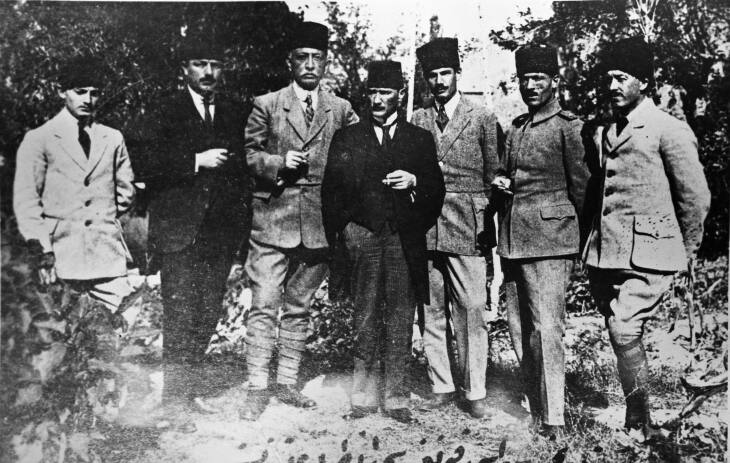
1919—1923
Atatürk and national sovereignty
A changing basis of leadership from official assignment to congress authority, the Representative Committee and the Assembly.
Explore →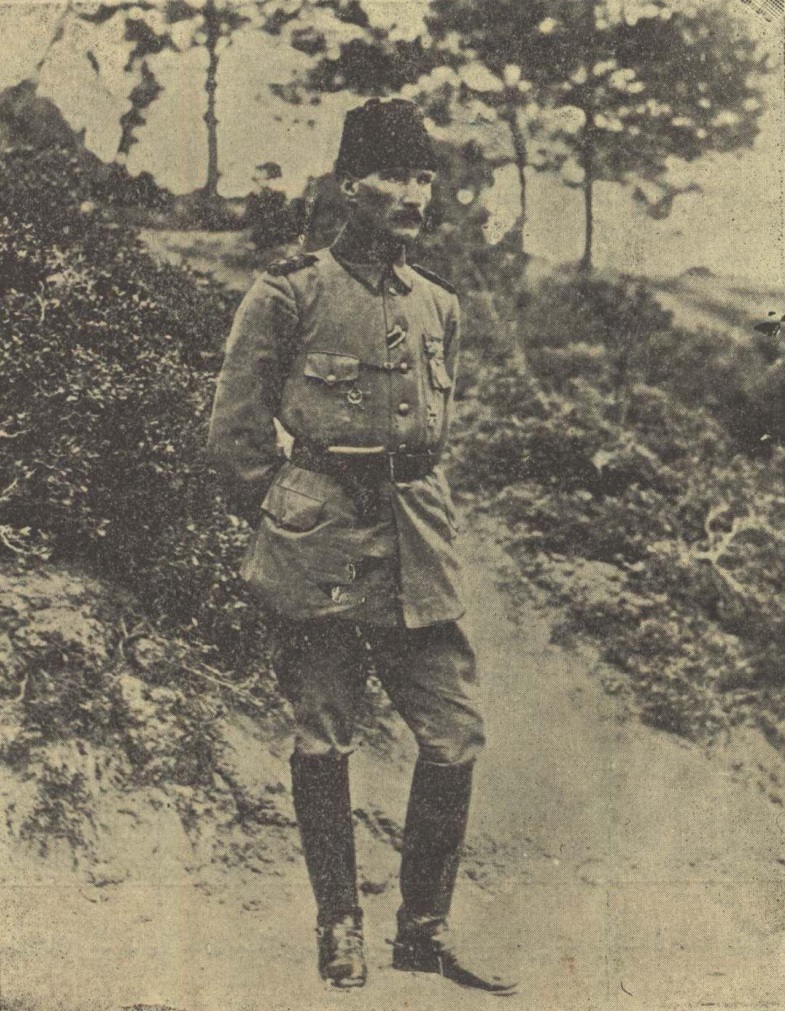
1881—1918
Atatürk’s formative years
From the layered world of Thessaloniki through military education and the empire’s final wars.
Explore → 1881—10 November 1938
Mustafa Kemal Atatürk
A life from military education and Gallipoli to the National Struggle and the institutions of the Republic.
Explore →Documents and sources23 sources
Official reference points used to verify the chronology and interpretive frame on this page.
- The Law on Unification of Education ↗Millî Eğitim Bakanlığı
Context of the education legislation of 3 March 1924.
- The 1924 Constitution ↗Anayasa Mahkemesi
Constitutional text and dated amendments.
- Chronology of women's political rights ↗TBMM
Parliamentary record of the 1930, 1933 and 1934 legal milestones.
- Atatürk's reforms ↗Atatürk Ansiklopedisi
Periodisation of legal, educational and political change.
- Alphabet reform ↗Millî Eğitim Bakanlığı
Context of the new Turkish alphabet and educational mobilisation.
- Diyanet · Başkanlığın yüzüncü yılında kuruluş düzenlemesi ↗ilmidergi.diyanet.gov.tr
- MEB · Kıyafette değişiklik: 1925 ile 1934 düzenlemelerinin ayrımı ↗www.meb.gov.tr
- ATAM · Tekke, zaviye ve türbelerin kapatılması ↗atam.gov.tr
- Konya Büyükşehir Belediyesi · Mevlevilik ve dergâhtan müzeye geçiş ↗www.konya.bel.tr
- Atatürk Ansiklopedisi · Takvim, saat ve ölçü sistemlerinin değiştirilmesi ↗ataturkansiklopedisi.gov.tr
- TBMM · 31 Aralık 1932 oturumu: Ölçüler Kanunu'nun 28. maddesinin değiştirilmesi, s.73–79 ↗www5.tbmm.gov.tr
- ATAM Dergisi · Hakan Bacanlı, Ölçü İnkılabının Tarihsel Süreci, 2022 ↗www.atamdergi.gov.tr
- TBMM · Medeni Kanun tasarısının gerekçesi: 1926 kabul ve yürürlük tarihleri ↗cdn.tbmm.gov.tr
- Atatürk Ansiklopedisi · Uluslararası sayıların kabulü, 1288 sayılı Kanun ↗ataturkansiklopedisi.gov.tr
- TBMM · Cumhuriyet kronolojisi: 1934 Soyadı Kanunu ve tarihli kayıtlar ↗cdn.tbmm.gov.tr
- ATAM · Soyadı Yasası ↗atam.gov.tr
- Atatürk Ansiklopedisi · Türk Kadınlar Birliği ve siyasî haklar için örgütlenme ↗ataturkansiklopedisi.gov.tr
- Atatürk Ansiklopedisi · Kadın temsiliyeti ve 1935 seçimleri ↗ataturkansiklopedisi.gov.tr
- İş Bankası · Kuruluş ve ilk yönetim ↗www.isbank.com.tr
- Yozgat Bozok Üniversitesi · İnkılap Tarihi II kamuya açık ders filmleri ↗yobutv.bozok.edu.tr
- MEB · Tarihî mevzuat çizelgesi: 677 ve 2525 sayılı kanunların yayım tarihleri ↗oygm.meb.gov.tr
- İstanbul Barosu · 1934 kisve ve unvan kanunlarının tarihleri ve kapsamı ↗istanbulbarosu.org.tr
- Atatürk Ansiklopedisi · Hatice Özgener'in 1936 ara seçiminde Meclise katılması ↗ataturkansiklopedisi.gov.tr