
← Back to History of the Republic
Başbakanlık Basın-Yayın Genel Müdürlüğü; fotoğrafçı bilinmiyor / Wikimedia Commons · Public domain · PD-Ottoman ↗ Atatürk library · II
Atatürk and national sovereignty
The National Struggle concerned not only military resistance but the legitimate institution in whose name decisions would be made. Mustafa Kemal’s leadership developed inside that institutional line.
1919—1923Samsun · the congresses · Ankara
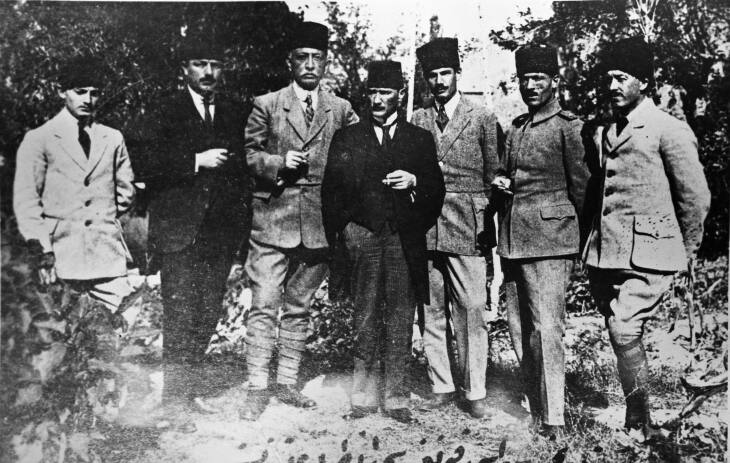
In Sivas: Muzaffer Kılıç, Rauf Orbay, Bekir Sami Kunduh, Mustafa Kemal, Ruşen Eşref Ünaydın, Cemil Cahit Toydemir and Cevat Abbas Gürer.
At a glance
- Samsun
- 19 May 1919
- Sivas Congress
- 4—11 September 1919
- Assembly
- 23 April 1920
- Republic
- 29 October 1923
Why sovereignty was a wartime question
The national struggle involved determining in whose name decisions would be made as well as resisting foreign military occupation. Raising forces, requesting resources and conducting external negotiations required an institution claiming authority to do so. Mustafa Kemal's leadership between 1919 and 1923 cannot therefore be understood only as a sequence of military achievements. Official inspectorate, congress chairmanship, the Representative Committee and Assembly presidency rested on different foundations of authority. Each stage carried a claim to represent a wider constituency. Following the transitions shows how sovereignty became connected to institutions capable of making decisions rather than remaining an abstract formula. Military objectives and the search for representation developed within the same political process.
↑ Back to dossier contentsFrom official powers to congress support
The appointment with which Mustafa Kemal travelled to Samsun provided access to communications and military commanders. Through Havza and Amasya those tools were used for a broader political organisation. As disagreement with the Istanbul government deepened, tension developed between the authority of the office and the programme being pursued. Resigning from the military marked a change in that foundation. Election as chair at Erzurum and Sivas gave leadership another basis in the representatives' decisions. This was more than the use of personal reputation. Congress decisions offered a framework through which different local organisations could justify common action. The congresses were not direct ballots of the entire population in a contemporary sense, but forms of representation constructed under the conditions of their time.
↑ Back to dossier contentsThe Representative Committee and continuity of decisions
A congress meets on particular days, but implementing its decisions must continue after the meeting ends. The Representative Committee addressed that need for continuity. Communications, relationships with local organisations and political discussions turned principles into everyday activity. Mustafa Kemal's leadership within this system involved keeping different priorities connected to one programme. A claim to representation does not work simply because it appears in a written resolution; it must be recognised across regions and become effective in practice. Understanding the route towards national sovereignty therefore requires attention to organisational relationships as well as texts. Moving to Ankara and then opening the Assembly were separate stages in passing from temporary congress arrangements towards a more continuous structure of government.
↑ Back to dossier contentsAssembly leadership and exceptional powers
The opening of the Assembly transferred the central place of decision to an elected body. Mustafa Kemal was its president, while deputies expressed different views about administration, resources and military strategy. The statutory grant of commander-in-chief powers in 1921 and debate over their duration show that even exceptional military requirements remained connected to the representative institution. This relationship was not always easy or free of tension. The need for rapid wartime decisions existed alongside a determination to preserve the Assembly's authority. Describing the period either as unrestricted personal command or as an environment of effortless agreement would be incomplete. One important feature of founding politics was its attempt to produce shared decisions and implementation through those tensions.
↑ Back to dossier contentsSeparate legal steps towards the Republic
The 1921 Constitution stated the principle of national sovereignty, and the sultanate was abolished on 1 November 1922. Ratification of Lausanne, designation of Ankara as capital and proclamation of the Republic followed through separate Assembly decisions in 1923. This sequence shows that the state's institutions did not all emerge in one night. Each decision addressed another question: the source of representation, dynastic authority, the legal framework for external relations, the seat of government and governmental form. Mustafa Kemal was a principal director of the transformation, but its continuing effect was connected to institutions and legal acts. Leadership and institutionalisation were complementary dimensions of the founding period; subsequent democratic developments require their own historical examination.
↑ Back to dossier contentsArchive note
Archive images for wider context


Cumhuriyet Atlas
Continue the story here
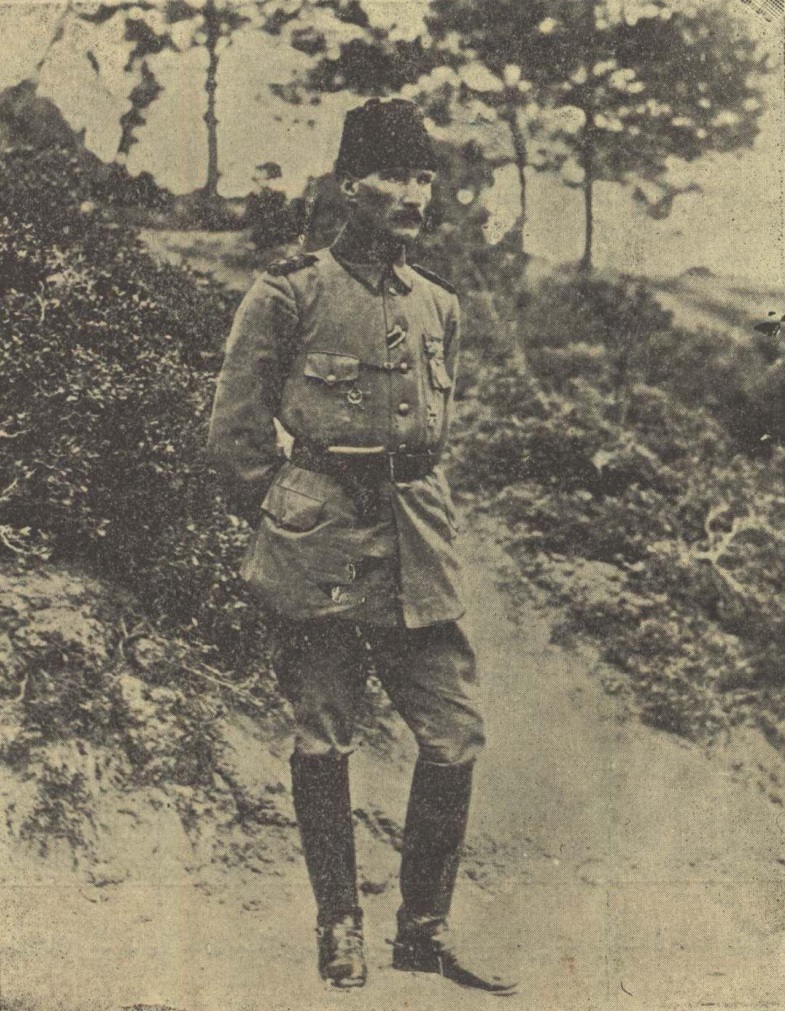
1881—1918
Atatürk’s formative years
From the layered world of Thessaloniki through military education and the empire’s final wars.
Explore →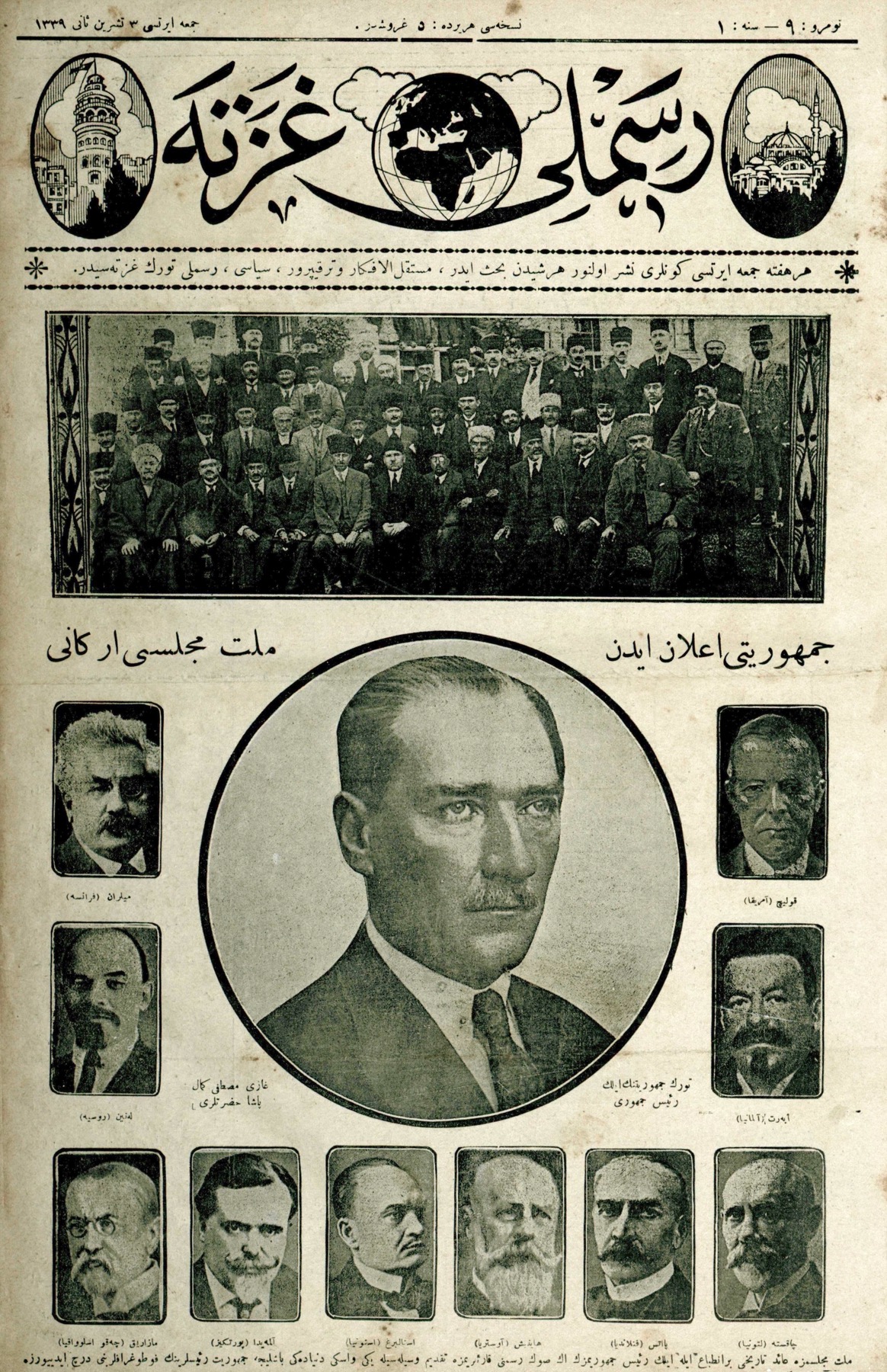
29 October 1923—10 November 1938
Reforms during Atatürk’s presidency
New institutions in law, education, script, citizenship and everyday life.
Explore → 23 April 1920
Opening of the Grand National Assembly
Decision-making and executive authority moved to an assembly composed of elected representatives.
Explore →Documents and sources4 sources
Official reference points used to verify the chronology and interpretive frame on this page.
- The Amasya Circular ↗ATATÜRK ANSİKLOPEDİSİ
Preparation on 21–22 June, collective support, representation and the congress call.
- The Sivas Congress ↗ATATÜRK ANSİKLOPEDİSİ
Unification of associations, the mandate debate and İrade-i Milliye.
- The 1921 Constitution ↗Anayasa Mahkemesi
Constitutional text establishing national sovereignty and assembly government.
- Chronology of 1923 ↗Kültür ve Turizm Bakanlığı
Separate dates for peace, the capital decision and proclamation.