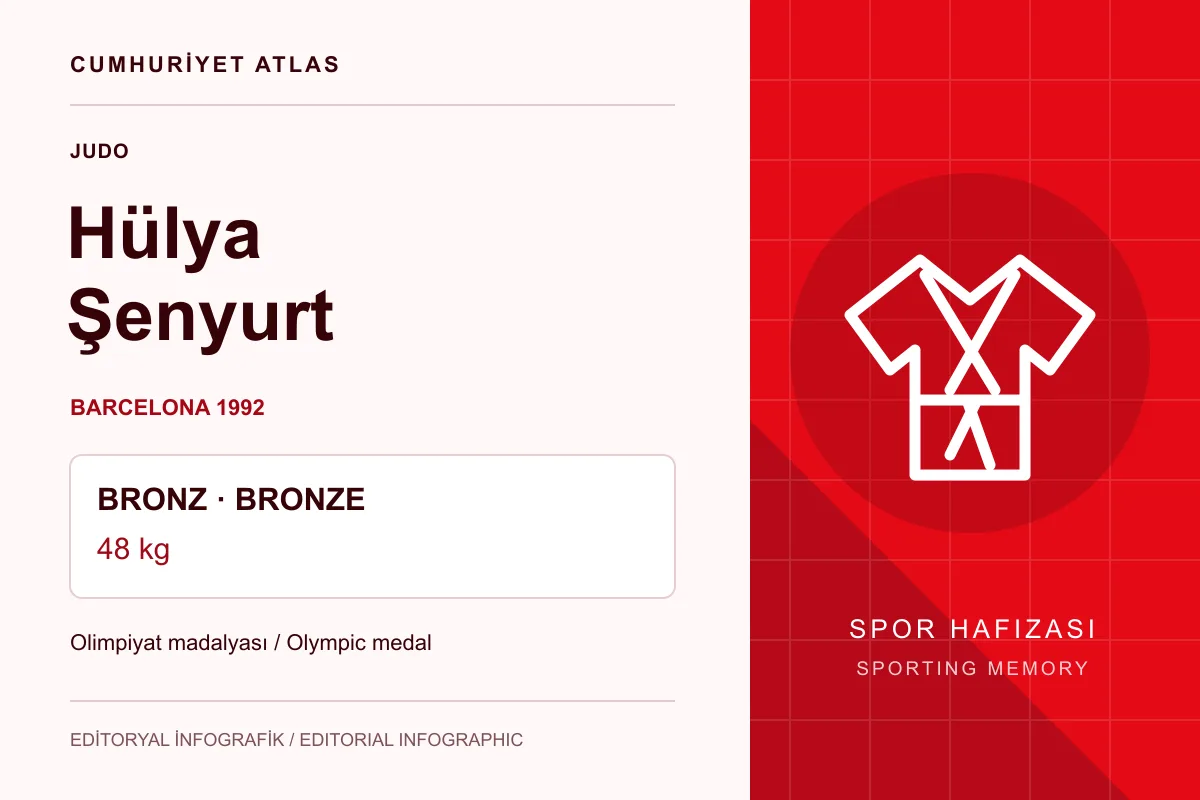
Hülya Şenyurt's bronze in women's 48kg judo at Barcelona 1992 marks a threshold in Türkiye's Olympic history: the country's first Olympic medal won by a woman. Its significance does not require it to be renamed gold or an Olympic championship. Born in Ordu in 1973, her story includes the learning that preceded the podium and the sharing of knowledge that followed it. This profile places a pioneering biography alongside judo's distinctive competitive logic.
- Discipline
- Judo
- Olympic result
- Barcelona 1992 · women's 48kg · bronze
- Historical milestone
- Türkiye's first female Olympic medallist
- IJF record name
- Hulya Gebes Senyurt · the same athlete
An opportunity encountered in Ordu
In the first-person account included in an İnönü University study, Şenyurt identifies a free judo course she heard about during middle school as her starting point. That detail reminds us that an elite career does not always begin with a professional plan prepared in childhood. A local course can make an unfamiliar discipline accessible to a student or family. Looking backwards from Olympic success should not turn the first opportunity into a predetermined scene of destiny.
Beginning judo involves more than learning a throw: safe behaviour on the mat, following rules and controlled work with another athlete matter too. This profile does not claim to possess a complete diary of her first lessons. The documented local beginning helps explain the environment in which she developed. Ordu is more informative as a place where she encountered sport and later worked with younger generations than as a birthplace label alone.
Back to contentsBarcelona 1992: the route to bronze
IJF records her third place in women's 48kg on 27 July 1992. The draw places her in pool C with France's Cécile Nowak, who advanced from that pool and later won gold. Şenyurt continued through the repechage. The concluding medal section shows her paired with Britain's Karen Briggs and records the bronze outcome. This makes the achievement visible as a tournament journey rather than only a final podium photograph.
Repechage does not mean every defeated athlete can return unconditionally. It is a second medal route defined by the competition's format. The 1992 draw has its own structure and should not automatically be treated as identical to a modern event. The example shows why an initial defeat in some elimination formats need not end every medal possibility. Identifying the route also makes the competitive challenge more understandable.
Back to contentsWhy the first women's medal matters
The Manisa Governorate's 2022 account identifies Şenyurt as Türkiye's first woman to win an Olympic medal. That does not mean the first woman to participate in the Olympics. Participation, reaching a final and earning a medal are different historical thresholds. Her distinctive place is at the medal threshold. Reading her alongside later athletes such as Buse Naz Çakıroğlu and Yasemin Adar shows women's visibility extending across separate sporting disciplines.
A pioneering medal should not be described as having removed every inequality overnight. A firmer interpretation is that it supplied a concrete example of women representing the country successfully at elite competition. An identifiable biography can matter to a young person considering judo at school or a local club. Role models do not replace facilities, coaching or sustainable opportunities to train, however. Sporting history is more complete when institutions remain part of the story.
Back to contentsWhat to notice in judo footage
Judo should not be read as an exchange of punches and kicks. Gripping, disrupting balance, throwing and groundwork form different layers of the action. Look before the moment someone falls: foot placement and the contest for a grip can explain how a movement became possible. No verified personal match archive is supplied here that would justify assigning Şenyurt's entire career to one signature technique.
IJF's official short film helps viewers learn this visual language, but it was made in 2018. Changes announced by the federation in late 2024 and implemented in 2025 show that the rule language evolves. Judging an older Olympic recording entirely through today's scoring concepts can be misleading. The film is clearly offered as an educational companion, not footage of Şenyurt or a complete explanation of the current rules.
Back to contentsBeyond the podium: teaching and widening access
TMOK's 2018 activity report names Şenyurt within educational support for coaches in Ordu. The official Manisa visit in 2022 was connected to a discussion of women, sport and Olympism. These dated records prevent the post-competition part of her biography from becoming an empty line. Sporting knowledge circulates through explanation, communication and work with young people as well as through winning a place on a podium.
Anadolu Agency's first-person interview in Ordu in 2025 describes her work developing new judokas. This is a documented coaching period, not a guarantee of course availability or a statement about a 2026 appointment. Winning a medal and guiding a student's first safe practice involve different responsibilities. Understanding Şenyurt's legacy more fully means placing the Barcelona bronze beside this later role of carrying a learning opportunity to others.
Back to contentsA timeline of life, work and history
- 1973
Birth in Ordu
In the university study's first-person account she gives her birth year as 1973 and her birthplace as Ordu.
- 1992
Olympic bronze in Barcelona
Won women's 48kg judo bronze on 27 July, becoming Türkiye's first female Olympic medallist.
- 2018
Coach-development record
TMOK's activity report includes her in educational support for coaches in Ordu.
- 2022
Women, sport and Olympism
The official Manisa visit and discussion document another occasion on which she shared her experience.
- 2025
Developing new judokas
A first-person interview in Ordu records her coaching work beyond the medal-winning years.
Watch and listen: a visual reading path
Use this selection alongside the analysis above. Supported YouTube publications can be watched on this page after you choose to load their player. The publisher’s rights and availability conditions apply; the player does not load or start automatically. Official publication links remain available as an alternative.
International Judo Federation
IJF's quick guide to judo
Neil Adams's 2018 educational film provides context for balance, throws and groundwork in judo footage. It is not a recording of Şenyurt at Barcelona; its 2018 scoring explanations should not be treated as either the 1992 or current 2026 rules.
Choosing to load the player connects to YouTube and shares technical data such as your IP address with Google. Autoplay is off. This choice does not change your cookie preferences. The publisher may restrict regional access or embedding; the official link below provides an alternative.
Questions and explanations
Was Şenyurt an Olympic champion?
She won bronze at Barcelona 1992, not the gold that makes someone an Olympic champion. Becoming Türkiye's first female Olympic medallist is a separate, important achievement. Its pioneering significance can be explained without changing the medal's colour.
Is Gebes Senyurt on IJF's site a different person?
No. That official record shows Hülya Şenyurt's 1992 48kg bronze. Name variations should not create duplicate biographies of the same athlete; the competition date and category strengthen the identity match.
Will the video show her Barcelona bout?
No. It is IJF's 2018 introduction to judo, provided to explain the discipline. It does not replace a verified personal match recording. Its period-specific rules should also not be applied unchanged to either the 1992 competition or current events.
Sources, image rights and research method
This is original explanatory and analytical writing informed by the sources below. AI assisted research and drafting. Awards for people, teams and institutions are distinguished; dated results are not current rankings. Media links do not claim a licence to republish a video here. Use the publisher’s correction process if a fact is wrong.
- IJF: Hülya Gebeş Şenyurt sporcu kaydı ve Barcelona 1992 sonucu ↗ Source check: 2026-10-03
- IJF: Barcelona 1992 kadınlar 48 kilo kura, repesaj ve madalya tablosu ↗ Source check: 2026-10-03
- Türkiye Judo Federasyonu: 1962–2017 uluslararası başarılar dökümü ↗ Source check: 2026-10-03
- İnönü Üniversitesi: olimpiyat madalyalı sporcular araştırmasında Şenyurt'un birinci el yaşam anlatısı ↗ Source check: 2026-10-03
- Manisa Valiliği: 7 Mart 2022 ziyareti ve kadınlar günü spor söyleşisi ↗ Source check: 2026-10-03
- TMOK 2018 Faaliyet Raporu: antrenörlerin gelişimi için Ordu eğitim desteği ↗ Source check: 2026-10-03
- Anadolu Ajansı: 4 Haziran 2025 Ordu'da antrenörlük üzerine Şenyurt'la birinci el görüşme ↗ Source check: 2026-10-03
- IJF: Quick Guide to Judo, 2018 öğretim filmi ↗ Source check: 2026-10-03
- IJF: 13 Aralık 2024 kural değişiklikleri ve 2025 uygulama süreci ↗ Source check: 2026-10-03