In goalball, a quiet crowd does not mean a quiet contest. Silence allows athletes to hear the bells inside the ball and the movement on court. Born on 1 April 1994, Sevda Altunoluk has helped transform the sport's visibility in Türkiye. She belonged to the women's national team's gold-medal squads at Rio 2016, Tokyo 2020 and Paris 2024. This biography examines not only her scoring but her continuity within teams that changed across three championship cycles.
- Sport
- Women's goalball
- Paralympic golds
- Rio 2016 · Tokyo 2020 · Paris 2024
- Goals in the Tokyo final
- 9 · 3 September 2021
From school to international competition
In her IPC interview, Altunoluk describes taking up goalball in middle school and competing for Türkiye at the European Championships by the age of 16. The interview also discusses balancing sport with her studies and the support she gained over time. This is a longer development story than the idea of a fully formed star appearing suddenly in 2016.
Early international experience involves more than developing a powerful throw. Communicating with teammates, recovering position and recognising the rhythm of a match are also learned. The connection with education invites a useful reading of her career: sporting progress is not separate from everyday life but requires organisation and sustained work within it.
Back to contentsRio: a first title and wider recognition
Türkiye beat China 4–1 in the Rio 2016 final. Altunoluk scored three of those goals and 36 across the tournament. Her IPC biography also records her role as top scorer at the team's first European title in Kaunas in 2015. Rio brought the women's national team its first Paralympic championship.
Goals make an attacking contribution visible, but they do not describe an entire victory. If the defence cannot stop the ball and keep play moving, a star's next throw never arrives. Reading individual production alongside collective performance therefore offers a fuller appreciation of both Altunoluk and her teammates.
Back to contentsTokyo: nine goals, another team championship
The Tokyo 2020 final was played on 3 September 2021. Türkiye defeated the United States 9–2; Altunoluk scored all nine goals and finished the tournament as top scorer with 46. The official video here shows that actual final. Although the competition retained the name Tokyo 2020, its events took place in 2021.
One athlete scoring every goal does not turn the contest into a one-person sport. Winning the ball back, moving from defence to attack and creating room for the thrower depend on coordinated decisions. When watching Altunoluk, also watch her teammates' body positioning. The score becomes easier to understand when the defensive structure is visible.
Back to contentsParis: continuity across changing squads
On 5 September 2024 at South Paris Arena 6, Türkiye beat Israel 8–3 in the final, with Altunoluk scoring four times. The IPC report identifies her as the only player included in all three gold-medal squads and the first athlete to win three women's goalball Paralympic golds. This is a dated, sport-specific distinction, not a claim about every event in Paralympic history.
The final scores tell three separate stories: 4–1 in Rio, 9–2 in Tokyo and 8–3 in Paris. Repeating a title while the roster changes highlights the importance of rebuilding a working team culture at international level. Recognising one player's continuity need not remove the contributions of the other athletes who won alongside her.
Back to contentsUnderstanding goalball: eyeshades, sound and a wide goal
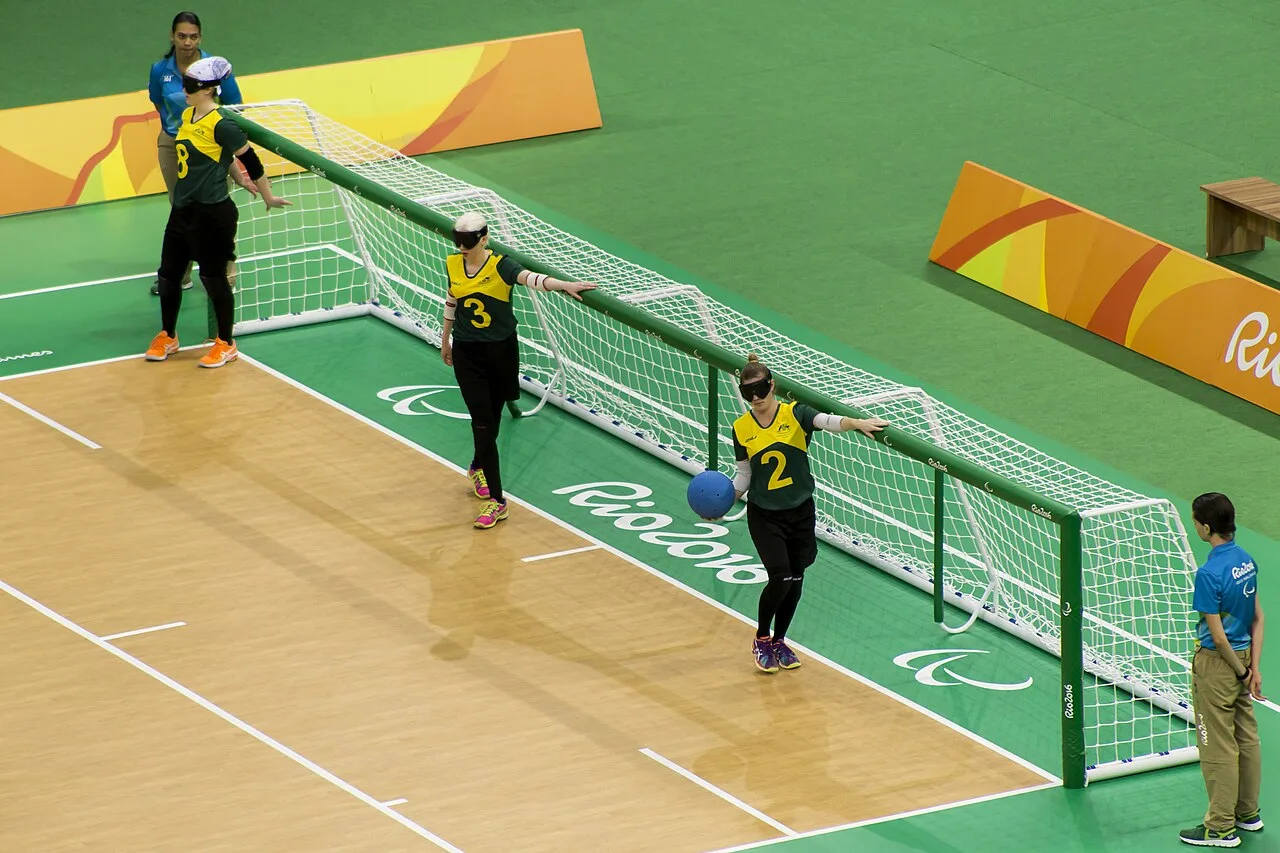
Goalball was developed for athletes with vision impairment; it is not an adaptation of an Olympic equivalent. Each team has three players on court. The nine-metre goal spans its entire width, and regulation play consists of two 12-minute halves. Athletes from vision classes B1, B2 and B3 can play together, with opaque eyeshades equalising vision during competition.
Hearing the ball's bells and feeling raised court lines are technical skills, not background details. Direction, bounce and arrival time at a gap in the defence matter as well as throwing speed. Spectators remain quiet during play and can support the team during breaks. Removing the eyeshades or copying professional throws without appropriate instruction is not a suitable way to begin learning the sport.
Back to contentsWork beyond the medals and a reading route
In her 2024 preparation interview, Altunoluk describes morning goalball sessions, evening physical preparation and analysis of weaknesses with coaches. That account concerns her programme at that time; it is not a universal prescription for training load or diet. World silver in 2018 and the team's 2022 world title also demonstrate that the path was not an uninterrupted line of victories.
The Para Sport Guide is the next stop for comparing classification across different sports. The women's volleyball dossier offers a separate team-sport comparison: how individual specialisms fit a shared structure. These pages should not be used to explain goalball through volleyball rules. Read them together to explore the relationship between a visible star and collective labour.
Back to contentsA timeline of life, work and history
- 1994
Birth
The official Rio results book records 1 April 1994.
- 2015
European title
Top scorer during Türkiye's first European championship in Kaunas.
- 2016
Rio gold
Scored three times in the 4–1 final victory over China.
- 2018
World final
World silver in Malmö, with 46 goals across the tournament.
- 2021
Tokyo gold
Scored every goal in the 9–2 final victory over the USA.
- 2022
World title
Member of Türkiye's world-championship-winning squad.
- 2024
Third Paralympic gold
Four goals in the 8–3 Paris final and continuity across all three gold squads.
Watch and listen: a visual reading path
Use this selection alongside the analysis above. Supported YouTube publications can be watched on this page after you choose to load their player. The publisher’s rights and availability conditions apply; the player does not load or start automatically. Official publication links remain available as an alternative.
Paralympic Games
Türkiye–USA: Tokyo 2020 women's goalball final
The IPC's actual 2021 final footage: watch defensive positioning and recovery after the ball as well as Altunoluk's attack. This is not the Paris 2024 final.
Choosing to load the player connects to YouTube and shares technical data such as your IP address with Google. Autoplay is off. This choice does not change your cookie preferences. The publisher may restrict regional access or embedding; the official link below provides an alternative.
Questions and explanations
Is goalball blind football?
No. It is a distinct sport played with a bell-containing ball thrown by hand towards goals spanning the court's width. It is not a football or volleyball category.
Why does every player wear eyeshades?
Athletes from B1–B3 can have differing levels of vision impairment and compete together. Opaque eyeshades equalise vision on court; they do not mean every athlete has the same personal vision.
Are Altunoluk's three golds individual medals?
She is a member of three championship-winning national teams. Top-scorer honours are individual statistics; the Paralympic gold is the outcome of the team competition.
Sources, image rights and research method
This is original explanatory and analytical writing informed by the sources below. AI assisted research and drafting. Awards for people, teams and institutions are distinguished; dated results are not current rankings. Media links do not claim a licence to republish a video here. Use the publisher’s correction process if a fact is wrong.
- IBSA: Rio 2016 resmî golbol sonuç kitabı ve doğum tarihi ↗ Source check: 2026-10-03
- IPC: Sevda Altunoluk biyografisi, Rio ve 2018 dünya şampiyonası ↗ Source check: 2026-10-03
- IBSA/IPC: Tokyo 2020 finali ve gol kraliçeliği ↗ Source check: 2026-10-03
- IPC: Paris 2024 üçüncü altın madalya ↗ Source check: 2026-10-03
- IPC: 18 Nisan 2024 sporcu söyleşisi ↗ Source check: 2026-10-03
- IPC: Paris 2024 golbol tanıtımı ↗ Source check: 2026-10-03
- IPC: golbolcuların oyun ve yön bulma açıklamaları ↗ Source check: 2026-10-03
- IPC: golbol sınıflandırması ve göz maskeleri ↗ Source check: 2026-10-03