Leyla Gencer’s career connects the musical institutions of Republican Türkiye with international opera houses through an individual artistic life. Calling her only a national success story, however, can obscure repertoire choices and the labour of interpretation. This guide explains terminology and offers a traceable route through stage history, recordings and archives. It does not repeat a disputed birth date as a settled fact.
- Field
- Soprano / opera
- Early roles
- Santuzza and Madame Lidoine
- Suggested repertoire route
- Anna Bolena → Roberto Devereux → Maria Stuarda
From Ankara to La Scala: institutions and roles
Gencer studied singing in Istanbul and appeared as Santuzza in Mascagni’s Cavalleria Rusticana at Ankara State Opera in 1950. Her La Scala debut in Milan came in 1957 as Madame Lidoine in the world premiere of Poulenc’s Dialogues des Carmélites. Setting these works beside one another is a reminder not to confine the career to a single period or stylistic label.
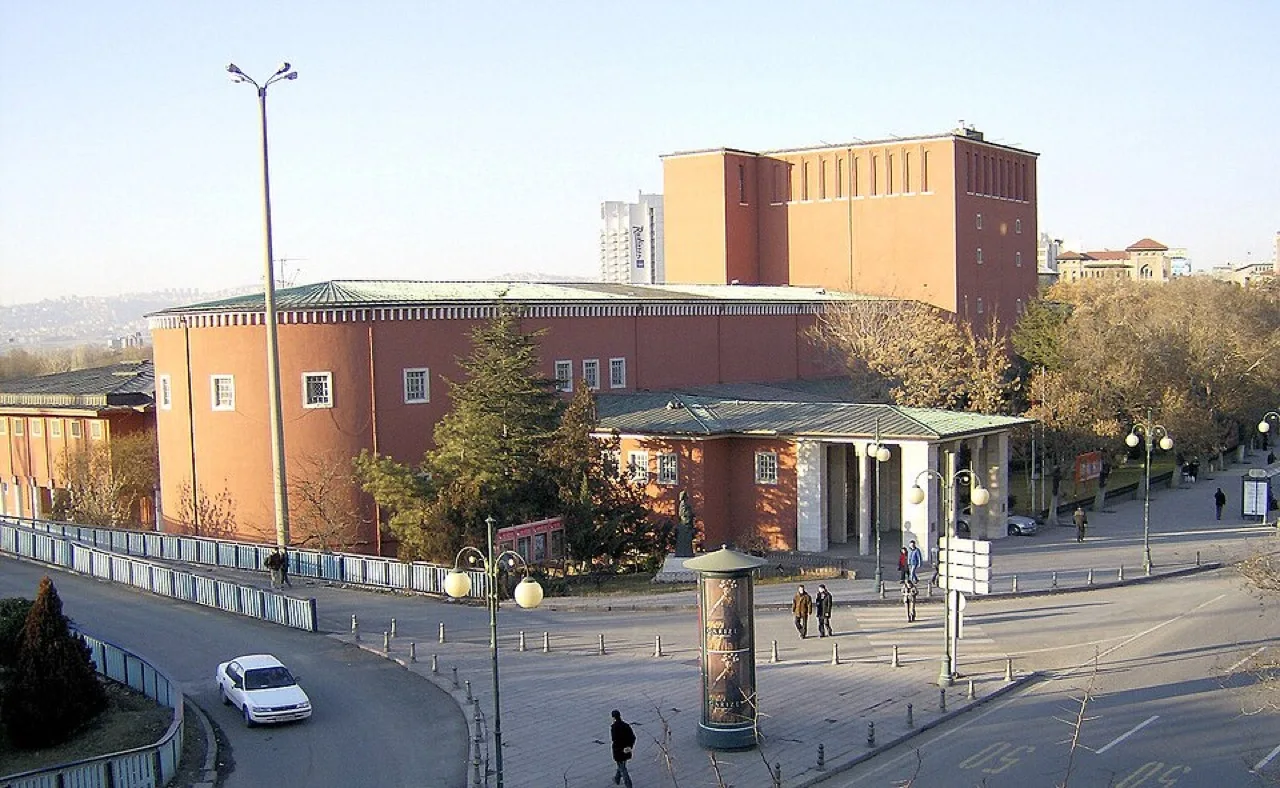
In an opera biography, the character’s name matters. Composer, work and role are different layers of information. Hearing the same singer in another opera changes not only the melody but the dramatic purpose of the voice. The photograph here shows Ankara’s opera building in 2007 as institutional context: it is neither a portrait of Gencer nor a document of her 1950 performance.
Back to contentsBel canto is more than a beautiful sound
Here, bel canto is a way of considering continuity of line, breath-shaped phrasing, clarity in ornamentation and dramatic meaning together. A change of vocal colour within a long phrase can communicate as much as a high note. Instead of waiting only for a difficult climax, follow the harmonic and dramatic situation that prepares it. This brings musical technique back into the unfolding scene.
The La Scala Museum highlights Gencer’s part in reviving early nineteenth-century Italian opera. The point is not that she composed those works, but that interpretation and repertoire selection helped make them audible again. The expression Donizetti Renaissance describes renewed attention to operas that had circulated less widely, rather than a new composer or a newly created musical style.
Back to contentsA listening route through three Tudor operas
Borusan Sanat’s 2018 Donizetti Queens release assembles Anna Bolena, Roberto Devereux and Maria Stuarda. Its documentation identifies the performances as Milan in 1958, Naples in 1964 and Florence in 1967 respectively. Keeping performance dates distinct from the album’s publication date prevents a modern issue of historical material from being mistaken for a new stage appearance.
Start with a brief synopsis, then choose a complete scene in which the protagonist faces a decision. Ask how the same singer creates distance, vulnerability or authority in different queen roles. These are interpretive questions, not a claim that an operatic character reproduces the historical person accurately. Hearing a scene rather than only a standalone aria also reveals other characters’ replies and the changing weight of the orchestra.
Back to contentsListening fairly to archival recordings
Audience sound, tape noise and limited frequency range may be present in an older live recording. They should not automatically be attributed to the singer’s technique. Microphone position, room acoustics and later transfers affect what reaches us. Note orchestra, conductor, venue and edition when comparing performances; reduced sound quality does not establish reduced artistic quality.
An official documentary and authorized recording catalogues can be complementary entry points. A film constructs a narrative from testimony and archival images; it is not automatically a neutral or exhaustive account of a life. This dossier does not copy complete performances without permission, and the availability of a watch link is not evidence that every sound and image within it may be reused freely.
Back to contentsTeaching and remembrance beyond performance
Gencer left the opera stage in 1985, while the education of younger artists formed another part of her career. Artistic direction of La Scala’s Academy for Opera Artists should not be confused with leadership of the entire theatre. Naming the institution and the responsibility accurately allows the educational contribution to be understood on its own terms.
The 2019 documentary produced by İKSV, directed by Selçuk Metin and scripted by Zeynep Oral is publicly available on the foundation’s official channel with English subtitles. International viewers can therefore encounter an archive-based narrative rather than only a list of honours. Publications and commemorative work following Gencer’s death in 2008 also provide concrete examples of how artistic memory is maintained and reinterpreted by institutions.
Back to contentsA timeline of life, work and history
- 1950
Santuzza in Ankara
The Cavalleria Rusticana role marks a dated point in Gencer’s operatic beginnings.
- 1957
Madame Lidoine in Milan
Her La Scala debut took place in the world premiere of Poulenc’s Dialogues des Carmélites.
- 1985
Farewell to the opera stage
This stage-career milestone should be distinguished from later educational and archival work.
- 2008
Death and legacy
Gencer died in Milan on 10 May; recordings, archival work and her teaching continue to frame her legacy.
Watch and listen: a visual reading path
Use this selection alongside the analysis above. Supported YouTube publications can be watched on this page after you choose to load their player. The publisher’s rights and availability conditions apply; the player does not load or start automatically. Official publication links remain available as an alternative.
İstanbul Kültür Sanat Vakfı (İKSV)
Leyla Gencer: La Diva Turca — documentary with English subtitles
An introduction through the official archive and testimony: a biographical film, not a substitute for a complete opera recording.
Choosing to load the player connects to YouTube and shares technical data such as your IP address with Google. Autoplay is off. This choice does not change your cookie preferences. The publisher may restrict regional access or embedding; the official link below provides an alternative.
Questions and explanations
Where should an opera beginner start?
Read a short synopsis and listen to a complete scene. Follow what the character wants and when the orchestra changes. That is more illuminating than listening only for the highest note.
Is Donizetti Queens a newly performed concert?
The 2018 release brings together historical live recordings. Its publication date is separate from the performances of 1958, 1964 and 1967; the album title does not identify a new stage production.
Why show an opera building rather than her portrait?
A photograph with verified reuse rights was selected for institutional context. The caption makes clear that it is not a portrait of the singer or an image of a historical performance.
Sources, image rights and research method
This is original explanatory and analytical writing informed by the sources below. AI assisted research and drafting. Awards for people, teams and institutions are distinguished; dated results are not current rankings. Media links do not claim a licence to republish a video here. Use the publisher’s correction process if a fact is wrong.
- İKSV — Leyla Gencer’in yaşamı ↗ Source check: 2026-10-03
- La Scala Müzesi — Leyla Gencer sergisi ve repertuvarı ↗ Source check: 2026-10-03
- Borusan Sanat — Donizetti Queens kayıtları ↗ Source check: 2026-10-03
- İKSV — resmî belgesel yapım ve yayın bilgisi ↗ Source check: 2026-10-03