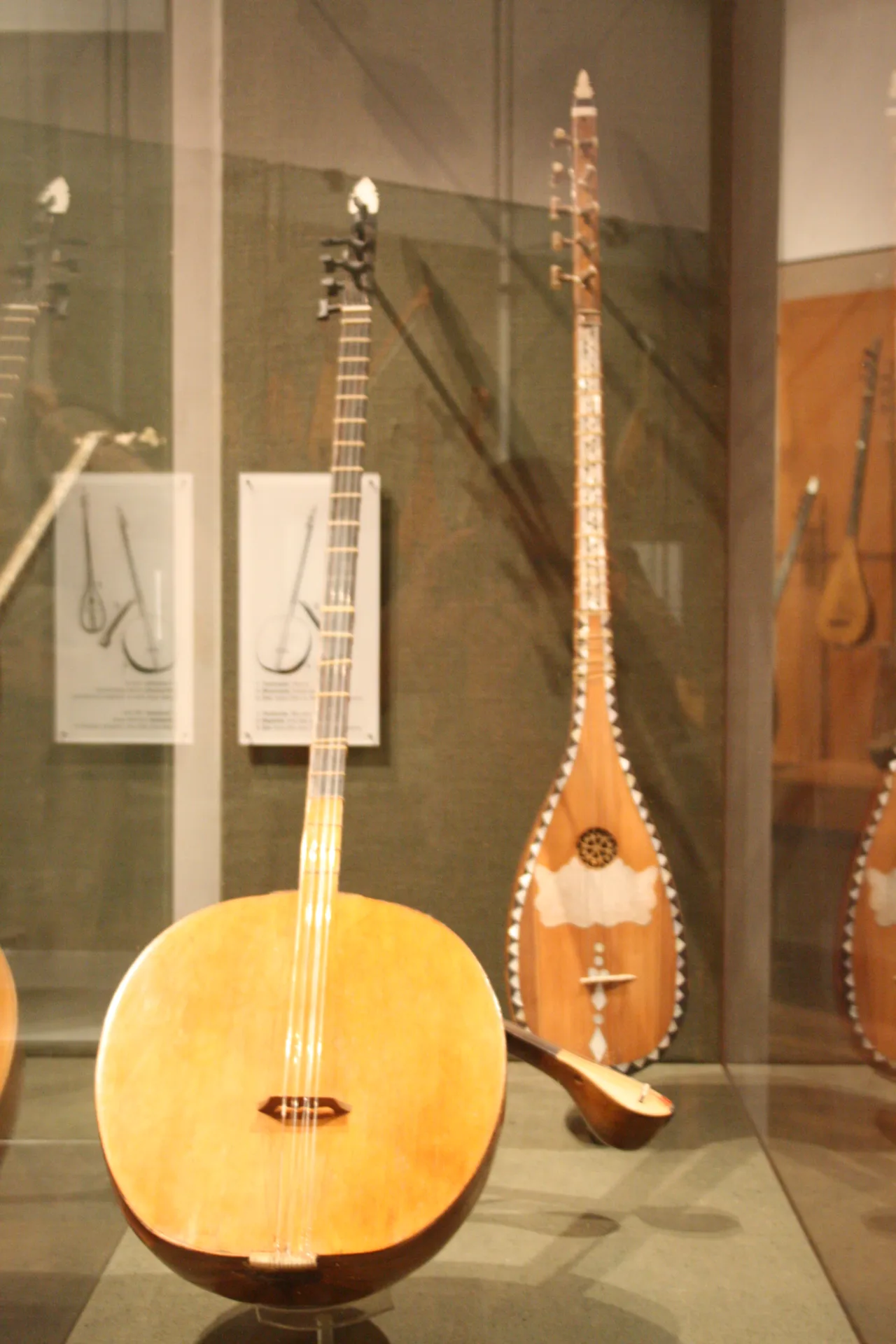
Tanburi Cemil Bey offers a route into Ottoman urban music through the sound of an actual performer rather than through scores alone. His name is associated with the tanbur, but his work with kemençe, lavta and bowed tanbur deserves attention too. This dossier connects biography with a practical way of hearing improvisation, while acknowledging conflicting birth records. Surface noise on an old disc is evidence of its recording medium, not evidence of poor musicianship. Archival listening requires a different kind of patience from listening to a contemporary studio release.
- Principal focus
- Tanbur, kemençe and makam improvisation
- Further reading
- Rehber-i Mûsikî
- Listening comparison
- Ferahfeza taksim and saz semaisi
Why the dates remain qualified
The TDV reference article compares birth dates in 1871, 1872 and 1873. Family testimony and official registration do not agree. We therefore use the early 1870s rather than presenting one birthday as settled. Accounts also differ about the day of his death in 1916. Such distinctions are useful rather than inconvenient: they reveal how a biography is assembled. A commemoration date and a securely documented historical date need not carry the same evidential weight.
Back to contentsAn instrumental world beyond the tanbur
Cemil Bey's reputation on tanbur and kemençe brings different means of sound production into a shared musical imagination. With a plucked instrument, listen for the resonance after the attack; with a bowed one, follow a line that can continue without the same decay. Hearing a makam on both makes clear that an instrument shapes phrase length as well as colour. Instead of immediately trying to imitate speed, beginners can follow where a short phrase comes to rest.
Back to contentsTaksim is not a random sequence of notes
A taksim is an improvisation exploring the identity and possibilities of a makam. Treating makam merely as a scale misses characteristic routes of ascent, return, resting and final resolution. In the Ferahfeza example, follow the journey between the opening sound and the final point of arrival. You do not need a vocabulary of Western harmony to attempt this. Hearing ornaments as part of that journey, rather than as isolated displays, reveals the relationship between virtuosity and expression.
Back to contentsA route between compositions and recordings
Listen to the Şedd-i Araban and Ferahfeza saz semais after a free taksim to hear a different relationship to time. Compare recurring sections in the composed form with the more flexible movement of an improvisation. Kalan Music's collected edition is a useful archival gateway, but a digital release date is not the recording date of the historical performance. Keep title, instrument, original source and reissue information separate, especially when the same recording circulates online under several different labels.
Back to contentsA legacy larger than a solitary genius
Cemil Bey's influence continues through performers studying his manner and through recordings that can be heard repeatedly. His Rehber-i Mûsikî also provides a route into the relationship between theory and performance. The photograph on this page shows an Ottoman tanbur among instruments in an Athens museum, not an instrument claimed to have belonged to him. Images need source criticism too. Comparing makam examples with a teacher can turn an old recording from nostalgic background sound into a sustained musical investigation.
Back to contentsA timeline of life, work and history
- Early 1870s
Birth in Istanbul
Sources differ on the precise year and day; an approximate period is used here.
- 1892
Employment alongside music
His Foreign Ministry employment belongs to the working life that accompanied his musical activity.
- 1900s
Recorded testimony
Disc recordings enabled later generations to hear aspects of his improvisational manner directly.
- 1916
End of his life
The year is established; conflicting accounts of the exact day should be treated separately.
Watch and listen: a visual reading path
Use this selection alongside the analysis above. Supported YouTube publications can be watched on this page after you choose to load their player. The publisher’s rights and availability conditions apply; the player does not load or start automatically. Official publication links remain available as an alternative.
Kalan Müzik
Ferahfeza Taksim — Kalan Music collected recordings
A historical performance for following a makam's development; 2016 identifies the reissue, not the original recording session.
Choosing to load the player connects to YouTube and shares technical data such as your IP address with Google. Autoplay is off. This choice does not change your cookie preferences. The publisher may restrict regional access or embedding; the official link below provides an alternative.
Questions and explanations
Why is there no precise birthday?
Family and registration sources give different dates. Following the comparison in the TDV entry, we make that uncertainty visible instead of converting an unverified day into a definite fact.
Is a taksim the same as a composition?
No. A taksim is improvised within a makam framework. A composed form such as a saz semaisi has an established sectional and recurring structure, so the listener approaches its unfolding differently.
Should surface noise be removed?
Restoration can improve access, but aggressive processing can also alter instrumental colour. When comparing transfers of the same recording, assess the clarity of the musical phrase as well as the amount of remaining noise.
Sources, image rights and research method
This is original explanatory and analytical writing informed by the sources below. AI assisted research and drafting. Awards for people, teams and institutions are distinguished; dated results are not current rankings. Media links do not claim a licence to republish a video here. Use the publisher’s correction process if a fact is wrong.
- TDV İslâm Ansiklopedisi — Cemil Bey, Tanbûrî ↗ Source check: 2026-10-03
- Uluslararası Tanbûrî Cemil Bey Sempozyumu bildirileri ↗ Source check: 2026-10-03