
What was announced today?
On 5 October 2026, the Nobel Assembly at Karolinska Institutet announced that Karl Deisseroth, Peter Hegemann and Georg Nagel jointly receive the Physiology or Medicine award. Its citation is “for their discoveries concerning light-gated ion channels and optogenetics”. This is news of an award decision, not a technique first discovered today.
The official announcement lists Stanford for Deisseroth, Humboldt University of Berlin for Hegemann and the University of Würzburg for Nagel. Same-day statements from Stanford and Würzburg corroborate the awards to their researchers.
Back to section list ↑What does the light actually change?
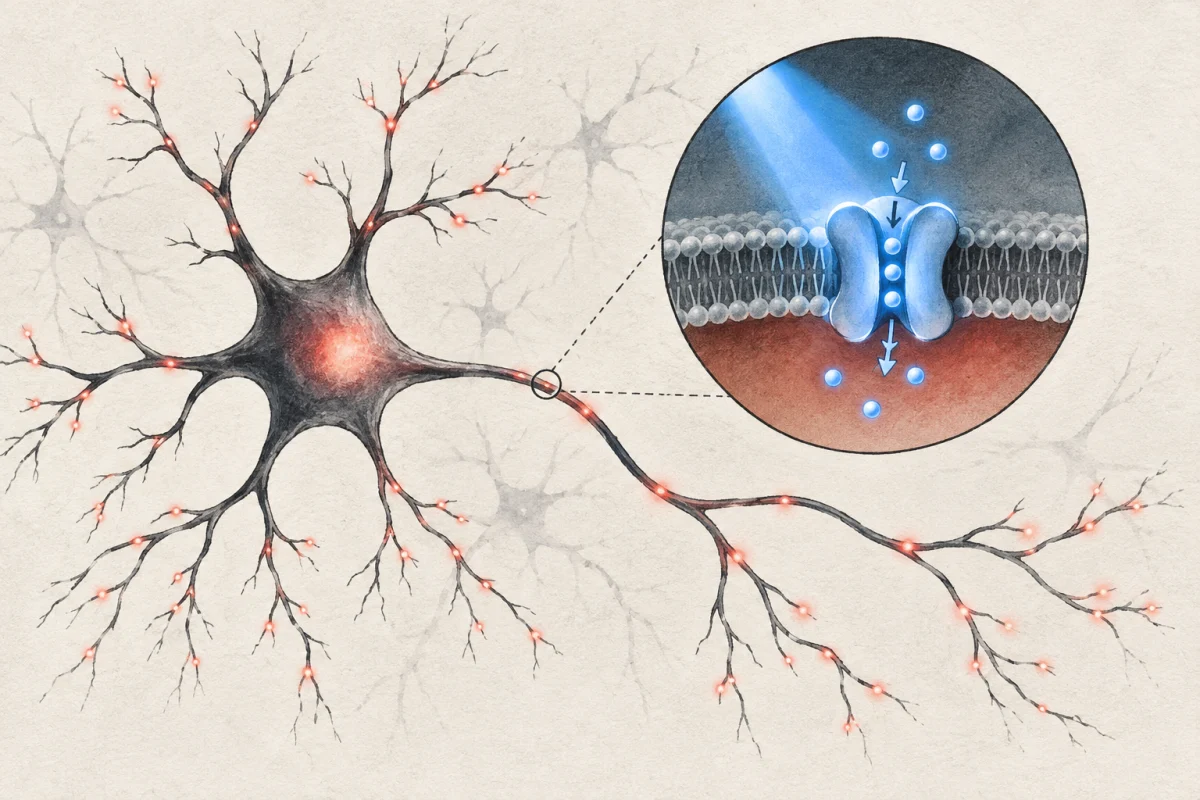
The starting question concerned how the single-celled alga Chlamydomonas detects light. When activated, proteins called channelrhodopsins allow ions across a cell membrane. Ions carry electrical charge, so their movement can change a cell's electrical state. This property became a tool for investigating cell activity.
In optogenetics, genetic tools make selected cells produce light-sensitive proteins. Researchers then deliver controlled illumination and measure the response. That is not equivalent to shining external light on an unmodified neuron or a person's head and obtaining the same result. KTH's account likewise frames the method around research into what cells do in a living brain.
Back to section list ↑The discovery chain: 2002, 2003, 2005 and 2007
The Nobel popular background's bibliography places channelrhodopsin-1 work in 2002 and channelrhodopsin-2 work in 2003. These steps established properties of the light-sensitive channels. Optical control of activity in cultured neurons was demonstrated in 2005: a separate stage from experiments in a living animal.
Research in living mice in 2007 combined light delivery to genetically selected cells with measurements of behaviour-related responses. The scientific background credits teams and other research groups along this path. An award to three people should not be read as a claim that only those three carried out all the experiments.
Back to section list ↑Watching a signal versus testing its contribution
A cell population being active during a response does not, by itself, establish that it produces that response. Optogenetic tools let researchers make timed changes in particular cells and examine whether the response changes. The question can therefore move from association towards an experimental test of causal contribution, within the limits of the experiment.
Activation and suppression are not the same tool. Early channelrhodopsin tools drove neuronal activity; selective suppression needed additional tools based on different proteins. The scientific background's distinction matters when interpreting an oversimplified description of the method as a single on-off switch.
Back to section list ↑How to read this report's limits
This report explains an award decision, a conceptual method and research history. It does not assess treatment effectiveness, safety, availability or regulatory status. A Nobel award does not automatically establish any of those things.
We read the decision and institutional announcements, comparing relevant scientific-background sections with the popular background's bibliography. We did not separately review the original experiment papers for this report. The claim-to-source ledger below shows which records support each statement. Like the text, the image uses AI assistance; it is not documentary evidence of an experiment.
Back to section list ↑