
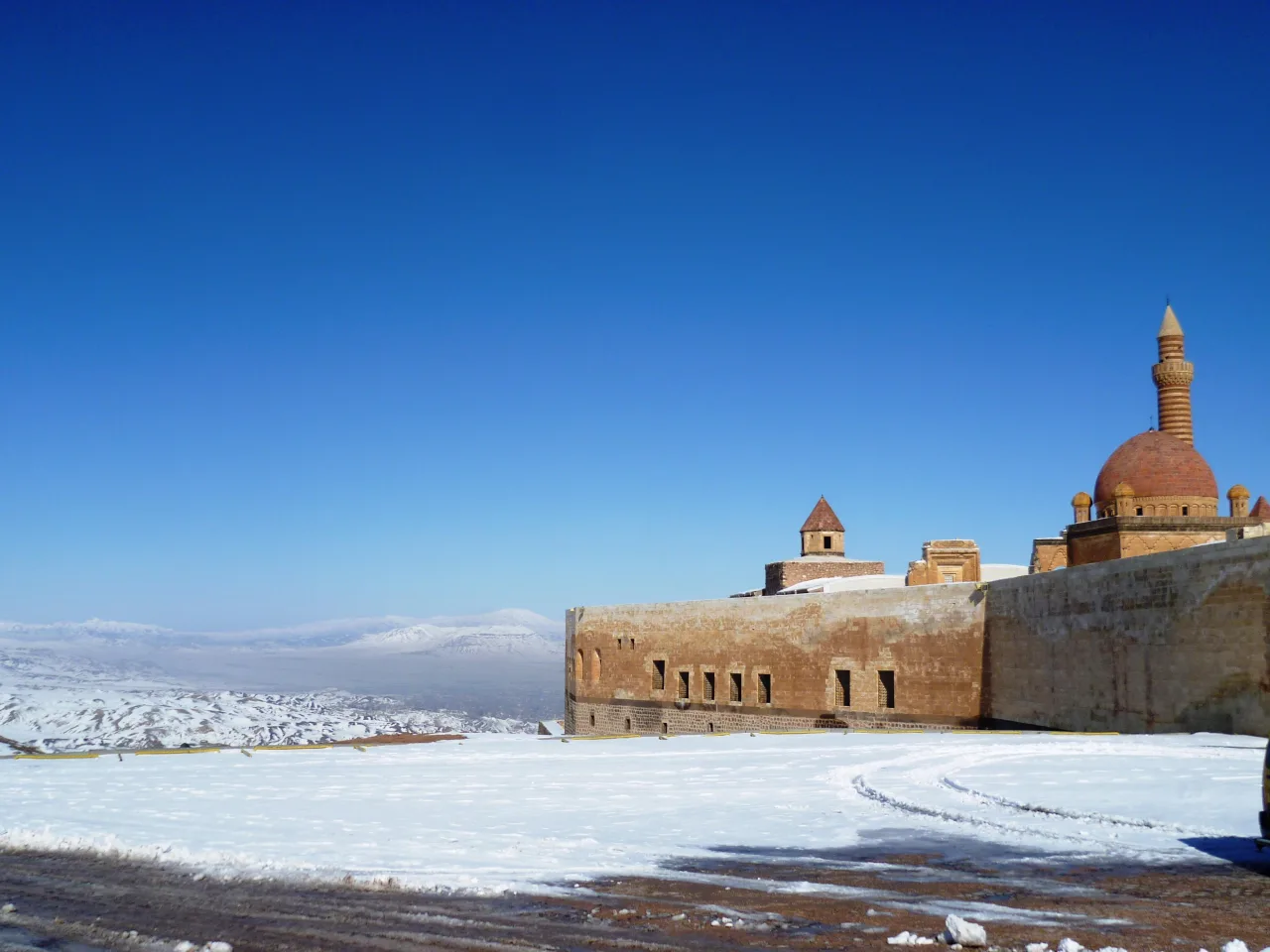
A visit to Ağrı province extends beyond its administrative centre. Around Doğubayazıt, İshak Paşa Palace rewards close observation, while Mount Ararat asks you to understand a much larger landscape.
An AI-assisted synthesis of the sources below, with Atlas planning suggestions. This is not a first-hand visit report. Admission, transport and access conditions must be checked with operators before travel.
In this guide
Read the palace through its plan
Construction began in the late seventeenth century and was completed in 1784. Two courtyards connect administrative, residential and service spaces. Beyond the decorated gateways, follow how rooms relate to one another and how the complex separates public business from private life. This makes the palace more intelligible than a sequence of decorative details.
More than a summit
The national park extends across both Ağrı and Iğdır provinces. Volcanic terrain, glaciers and altitude distinguish this environment from an ordinary walking route. Accounts associated with Noah belong to religious and cultural tradition; that is different from claiming that a ship has been archaeologically established here.
Separate sightseeing from mountaineering
A palace visit and views from permitted locations are not the same undertaking as a summit expedition. Climbing requires specialist assessment of current permits, guiding and weather. Calculate transport around Doğubayazıt, and never assume that a distant mountain view implies easy access to the mountain itself.
Treat Ağrı city and Doğubayazıt as different bases
The province, the mountain and the administrative city do not describe an identical journey. From Ağrı city, Diyadin, Taşlıçay and Hamur open different directions. Doğubayazıt is a separate focus for the palace, the older settlement and mountain views. Choosing accommodation only for proximity to the airport can leave you repeatedly travelling to the places you actually came to see. Plot the stops with their district names before deciding where to spend the night. Rather than compressing the entire provincial list into a city tour, choose a cultural corridor and a landscape corridor.
Around Doğubayazıt, İshak Paşa Palace, the old Bayazıt settlement and the Ahmed-i Hani visiting area offer different perspectives. The palace introduces administration and domestic life; the castle surroundings explain defensive geography; the commemorative and religious site opens literary and spiritual memory. Read them through these different functions rather than as a sequence of interchangeable photographs. Respect the privacy of people using active places of worship or remembrance.
Power, daily life and craftsmanship inside the palace
The palace courtyards are not simply a pleasing arrangement: their thresholds organised the movement of people. Administrative sections, private accommodation and service spaces formed a centre of regional authority together. A kitchen, bath, mosque and tomb within the complex show why it was more than a residence. Comparing the ornamented gateways with quieter functional areas helps reveal where display was concentrated. Instead of assigning an invented purpose to every room, consider the explanatory labels alongside the visible plan.
Different architectural traditions are often discussed in relation to the palace. These should not become rigid ethnic labels attached to each surface. Worked stone, arches and courtyard connections offer concrete things to observe. Protective measures and repairs visible today belong to the building's later history as well. The date of a photograph, the period of construction and present visiting arrangements are different kinds of information; a historic exterior photograph cannot guarantee that every interior section is accessible now.
Diyadin: a canyon, thermal water and rock-cut spaces
The Murat River runs through Diyadin Canyon. Looking across the landscape, approaching the water and following a lengthy trail are different activities. Do not try to reproduce a promotional photograph by stepping onto an exposed or fragile edge. If walking is part of the plan, establish the available route, conditions and return point through local information. Nearby thermal areas offer another kind of visit. Recreational use of hot water does not amount to an evidence-based recommendation to treat a particular illness.
The rock-cut spaces of Meya near Günbuldu add a historical layer to the Diyadin corridor. Presenting them as a completely preserved town from one single period would oversimplify different functions and later uses. Consider a separate day for Diyadin rather than joining numerous rural stops to an already full palace day. Near villages, discuss parking and photography with consideration for the people who live there. A rural destination is not a visitor's set, and an attractive rock opening is not permission to enter an unstable or restricted section.
Lake Balık: more than a highland view
Lake Balık extends across the Taşlıçay and Doğubayazıt area. It is more than a water surface beside which to take a break. The provincial directorate's account identifies its role in drinking-water supply and its importance for birds. Visitor behaviour therefore matters to the landscape's continued health: leaving rubbish, approaching breeding areas or lighting fires indiscriminately cannot be treated as harmless personal preferences. Agricultural ground and grazing areas around the lake also remind travellers that this is a working landscape.
Its elevated setting makes the approach, especially the final road section, sensitive to seasonal conditions. A summer photograph does not establish the state of the road in another month. Discuss the district from which you will approach, the final access and return transport before departing. Treating the lake as its own day of landscape observation is more realistic than adding it casually to a summit itinerary. Make the distinction between a lakeside stop and an unsupported walk into remote terrain before arranging transport.
Literature, Urartian traces and the evidence behind a story
Ahmed-i Hani is an important figure in the region's Kurdish literary and intellectual history. The visiting area offers an opportunity to learn about that memory, but a tomb or commemorative site cannot explain a writer's entire life. Separating his work, language and period from the later tradition of remembrance makes the visit more than an exercise in recognising a name. Around Patnos, places such as Aznavur and Girik Tepe belong to an Urartian historical setting. They should not be folded into the palace's much later Ottoman history.
Accounts of Noah form part of the mountain's religious and cultural significance. Explaining the importance of a tradition is different from declaring that a ship has been archaeologically established. When a natural formation is presented at a visitor stop, first ask exactly what is claimed and what kind of evidence is offered. Respect for religious heritage does not require presenting an unverified claim as settled history. The same habit of distinguishing narrative from evidence makes encounters with literature, archaeology and commemorative places more rewarding.
Choose the visit that fits your question
Architecture day
Follow the relationship between gateways, courtyards and service rooms.
Landscape day
Observe the mountain from permitted viewpoints.
Specialist expedition
Do not bolt a summit attempt onto a city tour.
Visual exploration before you travel
Ağrı — official introduction on the Ministry's WebTV
A short destination film catalogued on WebTV in 2025 introduces mountain and cultural landscapes. It is not a comprehensive district guide or a current notice of roads, facilities and permits.
Kültür ve Turizm Bakanlığı / TGA GoTürkiye · Watch the official publication ↗
Practical questions before your visit
Can I see the entire province in one day?
This guide does not promise that. For a short visit, select Doğubayazıt's architectural and commemorative sites. With more time, plan Diyadin and Lake Balık as different corridors. Your arrival point, season and main interests should determine where you stay.
Does visiting the palace prepare me for climbing Mount Ararat?
No. Museum visits and sightseeing do not prepare someone for altitude and technical mountaineering. A summit plan requires specialist guiding, current permissions and assessment of weather. It should not be attached casually to a city tour.
How should I read claims about thermal water or Noah's Ark?
Thermal tourism is not medical treatment advice; discuss health decisions with a qualified clinician. A religious or cultural account is likewise not the same as a verified archaeological discovery. Identify the kind of claim and the evidence supporting it in each case.
Sources and scope of this guide
These primary sources support the historical and heritage background. Comparisons and suggested ways to organise a visit are Atlas editorial analysis, not instructions from the source institutions.
- Kültür Portalı · İSHAK PAŞA SARAYI ↗
- Kültür Portalı · AĞRI DAĞI ↗
- Ağrı İl Kültür ve Turizm Müdürlüğü — Kültür turizmi ↗
- Kültür Portalı — Diyadin Kanyonu ↗
- Ağrı İl Kültür ve Turizm Müdürlüğü — Balık Gölü ↗
- GoTürkiye — Ağrı'nın ilçe ve kültür durakları ↗
- Kültür ve Turizm Bakanlığı WebTV — Ağrı tanıtım filmi ↗