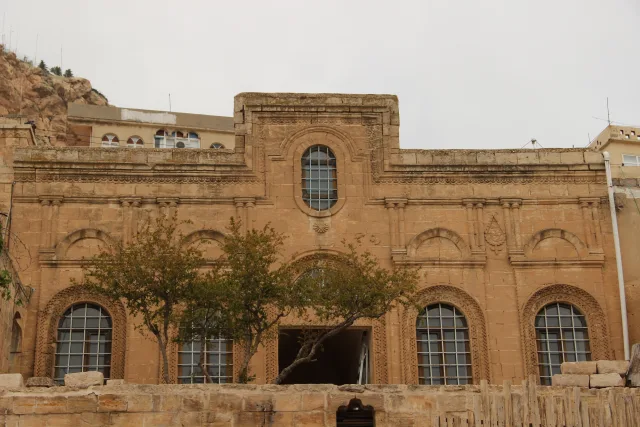
Dara and Deyrulzafaran are major destinations beyond central Mardin. One reveals infrastructure in a frontier city; the other the continuity of Syriac religious and cultural life.
An AI-assisted synthesis of the sources below, with Atlas planning suggestions. This is not a first-hand visit report. Admission, transport and access conditions must be checked with operators before travel.
In this guide
Water and defence at Dara
Cisterns matter alongside walls in this Eastern Roman settlement. Distinguish rock-cut burial spaces from water storage. Rather than calling a large underground chamber a dungeon from its appearance alone, follow the site’s current interpretation.
Deyrulzafaran is not simply a museum
Buildings added in different periods reveal long use. Religious education and printing history make the monastery a cultural centre beyond its stone craftsmanship. Follow visiting and photography rules in a living place of faith.
Allow enough time outside the centre
Do not calculate either journey as a tiny addition to a walk through Mardin’s streets. Confirm monastery visiting arrangements and open sections at Dara. Prepare for sun and uneven ground, and give the contrasts between infrastructure, learning and worship time to become clear.
From the stone hillside to the province: old Mardin is not all of Mardin
Old Mardin's stone fabric facing the plain makes its geography immediately visible. A walk in Artuklu, however, is not the same journey as visiting Midyat, Savur, Nusaybin, Kızıltepe or Dara. A distance that looks short on the hillside can involve steps and changes of level; a flat map does not explain the whole physical effort. Find your bearings on the main route, then choose a museum, a madrasa and a neighbourhood branch. This offers more understanding than a hurried photograph hunt that enters private courtyards or rooftops without permission.
Mardin Cultural Landscape was submitted to UNESCO's Tentative List on 25 February 2000. That entry is not World Heritage inscription for the entire province. Ulu Mosque, Zinciriye and Kasımiye should likewise not be treated as unchanging examples of a single style. Construction, repair, education and worship are different questions. Separating the collections of Mardin Museum from those of a city museum clarifies the relationship between buildings, objects and their setting. A shared stone colour cannot by itself provide a complete historical explanation of everything a visitor sees.
Deyrulzafaran: layered history within a living Syriac institution
Overlooking the plain, Deyrulzafaran is more than a historical facade to photograph: it remains an important religious centre of Syriac Orthodox life. Additions from different periods should not be reduced to one foundation date. Mor Hananyo and Deyrulzafaran reflect different historical names of the same institution. A long history does not mean every visible stone survives from the same early century. Reading changes within a continuing institution explains more than treating age as a competition or describing the entire complex as one perfectly unchanged ancient structure.
Separate the monastery's visitor arrangements from the rhythm of worship. A section open to a guided visit does not mean every room or aspect of community life is publicly accessible. Connect the guide's account with the building and its different phases rather than repeating only a slogan about religions meeting. Ask about photographs, quiet behaviour and ceremonies. Older multilingual official entries can contradict one another on prices and times, so confirm the present arrangements directly with the institution. That is particularly important when planning transport outside the old city and allowing time for the monastery's own visitor sequence.
Dara: water, defence and daily needs in a frontier city
Around the present settlement of Oğuz, Dara gained importance through the Eastern Roman military city developed under Emperor Anastasius near the Sasanian frontier. Rock-cut burials are visually striking, but describing the place through the necropolis alone leaves much unexplained. Water collection and storage, fortification, movement and living areas form connected systems. Calling every large underground space a dungeon confuses visual impression with function. Follow the archaeological interpretation rather than assuming that size and darkness establish what a space was used for.
Excavations continue to add evidence of how the city worked. The provincial directorate's report of finds in July 2025 shows that work around the commercial area is revealing a settlement broader than older tour descriptions suggest. A newly announced mosaic is not automatically on display to every visitor immediately after discovery. Distinguish the open route, protective covering and excavation area. Current village life exists beside the ancient remains: inhabited houses and gardens are not archaeological scenery. Viewing a frontier city alongside those realities helps keep both past and present visible without confusing them.
Midyat and Tur Abdin: stone craft and monastic landscapes
Estel, Midyat's old streets, the guest house, cultural house and telkâri heritage offer distinct subjects for observation. Stone carving and fine silver-wire work are different crafts. Ask about tools, design and working time in a workshop so that the finished object becomes more than a bright souvenir. A facade used for television filming cannot explain the town's entire history or provide permission to enter every interior. A place may acquire a new media association while retaining older uses and the needs of people who continue to live and work there.
Mor Gabriel and surrounding Syriac churches and monasteries form part of Tur Abdin's living religious landscape. The selected late antique and medieval buildings submitted to UNESCO's Tentative List on 15 April 2021 were not all built at once, nor do they all share identical access rules. Village extensions such as the area around Anıtlı need transport planning and attention to institutional arrangements. Avoid shrinking migration, worship and language memory into a phrase about abandoned monasteries. Some places have changed profoundly; others remain active. Recognising that range produces a more accurate understanding than assuming an empty historical landscape everywhere.
Nusaybin, Savur and Kızıltepe: build routes around settlements
The proximity of the Zeynel Abidin complex and Mor Yakup Church in Nusaybin offers a way to consider different faiths, educational traditions and repair periods within one setting. Their Tentative List submission on 15 April 2014 is separate from Mardin's landscape entry of 2000 and the Tur Abdin record of 2021. Nearness does not mean all construction phases are contemporary: inscriptions, extensions and changes of use supply distinct evidence. Taking time to read those distinctions is more rewarding than assigning one simple coexistence story to every stone.
In Savur, a mansion and stream setting, or the church and village fabric of Dereiçi, can form a different daily journey. Do not confuse Kızıltepe's historical mosque with the Ulu Mosque in old Mardin because of a similar name. Organise movement between district centres, agricultural surroundings and village stops according to your own transport arrangements. Landmarks placed beside one another in a tourism list are not necessarily linked by a short walk. First decide which settlement and historical layer you want to understand; that choice makes the itinerary clearer and avoids an exhausting attempt to see the entire province as an extension of one street.
The table, vineyards and craft: do not flatten diversity into one flavour
Irok and ikbebet introduce different fried and boiled preparations of stuffed meatballs, while stuffed ribs make visible another kind of kitchen labour involving meat, rice and almonds. Mırra brings its own serving rhythm through small cups and intensive preparation. Vine growing connects grape molasses, fruit leather and Syriac wine as different uses of a crop. Wine should not be presented as an identity marker consumed in the same way by every community: belief and individual preference vary. Food becomes more informative when technique and context accompany the names of dishes.
Questions about nuts, cereals, dairy or meat do not diminish the value of a local recipe. Learning about the maker and technique of silverwork similarly makes a bazaar purchase more meaningful. Treat the old-city walk, the Dara and Deyrulzafaran direction, and Midyat or Savur as distinct journeys. This is not a race to finish every landmark. It is a visiting rhythm in which stonework, religious life, archaeology and contemporary settlement receive the attention needed to be understood. That creates a richer account of Mardin than a series of famous facades without the places and people behind them.
Choose the visit that fits your question
Infrastructure
Read cisterns as part of a settlement’s survival.
Cultural history
Explore the monastery’s teaching and printing roles.
Respectful visiting
Do not treat worship space as an unrestricted exhibition.
Visual exploration before you travel
Evliya Çelebi — Mardin, episode 39
TRT's public city programme complements the historical and street context. It is a modern documentary, not contemporary footage of historical events or a current access record for every district destination.
Practical questions before your visit
Is the whole province a UNESCO World Heritage Site?
No. Mardin Cultural Landscape, the two religious complexes at Nusaybin and selected Tur Abdin churches and monasteries have separate Tentative List records from 2000, 2014 and 2021 respectively. Tentative listing is not World Heritage inscription.
Is every underground space at Dara a dungeon?
No. Water-storage and other functions need to be considered. A large dark space does not establish a dungeon's function on appearance alone. Follow archaeological interpretation and distinguish visiting routes from excavation and conservation areas.
Can I add Midyat and Deyrulzafaran as quick stops on one city walk?
They are separate destinations. Midyat is another district with its own monastic surroundings, while Deyrulzafaran lies outside the old city. Check transport, guided visiting and worship arrangements separately instead of assuming both are short walking extensions.
Sources and scope of this guide
These primary sources support the historical and heritage background. Comparisons and suggested ways to organise a visit are Atlas editorial analysis, not instructions from the source institutions.
- Kültür Portalı · DARA ANTİK KENTİ ↗
- Kültür Portalı · DEYRULZAFARAN MANASTIRI ↗
- UNESCO — Mardin Cultural Landscape, Tentative List ↗
- Mardin İl Kültür ve Turizm Müdürlüğü — Mardin Rotalar ↗
- Mardin İl Kültür ve Turizm Müdürlüğü — Deyrulzafaran Manastırı ↗
- Mardin İl Kültür ve Turizm Müdürlüğü — Dara Antik Kenti ↗
- Mardin İl Kültür ve Turizm Müdürlüğü — Dara kazısı, 7 Temmuz 2025 buluntu haberi ↗
- UNESCO — Churches and Monasteries of Midyat and Surrounding Area, Tur ʿAbdin ↗
- Mardin İl Kültür ve Turizm Müdürlüğü — Midyat ↗
- UNESCO — Zeynel Abidin Mosque Complex and Mor Yakup Church ↗
- GoTürkiye — Mardin cuisine ↗
- TRT 2 — Evliya Çelebi, Mardin, episode 39 ↗