
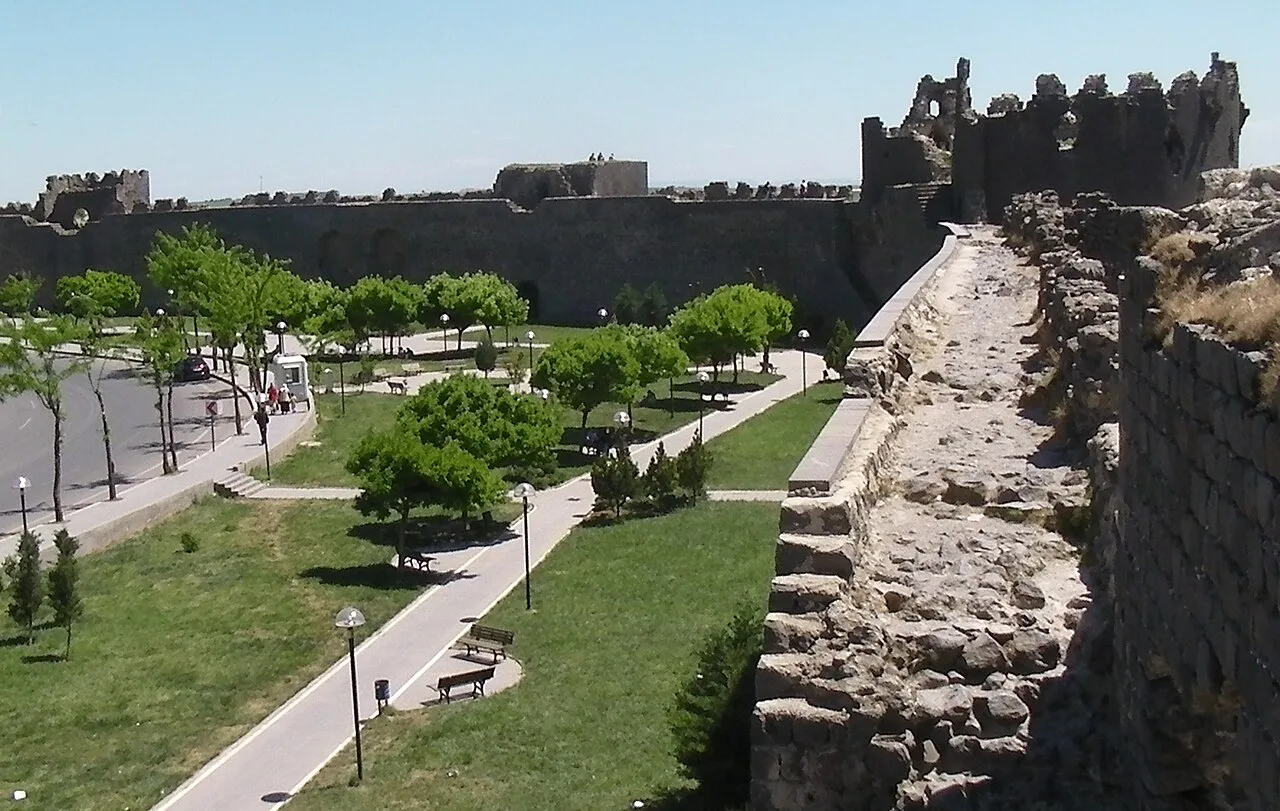
Read Diyarbakır’s walls together with the Hevsel Gardens. Defence, production and settlement belong to one urban system; Zerzevan in Çınar reveals military life at another scale.
An AI-assisted synthesis of the sources below, with Atlas planning suggestions. This is not a first-hand visit report. Admission, transport and access conditions must be checked with operators before travel.
In this guide
Walls and gardens belong together
The productive land beyond the fortifications helps explain the city’s continuity. Hevsel is a living cultural landscape, not empty scenery. Observe from permitted routes without entering cultivated plots uninvited.
Everyday needs at Zerzevan
The Roman garrison includes housing, water storage and religious spaces alongside its defences. The Mithras sanctuary is important, but it should not eclipse the rest of the settlement. Cisterns and control of the road help explain how military life functioned.
Plan two distinct routes
Separate the city walk from the transfer towards Çınar. Not every stretch of wall is open or suitable for walking; follow current visitor arrangements. Prepare for exposed ground and sun at the archaeological site. Comparing a large inhabited city with a smaller fortified settlement is more revealing than collecting photographs of their walls alone.
Walls and Hevsel: the defended city and the landscape that feeds it
Diyarbakır Fortress and the Hevsel Gardens entered the UNESCO World Heritage List together in 2015. That pairing matters: a city survives not through defensive walls alone, but also through the land and water that sustain its population. İçkale, gates, towers, gardens and the Tigris reveal different parts of a functional relationship. Inscriptions from different periods show that the fortifications were not completed once and then left unchanged. Repairs and additions belong to their history rather than representing details to ignore in pursuit of a single original date.
Connect a gate with an authorised place from which to observe the wider landscape. A garden is productive land, not empty photographic scenery, and entering private plots requires permission. Walking on every wall section is neither necessarily safe nor allowed. Follow closures and choose observations from ground level where appropriate. Seeing defence, cultivation and water within the same view explains the city more effectively than repeating an unverified claim about having the world's longest walls. It also lets visitors appreciate the relationship without putting either people or fabric at risk.
Ulu Mosque and the hans: worship beside commerce
Ulu Mosque's substantial repair in 1091 requires a distinction between its early Islamic past and later building campaigns. Do not force all the present courtyard, facades and uses into a single foundation year. Reused materials and different construction phases offer a way to think about continuity within the city. Architectural observation here is also a visit to a place of worship, where quiet behaviour, dress and prayer arrangements matter alongside historical explanation. A visitor's interest does not remove the responsibilities of entering a building still used by its community.
East of the mosque, Hasan Paşa Han's courtyard and two-storey organisation, dated to 1573, reveal the spatial setting of trade. Deliller Han towards Mardin Gate makes a different connection with pilgrimage journeys and guides. Reading the buildings only as breakfast venues or hotel names hides those earlier movement networks. Study the relationship between courtyard, shops and upper level, while recognising that a working business or private section is not automatically open to architectural curiosity. Commerce today can help explain continuity, provided its current activities are not confused with every aspect of the historical use.
İçkale and the writers' houses: public history and everyday life
The İçkale museum complex brings archaeological objects, former administrative and military buildings, courtyards and surroundings into a common setting. A building's present museum function does not establish that it served the same purpose in the past. Its role in government and defence and its transformation into exhibition space are distinct layers. Within the galleries, separate an object's discovery location from its display location. Finds brought from elsewhere in the province should not be described as though every one was excavated directly beneath the citadel buildings.
The house built in 1733 where Cahit Sıtkı Tarancı was born in 1910 introduces the courtyard dwelling as well as a poet's personal possessions. Wings used in different seasons make the response to shade and temperature tangible. A literary museum need not be reduced to a few lines of a poem: house, family life and the memory of writing can be considered together. Other house museums, including Ziya Gökalp's, represent different individuals and collections, not another name for the same writer's residence. Give each its own subject instead of treating them as interchangeable architectural stops.
Zerzevan in Çınar: more than a sanctuary within a Roman garrison
Zerzevan is a military settlement in Çınar overlooking ancient transport routes. Its Mithras sanctuary attracts attention, but houses, defensive towers, a church, shelter and cisterns also explain the garrison's continuity. Soldiers and civilians needed water, accommodation and circulation within the same plan as places of belief. Looking at storage and distribution makes the settlement more understandable than a photograph of a high defensive position alone. The archaeological layout offers questions about maintaining daily life at a strategic location, not merely about the drama of a frontier.
The site was recorded on UNESCO's Tentative List on 14 April 2020; that is not inscription on the World Heritage List. Interpretations can develop as excavation and conservation continue. Especially for Mithras rituals, distinguish finds from interpretation rather than confidently reconstructing a detailed spectacle from a modern perspective. Follow open visiting routes and stay outside work areas. Plan the transfer separately from a city walk: comparing the scale of a garrison with that of a large inhabited city becomes more rewarding when neither is rushed. Archaeological protection is part of what allows that comparison to remain possible.
Silvan, Ergani and Eğil: routes into different historical times
Malabadi Bridge towards Silvan introduces Artuqid engineering through its large arch and stone decoration. It is not the Ten-Eyed Bridge and belongs to another river and road setting. Its Tentative List entry is also separate from the World Heritage status of the city walls and Hevsel. Reading a bridge through crossings, travellers and protection, rather than through span alone, makes its design more intelligible. The need to pass over water can produce both engineering and cultural forms, and the carved details deserve attention without turning every observation into a claim of world superiority.
Around Ergani, Çayönü is significant for research into early settled life and food production; nearby rock tombs at Hilar should not be assigned automatically to that same period. Eğil offers a different route through fortifications, carved rock, places of visitation and a water landscape altered by a reservoir. Çermik's thermal heritage further demonstrates that the province extends well beyond one urban centre, although tourism's language of healing is not medical evidence of suitability. Silvan, Ergani, Eğil and Çermik each deserve distinct questions and access checks instead of becoming a hurried chain of identical excursions.
Food and visiting pace: connect product names with production
Diyarbakır's burma kadayıf, liver kebab, braided cheese, watermelon and Karacadağ rice reveal a culinary range extending from dessert to the field. A geographical indication defines a product and its production relationship; it does not automatically certify every business or make its food suitable for everyone. Ask about the agricultural setting behind rice, milk-processing knowledge in cheese or cooking technique for kebab. Check ingredients such as dairy, nuts and offal where relevant to your needs. Understanding a local table is richer than collecting prestigious names without considering how the food is made.
A first city day can combine the walls' setting, Ulu Mosque, a han and one museum; another day can focus on a single district direction. This is a method for making extensive heritage readable, not a promise of precise durations or a business recommendation. Summer heat, exposed sites and routes with steps affect the pace. Listen to local voices, photograph with permission and respect the boundaries of working gardens. Diyarbakır cannot be explained adequately by black stone or a single historical period. Its strength lies in the relationships between the inhabited city, its monuments, its productive landscape and the wider province.
Choose the visit that fits your question
Urban reading
Connect defence with food production.
Garrison reading
Include cisterns and domestic spaces.
Access
Use only authorised wall and excavation areas.
Visual exploration before you travel
Diyarbakır — city and cultural landscape
The official short film published on 2 February 2024 introduces the relationship between the city and its surroundings. Its edited views do not establish current visiting arrangements for every wall section or historical building.
T.C. Kültür ve Turizm Bakanlığı WebTV · Watch the official publication ↗
Practical questions before your visit
Do Diyarbakır, Zerzevan and Malabadi have the same UNESCO status?
No. Diyarbakır Fortress and the Hevsel Gardens were inscribed on the World Heritage List in 2015. Zerzevan and Malabadi have separate Tentative List records, which should not be confused with inscription.
Can I walk anywhere on the fortifications?
No. Archive photographs and old itineraries do not establish present access or safety. Stay outside closed or protected areas and use only open, authorised routes. Ground-level observation can also reveal the history of the walls.
Are Çayönü and the Hilar rock tombs from the same period?
Do not treat early settlement archaeology and later rock-cut tombs as one historical layer simply because they are nearby. Separate object type, date and archaeological context to make an Ergani itinerary more accurate.
Sources and scope of this guide
These primary sources support the historical and heritage background. Comparisons and suggested ways to organise a visit are Atlas editorial analysis, not instructions from the source institutions.
- Kültür Portalı · Diyarbakır Kalesi Ve Hevsel Bahçeleri ↗
- Kültür Portalı · ZERZEVAN KALESİ VE MİTHRAS KUTSAL ALANI ↗
- UNESCO — Diyarbakır Fortress and Hevsel Gardens Cultural Landscape ↗
- Diyarbakır İl Kültür ve Turizm Müdürlüğü — Cami ve Kiliseler ↗
- Diyarbakır İl Kültür ve Turizm Müdürlüğü — Hanlar, Kervansaraylar ↗
- DÖSİMM — Diyarbakır müzeleri ↗
- Diyarbakır İl Kültür ve Turizm Müdürlüğü — Cahit Sıtkı Tarancı Evi ↗
- UNESCO — Zerzevan Castle and Mithraeum, Tentative List ↗
- UNESCO — The Malabadi Bridge, Tentative List ↗
- Diyarbakır İl Kültür ve Turizm Müdürlüğü — Tarihçe ↗
- Diyarbakır İl Kültür ve Turizm Müdürlüğü — Dağ ve Doğa Yürüyüşü ↗
- Diyarbakır İl Kültür ve Turizm Müdürlüğü — Yöresel Mutfak ↗
- Kültür ve Turizm Bakanlığı WebTV — Diyarbakır ↗