
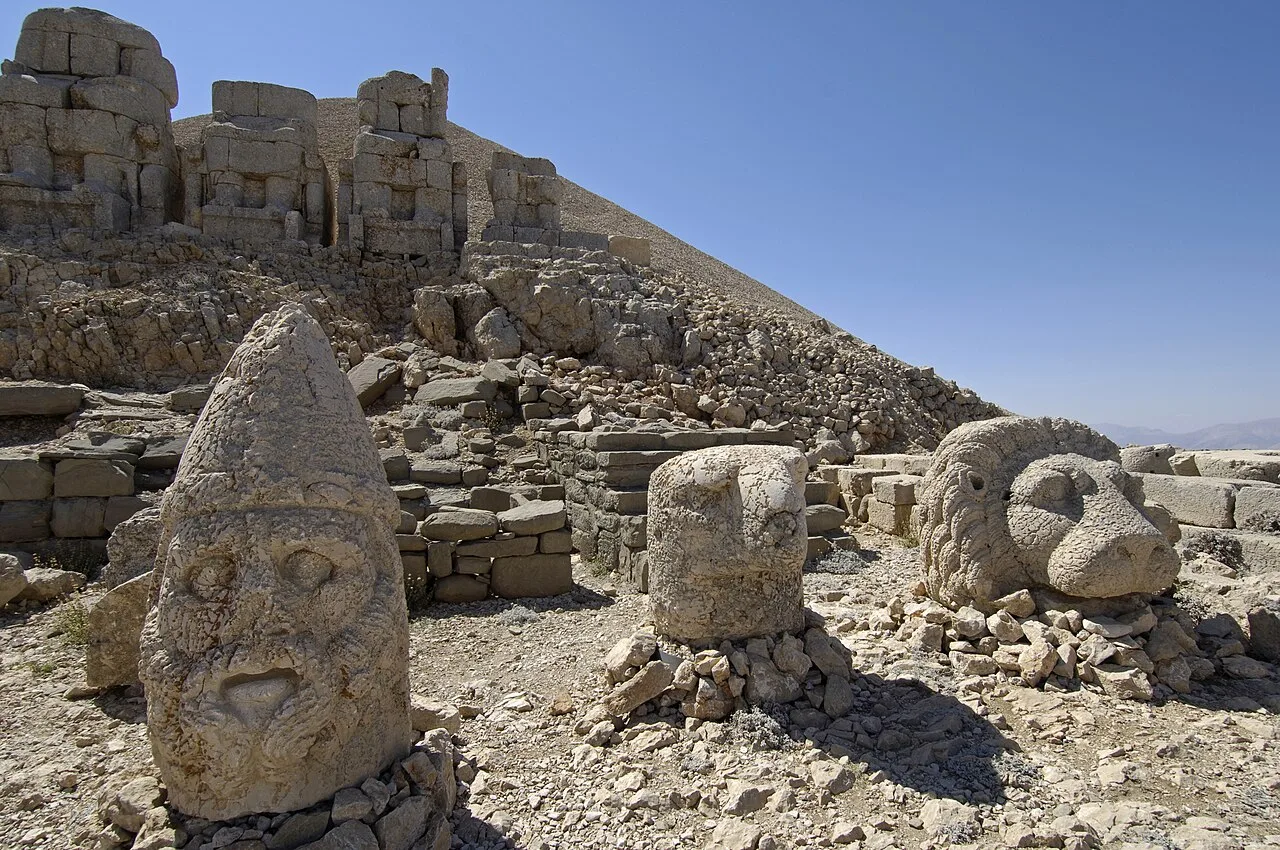
Nemrut and Cendere express two different uses of power. One places a ruler’s memory on a summit; the other organises movement across a river. Read the connection between them as you explore the Kahta area.
An AI-assisted synthesis of the sources below, with Atlas planning suggestions. This is not a first-hand visit report. Admission, transport and access conditions must be checked with operators before travel.
In this guide
Understand Nemrut’s terraces
Antiochos I’s sanctuary combines a mound of broken stone with monumental sculpture on its terraces. The detached heads are not the original composition: relate them to the seated bodies and the mound. Inscriptions refer to the king’s burial, but that does not mean the burial chamber has been discovered.
Why Cendere’s columns matter
The Roman bridge commemorated members of Septimius Severus’s family. The later removal of the column dedicated to Geta makes political memory visible in architecture. Look at the main arch and the valley crossing as well as the columns; this was infrastructure, not simply a monument.
Plan summit and valley separately
Nemrut is an exposed, high-altitude site. Weather in the city is not a reliable guide to conditions above. Sunrise is optional: enough daylight to understand the terraces may serve you better. Check current official access and transport notices, including arrangements following the region’s earthquakes, rather than assuming older itineraries remain practical.
Nemrut: move beyond sunrise photography into royal ideas
Adıyaman's Mount Nemrut must not be confused with the volcano and crater lake of the same name in Bitlis. Here the monumental sacred and funerary complex of Antiochus I of Commagene brings a piled tumulus together with east and west terraces. Inscribed on the UNESCO World Heritage List in 1987, its significance rests not only on a mountain sunrise but on the visual presentation of kingship, ancestry and divinity. Relate heads lying at ground level to the statue bodies and the original monumental arrangement rather than photographing them as unrelated objects.
Deities bearing Greek and Persian names form parts of the ruler's combined representational world, not two disconnected cultural displays. Reading inscription alongside sculpture shows why scale means more than engineering achievement. The existence of a tumulus does not establish that the king's burial chamber is open and available to enter. Observe without climbing on stone, crossing boundaries or displacing loose material. Light changes the surface, but historical explanation is not confined to one photographic hour. Appreciating the complex does not require turning conservation limits into obstacles to be overcome for a preferred image.
Arsameia and Karakuş: family memory alongside royal power
At Arsameia, reliefs, inscriptions and a ceremonial route reveal Commagene's political and religious language on another scale. A handshake scene is not equivalent to a contemporary photograph of two people: closeness between ruler and sacred figure becomes an account of legitimacy. Consider the relief's relation to route, rock and writing. Because the same ancient name can occur at different settlements, distinguish this Nymphaios Arsameia around the Kahta stream from another place named Arsameia. Geography is part of the historical explanation rather than an incidental label added after the sculpture has been described.
Karakuş Tumulus foregrounds family and remembrance as a funerary monument associated with royal women. Column, animal figure and mound should not be dismissed as small decorations repeating Nemrut's much larger terraces. Whose memory a monument commemorates matters alongside who commissioned it. Conservation and post-disaster repairs can alter the appearance of surviving parts; photographs from different years should not be assembled as a single contemporary view. Arsameia, Karakuş and Nemrut are connected, but each rewards different questions. One provides no reason to rush past the others as lesser versions of a single famous attraction.
Cendere and Old Kahta: a Roman crossing and later fortress life
Cendere Bridge represents Roman engineering founded on rock at a narrow water crossing. Arch, approaches and columns together reveal that passing over a river could also display imperial order. Columns associated with the family of Septimius Severus, and the account of removing Geta's memory, offer a starting point beyond aesthetic appreciation. Riverbank, bridge deck and traffic arrangement are different spaces: follow the marked route and crossing rules. The historical bridge should not be treated automatically as an unrestricted viewpoint or as a convenient route down to the water.
The name Yeni Kale at Old Kahta does not mean a recently built modern castle. Use across periods, repairs, water arrangements and settlement traces explain how a historical fortress changes. Do not reduce it to the same construction episode as the royal sacred complex at Nemrut. Fortress routes may include steps, steep gradients and closed sections; choose an open route rather than crossing a boundary to secure a view. Bridge and fortress can form part of a district day, but listing them merely as photographic stops hides the different functions that make their connection interesting.
Perre and the museum: connect burial architecture with the inhabited city
Near Adıyaman city, Perre is known for rock-cut tombs, but it should be considered through settlement and road relationships rather than as a cemetery alone. Entrances, passages and burial spaces within carved rooms show how death was given architectural form. Roman-period development also recalls continuity beyond the Commagene kingdom. An excavation announcement describing a new stairway or structure does not establish that every surrounding working area is open for free circulation. Follow designated access and use the archaeological explanation to connect the visible chambers with a wider city history.
Adıyaman Museum's historical collection brings together archaeological and ethnographic material associated with Lower Euphrates research. However, checked on 3 October 2026, the Ministry's closed-units list records general maintenance closure, and the museum portal specifies earthquake-related closure. Explaining the collection's significance is therefore not a promise that a museum visit is presently possible. Perre and other sites have their own access arrangements. Old opening times do not become usable visiting hours unless open status is verified. The distinction protects practical planning while allowing the collection to retain its place in the province's cultural account.
Besni and the table: cooking knowledge matters as much as ingredients
Besni tava involves more than placing meat and vegetables in a tray. Arrangement and oven cooking together define a local method. Discussing how aubergine, tomato, pepper, lamb and garlic interact is more informative than recognising a dish by name alone. A recorded recipe communicates production knowledge; it does not establish that every business serves the same portion or follows an identical preparation. Ask clearly about ingredients, allergens and dietary needs when ordering. Understanding a technique allows comparison without requiring a claim that one meal alone represents the entire authentic cuisine.
Food should remain connected with district geography. Everyday city cooking, Besni's oven tradition and a fish meal near Kahta's reservoir shore have different local contexts. Rather than treating sampling every example in one day as a compulsory achievement, learn about one preparation technique along the chosen route. A producer's labour, seasonal ingredients and family variations belong to a living culture. A geographical indication or a celebrated name is neither evidence of a health benefit nor a universal business quality guarantee. Evaluate the actual product and its preparation instead of asking recognition alone to stand in for information.
Routes, transport and the living post-disaster city
Give the central city and Perre one session, and the Commagene sites around Kahta another day. Official announcements describe regular Kommagene Ring services, but departure arrangements, seasonal operation and booking need confirmation for the actual day. Fixed overnight departures in older tour descriptions are not programmes valid for every year. Sunrise or sunset can be a landscape choice, while a daylight visit also permits close reading of sculptural detail and inscriptions. Transport should support the desired historical encounter, not force every place into a predetermined photographic schedule.
Nemrut's elevation, wind and seasonal road conditions differ from the central city's. The transfer, final walk and museum visit do not have identical physical requirements, so adapt the plan to mobility needs. Following the 2023 earthquakes, Adıyaman is experiencing reconstruction beyond the history of its monuments. Do not turn local life into a backdrop of destruction; respect residents' privacy and read restoration announcements with their dates intact. Understanding the province's past does not require excluding its present society. The strongest visit connects ancient representation, material survival and the people who continue to live around that inheritance.
Choose the visit that fits your question
Archaeology focus
Consider the terraces and mound as one designed landscape.
Transport history
Read Cendere as a crossing within its valley.
Slower itinerary
Allow recovery time between long transfers.
Visual exploration before you travel
Mount Nemrut — official short film
Published on 29 November 2019, the film introduces the relationship between terraces, sculpture and the mountain landscape. It is a short introduction, not a documentary covering every Commagene site or evidence of present weather and transport.
T.C. Kültür ve Turizm Bakanlığı WebTV · Watch the official publication ↗
Practical questions before your visit
Can I enter the king's burial chamber at Nemrut?
A tumulus and terraces do not establish that an open burial chamber is available. Visits follow authorised archaeological routes; climbing on stone or entering protected sections is inappropriate.
Can I include Adıyaman Museum in today's itinerary?
On the 3 October 2026 check, Ministry sources list it as closed. The historical collection description is not a promise of an open museum. Verify a reopening announcement and current status before relying on older hours.
Must every Commagene site be visited at sunrise?
No. Sunrise is one landscape preference; reliefs, inscriptions and architectural relationships can be studied during daylight. Confirm current ring or private transport separately according to season and mobility needs.
Sources and scope of this guide
These primary sources support the historical and heritage background. Comparisons and suggested ways to organise a visit are Atlas editorial analysis, not instructions from the source institutions.
- Kültür Portalı · NEMRUT ÖREN YERİ ↗
- Kültür Portalı · CENDERE KÖPRÜSÜ ↗
- UNESCO — Nemrut Dağ ↗
- Commagene Nemrut Conservation and Development Programme — About Nemrut ↗
- Adıyaman İl Kültür ve Turizm Müdürlüğü — Müzeler ve Örenyerleri ↗
- Adıyaman İl Kültür ve Turizm Müdürlüğü — Köprüler ↗
- Adıyaman Belediyesi — Cendere Köprüsü ↗
- Adıyaman Valiliği — Tümülüs ve Höyükler ↗
- Adıyaman İl Kültür ve Turizm Müdürlüğü — Kommagene Ring ↗
- Adıyaman İl Kültür ve Turizm Müdürlüğü — Düzenli Kommagene seferleri ↗
- Kültür Portalı — Besni Tava ↗
- Kültür ve Turizm Bakanlığı — Geçici süreyle kapalı müzeler ↗
- Bakanlık müze portalı — Adıyaman Müzesi durum bilgisi ↗
- Bakanlık WebTV — Nemrut Dağı ↗