

← Back to History of the Republic
Makril, fotoğraf / photograph; Kjetil r, Commons kırpması / Commons crop; Clemens Holzmeister, mimari / architecture — Wikimedia Commons · CC BY-SA 3.0 ↗ From referendum to implementation · legislature and executive
2017–2018: constitutional amendments and the transition in government
Türkiye's Republic chronology combines continuity with significant institutional change between 2017 and 2018. This dossier distinguishes an electoral result, a constitutional provision, its commencement and later implementation. It explains the move from the prime minister's office to new executive arrangements alongside the earlier history of popular presidential election, parliament's responsibilities and constitutional review.
The 2017–2018 transition · 2020 review frameworkParliament · the electorate · Ankara · constitutional review
The assembly's third building: Kjetil r's Commons crop of Makril's photograph. The catalogue dates it to 22 July 2007, but conflicting camera metadata means that the exact capture day is not relied upon. This is institutional context, not a photograph of the 2017 referendum or the 9 July 2018 ceremony.
At a glance
- Amending law
- No. 6771 · 21 January 2017
- Referendum
- 16 April 2017
- Joint elections
- 24 June 2018
- Executive implementation threshold
- 9 July 2018
- Sources checked
- 3 October 2026
The earlier system: popular election is not the same as executive authority
Before the 2017 amendments, the executive arrangements of the 1982 Constitution assigned different responsibilities to the President and the Council of Ministers headed by the prime minister. Forming and maintaining a government depended on its relationship of confidence with parliament. The President also possessed constitutional powers: portraying that office as entirely without influence would be inaccurate. Equally, the existence of a head of state did not mean that executive authority was concentrated in the office in its present form. The institutional difference lies in appointment, decision-making and accountability, rather than simply the titles of the individuals involved.
Popular election of the President did not begin in 2018. The constitutional change of 2007 introduced that method, and the Supreme Election Council's 2014 calendar scheduled the first ballot for 10 August. Recep Tayyip Erdoğan's direct election in 2014 and the transformation of the executive structure in 2018 were separate thresholds. That distinction is essential to reading the Republic's chronology: who elects an office-holder and what powers the office carries are different questions. The transition of 2017–2018 changed the relationship between the legislature and the executive, not merely the way voters selected a head of state.
↑ Back to dossier contentsLaw No. 6771: extensive amendment rather than an entirely new constitution
Law No. 6771, adopted by the Grand National Assembly on 21 January 2017, amended the Constitution of 1982. The election council's referendum calendar identifies both the adoption date and Official Gazette issue No. 29976; the law was published on 11 February for submission to a referendum. The eighteen-article package changed or repealed many interconnected constitutional provisions. The number of articles in an amending law does not mean that precisely the same number of constitutional articles was affected. Describing the package as a simple renaming of one office would therefore understate its scope.
Establishment of the Republic in 1923 and a change in the system of government are different kinds of historical event. The constitutional provisions declaring the republican form of the state, its fundamental characteristics and their protection remained in the text. Removing the constitutional arrangements for the prime minister and the Council of Ministers nevertheless transformed the organisation of the executive. The term presidential government system is the official Turkish designation used here; it does not imply that every presidential model has an identical design. Such a model must be assessed alongside the country's electoral, party, judicial and oversight arrangements. A label alone explains neither its legal detail nor the quality of its implementation.
↑ Back to dossier contents16 April: the result, its denominator and differing choices
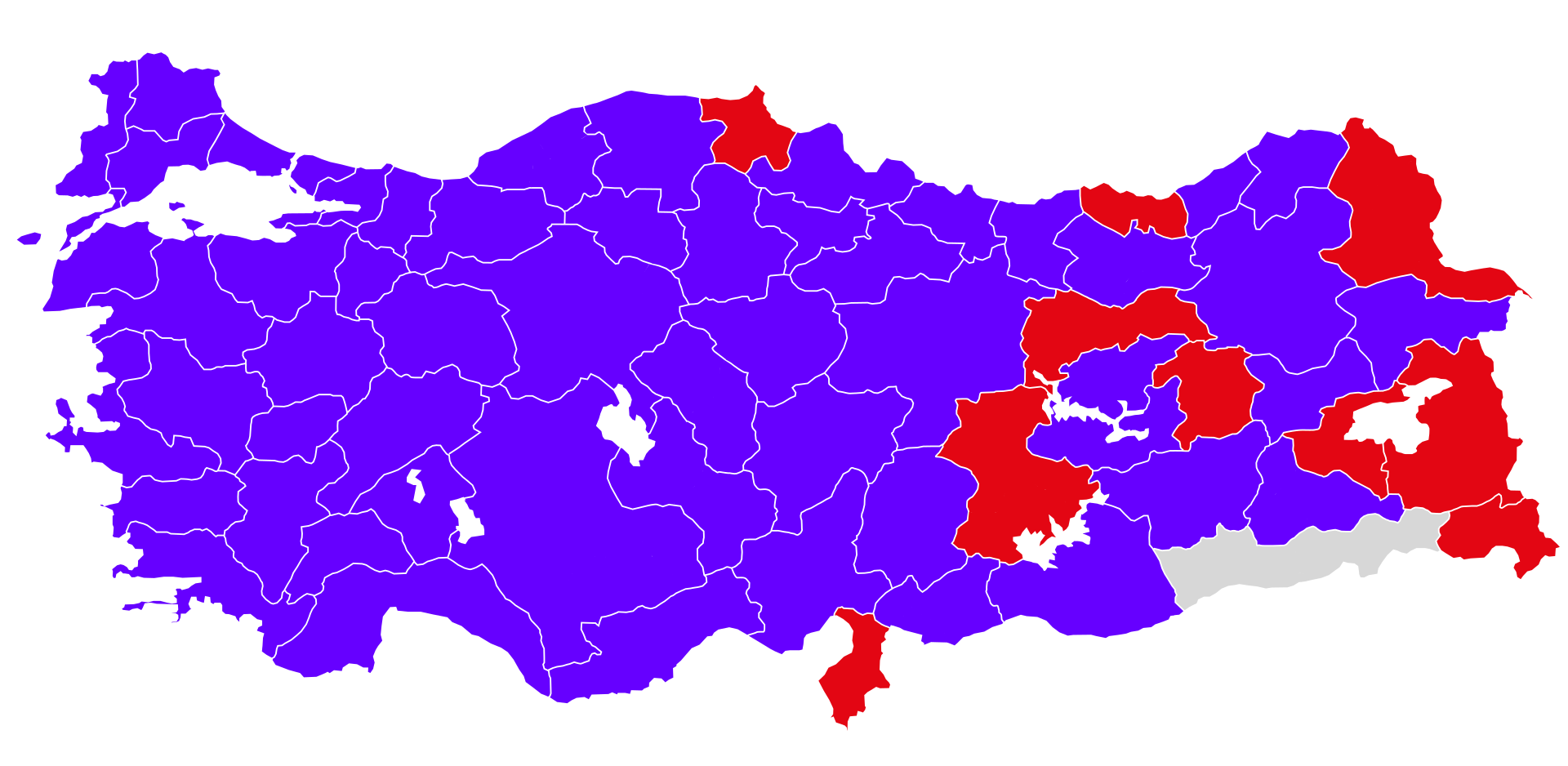
Voters considered the amendment package on 16 April 2017. The Supreme Election Council's final-result decision No. 663, dated 27 April, records 25,157,463 votes in favour and 23,779,141 against. Among valid votes, the respective shares were 51.41 and 48.59 per cent. These are not percentages of the entire population or of all registered voters. The same decision reports turnout separately at 85.43 per cent. A results chart is informative only if the denominator is clear; changing the population being measured can change the meaning even when the displayed number is copied correctly.
Approval enabled the legal change, but did not establish unanimity across society. A yes or no vote does not prove that an individual endorsed or opposed every subsequent policy. The referendum concerned an amendment text offered as one package, not the election of a president or members of parliament. The final-result record and an observation report examining campaign conditions answer different questions. Reading one does not make the other unnecessary. A careful account identifies the source of the officially declared totals separately from institutional assessments of the quality of the process, without treating either type of document as evidence for everything.
↑ Back to dossier contentsMore than one commencement date: 2017, the election and 9 July
The amendments were not all implemented at once. The commencement schedule published by the Constitutional Court dates removal of the requirement for an elected president to sever any party affiliation to 27 April 2017. Some judicial and transitional provisions also belonged to this earlier stage. Changes to the main executive structure were tied to the President taking office after the first joint parliamentary and presidential elections. The possibility of a party-affiliated president and the end of the prime minister's office should therefore not be described as events occurring on the same day.
Transitional Article 21 originally envisaged joint elections on 3 November 2019, while also providing for a parliamentary decision to hold elections. In practice, the presidential and twenty-seventh-term parliamentary elections took place on 24 June 2018. Election council records treat them as a process separate from the referendum. Erdoğan's taking the oath before parliament on 9 July marked the implementation threshold for the new executive structure; the Constitutional Court President's opening address of 2019 explicitly identifies that date. Election day, declaration of the final result and assumption of office are distinct acts. All belong in the chronology, but none can simply replace the others. This staged timetable explains why accounts describing a single instant of change can conceal important institutional developments.
↑ Back to dossier contentsThe executive: from prime minister and confidence vote to appointments
Amended Articles 8 and 104 placed executive authority with the President. Constitutional provisions on the prime minister and the formation and confidence procedure of the former Council of Ministers were repealed. Under Article 106, vice-presidents and ministers are appointed and dismissed by the President and are responsible to that office for their duties. Their appointment is not a separate popular election. Their oath before parliament does not preserve the former government confidence vote. Two ceremonies or procedures held in the same chamber can have different constitutional effects; an image of the chamber does not by itself explain the distinction.
If a member of parliament is appointed as a vice-president or minister, their parliamentary membership ends. Legislative membership and that executive position are thus separated in this respect. The President's ability to maintain a party affiliation and the behaviour of parliamentary party majorities nevertheless affect how the formal separation of responsibilities operates politically. A constitution cannot be understood merely by counting institutions with different names. Who makes an appointment, which decision needs legislation and how responsibility can be examined must be considered together. This section explains the design without declaring every practice of a particular administration either successful or unsuccessful. Assessing implementation requires evidence beyond the existence of the constitutional provision.
↑ Back to dossier contentsParliament: broader representation and different oversight instruments
The number of parliamentary seats increased from 550 to 600, and the minimum age for election fell from twenty-five to eighteen. Article 77 provided for parliamentary and presidential elections ordinarily to take place on the same day every five years. These were concrete changes in representation, but a larger membership does not itself establish stronger oversight in every respect. Legislative authority remained with parliament while the former no-confidence procedure was removed. Article 98 sets out parliamentary research, general debate, parliamentary investigation and written questions. Written questions are directed to vice-presidents and ministers, not to the President personally.
The budget relationship also combines change with continuity. The President submits the budget bill, while parliament considers and decides on it. Article 161 provides a continuity arrangement: if neither a new budget nor a provisional budget is enacted in time, the previous budget operates with adjustment by the revaluation rate. Understanding that mechanism helps explain the design for avoiding a financing interruption; it does not make scrutiny of public spending unnecessary. Under Article 116, parliament can renew elections with a three-fifths majority, and the President can also decide on renewal. In either case both elections are renewed together. This should not be confused with one institution directly removing the other through a procedure unconnected with elections. The electoral consequences are part of the institutional relationship.
↑ Back to dossier contentsA presidential decree is not a law: limits and judicial review
The power to issue presidential decrees in ordinary times is not an unlimited legislative power. Article 104's seventeenth paragraph excludes the specified categories of fundamental and political rights, matters that the Constitution reserves exclusively to legislation, and subjects explicitly regulated by law. Where a law and a decree contain differing provisions, the law applies; parliamentary legislation on the same subject renders the decree ineffective. It would also misstate the text to extend its rights restriction as though every category of constitutional right fell under an identical prohibition. The details of the provision matter more than a general slogan about decree-making.
The Constitutional Court's judgment E.2019/31, K.2020/5 of 23 January 2020 is an important record explaining a review framework that distinguishes competence over a subject from the constitutional substance of a rule. This judicial stage followed implementation in 2018; it was not a decision made on referendum day. Former decree-laws and the new presidential decrees should not be treated as identical instruments. Emergency decrees also operate under a separate constitutional regime, so the explanation of ordinary-time review here cannot automatically be transferred to every type of decree. Checking the legal basis, date and scope of a measure rather than only its title makes the change in authority understandable within everyday public administration.
↑ Back to dossier contentsReading the contemporary debate alongside the constitutional text
The referendum took place during the state of emergency introduced after the attempted coup of 2016. The OSCE/ODIHR final report of 22 June 2017 recorded concerns about unequal campaign opportunities and restrictions on fundamental freedoms, while assessing many technical aspects of administration positively. The Venice Commission's March 2017 opinion discussed the separation of powers and safeguards for checks and balances. These are assessments by the named institutions, not substitutes for the election council's result declaration or a judgment in an individual case. Identifying an assessment's author and scope is more informative than either concealing criticism or presenting it as an uncontested final verdict.
The transition of 2017–2018 was an institutional threshold leading into later implementation of the 1982 Constitution, not a summary of every issue in current Turkish politics. Sources were checked on 3 October 2026; that date does not mean that the events described happened then. Read the 1997 and 2016 dossier first, this transition next, and the second-century science and society dossier afterwards to connect the chronology. The exterior photograph introduces parliament as an institution and does not document a vote or the oath. Anadolu Agency's public footage of 9 July shows the actual ceremony. Applause or protest is evidence about the occasion, not a replacement for reading the constitutional text.
↑ Back to dossier contentsRead the turning points together
- 10 August 2014
An earlier threshold: direct presidential election
The popular-election method introduced by the 2007 amendment was applied in 2014. This was not the beginning of the executive structure implemented in 2018.
- 21 January 2017
Law No. 6771 adopted
Parliament adopted the amendment package affecting the 1982 Constitution. Adoption, the referendum and implementation of all its provisions were distinct stages.
- 11 February 2017
Publication for a referendum
The law appeared in Official Gazette issue No. 29976. The election council's calendar connects this legal record with the referendum process.
- 16 April 2017
Constitutional referendum
Voters chose approval or rejection of the package. This ballot did not elect a president or members of parliament.
- 27 April 2017
Final result and earlier commencement provisions
Election council decision No. 663 declared approval on the basis of valid votes. The constitutional commencement schedule dates removal of compulsory severance of presidential party affiliation to this day.
- 24 June 2018
Joint elections
The President and twenty-seventh-term parliament were elected. The polling date was not the date on which the elected President took the oath and assumed office.
- 9 July 2018
Implementation of the new executive structure
Erdoğan took the oath before parliament. Constitutional Court records explain this threshold in the transition from the prime minister and former Council of Ministers to the new executive arrangements.
- 25 April 2019
An institutional assessment by the Constitutional Court
The Court's fifty-seventh anniversary opening address discussed the transition of 9 July 2018 and review of presidential decrees as a new stage in its responsibilities.
- 23 January 2020
The framework for reviewing decrees
Judgment E.2019/31, K.2020/5 explains the distinction between competence over a subject and review of substantive provisions in ordinary-time presidential decrees.
Explore the archive and documentary context
Anadolu Ajansı
9 July 2018: the presidential oath before parliament
The actual ceremony on AA's own channel, supplementing the implementation threshold of 9 July 2018. It is neither referendum footage nor an impartial law lecture. Read speech, applause and chamber reactions as a record of the occasion; the film is not copied here.
Choosing to load the player connects to YouTube and shares technical data such as your IP address with Google. Autoplay is off. This choice does not change your cookie preferences. The publisher may restrict regional access or embedding; the official link below provides an alternative.
Supported YouTube publications can be watched here by choosing to load their player. Videos are not copied onto our server. Interpret archive images alongside their production date and the narrator’s perspective; the official publication link remains as an alternative.
Questions and historical distinctions
Was 2018 the first popular presidential election in Türkiye?
No. The constitutional amendment of 2007 introduced the method, and the 2014 presidential election was conducted by direct popular vote. The threshold in 2018 was implementation of a changed executive structure after joint elections, not the method's first use. How an office-holder is chosen and which responsibilities the office carries are separate matters.
Did every part of the system change on referendum day?
No. The final result was declared on 27 April 2017, and certain provisions, including removal of compulsory severance of party affiliation, changed at that stage. The main executive arrangements were implemented when the President assumed office on 9 July 2018 after joint elections. Ignoring the transitional provisions would collapse different commencement dates into one.
Did removal of the no-confidence procedure abolish all parliamentary powers?
No. Legislative and budget functions, along with constitutionally specified information and oversight procedures, continued, but the former no-confidence and confidence relationship was removed. Written questions address vice-presidents and ministers. Neither overlooking continuing powers nor claiming that oversight instruments remained unchanged gives an accurate institutional comparison.
Can a presidential decree replace legislation on every subject?
Not in ordinary times. Article 104/17 limits its subject matter, excluding areas reserved exclusively to legislation or explicitly regulated by law. A conflicting law applies, and subsequent parliamentary legislation on the same subject renders the decree ineffective. Emergency instruments have separate rules. This explanation is historical and institutional, not advice about an individual's legal dispute.
Does 51.41 per cent mean approval by that share of the whole population?
No. The election council calculated that share among valid votes. Registered electors, people voting, valid ballots and the entire population are different groups. Turnout was reported separately at 85.43 per cent. An electoral result does not reveal every citizen's view, or every later policy preference of people choosing the same option.
Cumhuriyet Atlas
Continue the story here
1939—14 May 1950
War years and multiparty politics
From the pressures of the Second World War to multiparty politics and electoral transfer of power.
Explore →
2023—21 April 2025
Second century, science and space
The Republic’s centenary and the human research missions of 2024 meet in one future-facing story.
Explore →
1999 and 2023 · reports extending into 2024
The 1999 and 2023 earthquakes: society, institutions and rebuilding lives
From Marmara and Düzce to Kahramanmaraş: read housing, insurance, coordination, education, work and heritage through dated institutional records.
Explore →Documents and sources11 sources
Official reference points used to verify the chronology and interpretive frame on this page.
- Constitution of the Republic of Türkiye: amendments and commencement schedule ↗AYM · anayasa ve yürürlük
Articles 8, 75–77, 98, 104, 106, 116, 161 and Transitional Article 21; the separate 2017/2018 commencement stages.
- Final referendum result of 27 April 2017 ↗YSK · 2017/663
The primary decision recording approval/rejection totals, valid-vote denominator and separate turnout calculation; result declaration is distinct from campaign assessment.
- Calendar for the 2017 constitutional referendum ↗YSK · 2017 takvimi
Adoption of LawNo. 6771, its Official Gazette reference and polling on 16 April.
- The presidential election of 2014 ↗YSK · seçim tarihi
Popular election following the 2007 amendment and the first ballot on 10 August 2014, not incorrectly reassigned to 2018.
- Election statistics 2009–2019: 24 June 2018 ↗YSK · istatistik kitabı
The official record of presidential and twenty-seventh-term parliamentary elections, distinct from the referendum.
- Opening address for the Court's fifty-seventh anniversary ↗AYM · 25 Nisan 2019
A dated institutional address describing implementation on 9 July 2018 and decree review, not a collective verdict on every political interpretation.
- Review of presidential decrees in the judgment of 23 January 2020 ↗AYM · E.2019/31, K.2020/5
The Court's English publication of the judgment distinguishing subject-matter competence, areas regulated by law and substantive review.
- Final observation report on the referendum of 16 April ↗AGİT/DKİHB · 22 Haziran 2017
The official English report: the mission's assessment of campaign conditions and technical administration, a different document type from the result decision.
- CDL-AD(2017)005: opinion on the constitutional amendments ↗Venedik Komisyonu · Mart 2017
The pre-referendum assessment of separation of powers and checks and balances, identified by institution and date.
- Legislative statistics for 2018 and the changed no-confidence procedure ↗TBMM · yasama istatistiği
The period publication distinguishing the legal framework of no-confidence procedures between the twenty-sixth and twenty-seventh terms.
- The President's oath before parliament ↗Anadolu Ajansı · 9 Temmuz 2018
The dated report containing the official AA YouTube ceremony footage; the film is not copied or locally republished.