
← Back to History of the Republic
The Republic continues · democracy
War years and multiparty politics
Türkiye remained outside active combat for most of the war, yet mobilization and scarcity burdened daily life. Multiparty politics and the 1950 election then changed the political order.
1939—14 May 1950Türkiye · Ankara
At a glance
- World War
- 1939—1945
- Democrat Party
- 1946
- Election
- 14 May 1950
- Turnout
- 89.3%
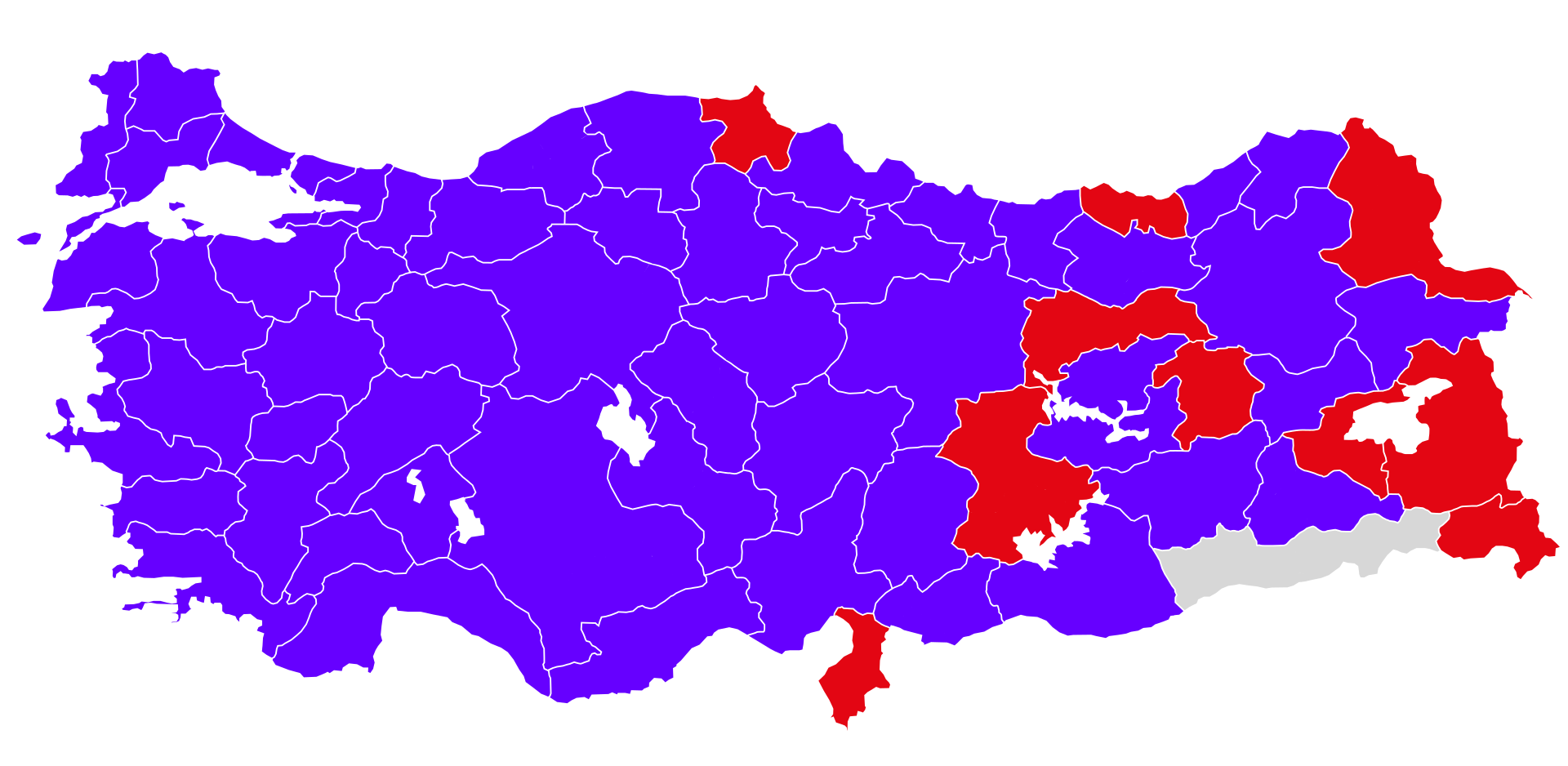
Spanshow / Wikimedia Commons · Visual record and provenance ↗ · CC BY 4.0 ↗ · Open the full-size map ↗
1939: a new president and a changing security map
Atatürk died on 10 November 1938; the Second World War began in September 1939. Decisions made during the war therefore cannot be attributed to his personal leadership. President İsmet İnönü, successive governments, diplomats and the general staff had to apply an inherited preference for peaceful relations in a much more dangerous international setting. The Balkans, Mediterranean, Straits and Black Sea were connected security questions: reducing one risk could create another. Policy was a continuing exercise in assessment rather than a single, timeless declaration.
The alliance signed with Britain and France on 19 October 1939 also shows that Türkiye was not an isolated spectator without international commitments. Nevertheless, alliance obligations did not automatically produce immediate entry into the fighting. Military equipment, delivery of assistance, possible directions of attack and relations with the Soviet Union all mattered. Remaining outside active warfare required repeated negotiation as the balance of power changed. Calling that outcome simply neutrality can obscure the commitments, pressures and bargaining that accompanied it.
↑ Back to dossier contentsAdana and Cairo: preparation under pressure
Churchill’s meeting with İnönü at Yenice near Adana on 30–31 January 1943 was an important stage in Allied efforts to bring Türkiye into the war. Discussions with Roosevelt and Churchill at Cairo in December made the practical questions more explicit: airfields, aircraft, arms deliveries and training schedules belonged to the same negotiation. For the Turkish side, stationing foreign aircraft was not a harmless technical arrangement; it could trigger hostilities with Germany before the country was ready to defend itself.
The agreed minutes of the meeting on 5 December reveal disagreement over how quickly sufficient preparation could be achieved. Such records explain more than stories built entirely around a leader’s temperament. Rail capacity, fuel, air defence and trained personnel could determine whether a diplomatic promise was workable. Examining İnönü’s caution alongside Allied strategic demands restores both sides of the discussion. The outcome seems familiar now, but it was not inevitable to the people making decisions with incomplete information at the time.
↑ Back to dossier contentsNo active front did not mean no wartime hardship
Avoiding combat did not remove the economic cost of the war. Keeping men under arms for long periods took labour away from farms and other workplaces; feeding the army added demands on limited resources, while international trade became more difficult. Shortages, rising prices and black markets were not merely economic indicators. They affected how households obtained bread, heating fuel and clothing. An urban wage earner and a farming household might face the same emergency through very different shortages and obligations.
The National Protection Law adopted on 18 January 1940 gave the state extraordinary powers over production, distribution and labour. Supply controls, food administration and rationing belonged to this wartime economic system. Understanding the declared purpose of a measure does not end the enquiry: the pressure placed on workers and producers must also be examined. A national rule on paper was not necessarily applied equally or effectively everywhere. Local markets, transport links and administrative capacity shaped the difference between policy as announced and policy as experienced inside a household.
↑ Back to dossier contentsThe Wealth Tax: revenue and equal citizenship
The Wealth Tax adopted on 11 November 1942 was presented as a levy on wealth and exceptional wartime profits. Its stated purpose and its implementation were not equivalent. Research drawing on archival records documents the severe, unequal burdens imposed on non-Muslim citizens and the sale of property to meet assessments. Sending people unable to pay to compulsory labour makes it impossible to explain this episode solely through revenue totals. Administrative methods had consequences for security, ownership and belonging as well as for the treasury.
A seamless story of national sacrifice would conceal those unequal experiences. Conversely, saying that only one community paid the tax would be inaccurate. The essential questions concern how liabilities were assessed and how the practice affected different people. Readers investigating the 1940s should consider the connection between economic justification, administrative power, loss of property and equal citizenship. Support in contemporary newspapers is evidence of public discourse, not in itself proof that a measure was just. Diplomatic success abroad and damaging policies at home can belong to the same period without cancelling each other out.
↑ Back to dossier contents1945–1946: opening space for opposition
The declarations of war on Germany and Japan on 23 February 1945 were chiefly a diplomatic step towards participation in the post-war international order; they did not open an active Turkish battlefield. At home, demands for representation and scrutiny of government became more visible. The Four Signatories’ Motion of 7 June 1945, associated with Celal Bayar, Adnan Menderes, Refik Koraltan and Fuad Köprülü, exposed divisions within the ruling CHP. The National Development Party in 1945 and Democrat Party on 7 January 1946 helped turn opposition into organised political competition.
The election of 21 July 1946 is remembered both for that competition and for objections to the reliability of the process. Open voting and secret counting created problems for free choice and public verification. Having more than one party does not, by itself, make an election democratic: campaign freedom, ballot secrecy, inspectable records and impartial supervision also matter. It is more useful to view 1946 as a threshold between expanding participation and inadequate safeguards than as a completed transition. The practical meaning of competition depended on rules as much as on the names appearing on the ballot.
↑ Back to dossier contents1948: ballot safeguards
Law 5258 already required private voting spaces and public counting procedures. It provided mixed local boards with municipal, professional and party representatives, but counted ballots were burned after processing. The transition from 1946 to 1950 therefore involved more than one reform: shielding a voter's choice and preserving evidence for later scrutiny were different safeguards.
↑ Back to dossier contents1950: judges and Parliament
Law 5545 formed the Supreme Election Council from Court of Cassation and Council of State members. Article 123 distinguished final decisions on certain pre-election objections from reports to Parliament on contested mandates; Article 126 left cancellation to Parliament. Article 119 required courts to retain ballots until mandates became final.
↑ Back to dossier contents14 May 1950: more than a winning result
Secret ballots, open counting and judicial supervision in 1950 were significant changes intended to address the mistrust associated with the earlier election. The Supreme Election Council’s historical series records the Democrat Party at 55.2 per cent of the vote and 416 seats. This page uses that dataset; comparisons between historical figures should use a consistent source and method. Vote share and parliamentary seat share are different measures. The way the electoral system translated a majority into representation is another part of the story, not an interchangeable number.
The lasting threshold was the peaceful transfer of government following the electorate’s decision. İnönü and the CHP accepted the result; Bayar became president and Menderes prime minister. That transfer did not settle every future question of freedom or representation. A democratic system depends not only on the winner being able to take office, but also on the loser’s rights and the continued possibility of competitive elections. The years 1939–1950 thus connect the avoidance of an external war with a domestic search for accountable government. They show both the value of institutional change and why its quality must be assessed through lived practice.
↑ Back to dossier contentsRead the turning points together
- 1939
War and an alliance
The world war began, and Türkiye signed an alliance with Britain and France on 19 October. International commitments and immediate entry into combat remained distinct questions.
- 1940–1942
A wartime economy
The National Protection Law, food controls and Wealth Tax had different consequences for production, consumption, labour and property, even without a Turkish combat front.
- 1943
Adana and Cairo
Meetings with Churchill in January and with Roosevelt and Churchill in December addressed Turkish entry into the war and the military preparation that would be required.
- 1945–1946
New parties and a contested election
The Four Signatories’ Motion and new parties widened political competition. Objections to the method of the July 1946 election sharpened demands for reliable safeguards.
- 9–14 July 1948
Amendment 5258
Adopted on 9 July, the law took effect upon publication on 14 July.
- 1950
Law 5545
Adopted on 16 February, it took effect upon publication on 21 February.
- 1950
Transfer through the ballot
The election of 14 May gave the Democrat Party a parliamentary majority. Peaceful transfer became a defining episode in the Republic’s history of representation and opposition.
Explore the archive and documentary context
TRT 2
Tarihin Ruhu: the Churchill–İnönü meeting and British fleet
This retrospective TRT 2 programme examines period film of the Adana meeting of 30–31 January 1943 and a British fleet visit in 1947. Its later commentary should be distinguished from the 1943 footage.
Choosing to load the player connects to YouTube and shares technical data such as your IP address with Google. Autoplay is off. This choice does not change your cookie preferences. The publisher may restrict regional access or embedding; the official link below provides an alternative.
Supported YouTube publications can be watched here by choosing to load their player. Videos are not copied onto our server. Interpret archive images alongside their production date and the narrator’s perspective; the official publication link remains as an alternative.
Questions and historical distinctions
Did Atatürk personally keep Türkiye out of the Second World War?
His diplomatic legacy matters, but he died before the war began. The decisions of 1939–1945 were made by governments and institutions during İnönü’s presidency. Recognising an inherited policy tradition does not require attributing a later administration’s decisions to Atatürk.
Why were there rationing and economic controls without active fighting?
Mobilisation affected labour and public resources, while wartime disruption restricted trade, transport and supplies. Staying outside the fighting was not the same as staying outside the wartime economy or its consequences for household income and access to food.
What changed between the elections of 1946 and 1950?
Competition became visible in 1946, but voting and counting practices generated serious objections. Secret voting, open counting and judicial supervision strengthened safeguards in 1950. The peaceful transfer of power then gave those rules a concrete political consequence.
Who could cancel a mandate under the 1950 law?
Parliament, not the Council.
Cumhuriyet Atlas
Continue the story here
The 2017–2018 transition · 2020 review framework
2017–2018: constitutional amendments and the transition in government
LawNo. 6771, the referendum of 16 April, the elections of 24 June and implementation on 9 July: read their different dates alongside parliamentary oversight and the limits on presidential decrees.
Explore →
1932—23 February 1945
The “peace at home” line and the Second World War
Continuity and distinction from the League, Balkan Entente, Montreux and Saadabad to the İnönü government’s wartime diplomacy.
Explore →
25 June 1950—27 July 1953
The Korean War: the Turkish Brigade and Cold War
Türkiye’s service under UN command: Kunu-ri and later battles, logistics on a distant front, human losses and the meaning of the armistice.
Explore →Documents and sources17 sources
Official reference points used to verify the chronology and interpretive frame on this page.
- Past parliamentary elections ↗YÜKSEK SEÇİM KURULU
Voter, turnout, vote and seat data from 1950 onward.
- Political parties established in 1946 ↗Atatürk Ansiklopedisi
The Democrat Party's foundation date and founders.
- The 1950 Election Law ↗Atatürk Ansiklopedisi
Changes in electoral security and rules of competition.
- A century of the Republic: 1945 ↗TBMM
Historical record of the declaration of war on 23 February 1945.
- The Wealth Tax ↗Atatürk Ansiklopedisi
Historical context of the exceptional tax of 1942.
- National Sovereignty and Democracy: Wealth Tax, pp. 160–162 ↗TBMM araştırma yayını
Implementation, collection and social consequences of the Wealth Tax.
- Wealth Tax implementation in Hatay, 1942–1943 ↗Atatürk Araştırma Merkezi Dergisi
Implementation, collection and social consequences of the Wealth Tax.
- Atatürk Ansiklopedisi — Türk–İngiliz–Fransız Bağlaşması, 19 Ekim 1939 ↗ataturkansiklopedisi.gov.tr
- US Department of State — Agreed minutes of the Cairo meeting, 5 December 1943 ↗history.state.gov
- US Department of State — Steinhardt to Roosevelt, 2 December 1943 ↗history.state.gov
- Atatürk Ansiklopedisi — Millî Korunma Kanunu, 18 Ocak 1940 ↗ataturkansiklopedisi.gov.tr
- Yasin Coşkun — Varlık Vergisi’ne Gösterilen Uluslararası Tepkilere Bir Örnek: ABD’nin Varlık Vergisi’ne Yaklaşımı, archival research, 2019 ↗dergipark.org.tr
- Atatürk Ansiklopedisi — 1946 Seçim Kanunu ↗ataturkansiklopedisi.gov.tr
- Atatürk Ansiklopedisi — Seçimler, 1939–1950 ↗ataturkansiklopedisi.gov.tr
- Yüksek Seçim Kurulu — 1950–1977 milletvekili seçimleri, Türkiye sonuçları ↗www.ysk.gov.tr
- TBMM · Seçim değişikliği 5258 (1948) ↗www5.tbmm.gov.tr
- TBMM · Seçim Kanunu 5545 (1950) ↗www5.tbmm.gov.tr