
← Back to History of the Republic
Social history of the Republic · disaster and memory
The 1999 and 2023 earthquakes: society, institutions and rebuilding lives
An earthquake may occupy a single day in a history book, but its aftermath has a history in people's lives. This dossier remembers loss while examining different dimensions of rebuilding life. An early response bulletin, an economic estimate, a school assessment and a heritage evaluation answer different questions at different scales. Keeping their dates visible prevents findings from one stage being mistaken for completed outcomes today.
1999 and 2023 · reports extending into 2024Marmara · Düzce · Kahramanmaraş and the surrounding region
At a glance
- Earlier period
- 1999 · Marmara and Düzce
- Later period
- 2023 · Kahramanmaraş-centred earthquakes
- Reading focus
- Housing · institutions · education · work · heritage
- Sources checked
- 4 October 2026

Steelman · Wikimedia Commons · original JPEG unchanged · Visual record and provenance ↗ · CC BY-SA 2.5 ↗ · Open the full-size visual ↗
1999: two shocks, from Marmara to Düzce
The Düzce Governorate's commemorative record describes how the Eastern Marmara earthquake of 17 August 1999 and the Düzce earthquake of 12 November struck the same province in succession. Its figure of 980 deaths concerns both events in Düzce, not all losses across Marmara or Türkiye.
The time of 03:02 on 17 August became a shared marker in later commemorations. An Afyonkarahisar AFAD record documents a 2020 anniversary exercise that dispatched search-and-rescue teams at that hour. Remembrance here involved rehearsing institutional readiness as well as making commemorative speeches.
Compressing the two earthquakes into one day erases the intervening months and lives disrupted again. This dossier treats the long aftermath as history too. Replacing a house and re-establishing a neighbourhood's daily routines are different questions, even when they appear under the same heading of reconstruction.
↑ Back to dossier contentsFrom reconstruction to risk reduction: MEER and ISMEP
The World Bank Independent Evaluation Group's report of 22 June 2018 connects the Marmara Earthquake Emergency Reconstruction project, MEER, with housing, infrastructure and insurance arrangements. Its successor approach in the Istanbul Seismic Risk Mitigation and Emergency Preparedness project, ISMEP, emphasised retrofitting or rebuilding public buildings and emergency capacity. Education and health facilities were important investment areas. The evaluation also found that replicating the Istanbul experience elsewhere had been limited.
These cases distinguish replacing a building from sustaining a service through a later emergency.
↑ Back to dossier contentsInsurance and coordination: answers to different needs
Düzce AFAD's DASK education notice, dated 17 April 2019, records the introduction of compulsory earthquake insurance on 27 September 2000 and the establishment of the Turkish Catastrophe Insurance Pool within the post-1999 framework.
AFAD's institutional history explains that Law No. 5902 created the presidency in 2009, bringing together functions of the civil-defence, disaster-affairs and emergency-management general directorates. Initially attached to the prime minister's office, AFAD was attached to the Ministry of Interior under the regulation dated 15 July 2018. Establishment and a later change in administrative affiliation are distinct events.
Reading the Republic's institutions as a list of names misses their purposes. DASK's financial-risk focus and AFAD's coordination responsibilities operate on different levels of the same society's needs. The existence of an institution neither proves that every problem was resolved nor makes the distinction between those responsibilities disappear.
↑ Back to dossier contents2023: the earthquake sequence and the response framework
An early AFAD bulletin records the magnitude-7.7 Pazarcık and magnitude-7.6 Elbistan earthquakes on 6 February 2023. It describes rescue participation by public agencies, fire services, civil society and volunteers, and transport by air and sea. Page-heading and body dates differ: this is an early situation bulletin, not a final account of losses.
The Türkiye Disaster Response Plan, TAMP, defines responsibilities and coordination. The first plan appeared in 2014; the updated plan entered into force on 15 September 2022. Its S1–S4 levels describe an expanding response scale, from local resources to support provinces, national capacity and international assistance when required. They are not measurements of earthquake magnitude.
A plan and its implementation are separate objects of historical inquiry. An organisational chart explains who should do what; it cannot establish, by itself, when a service reached a particular place. Understanding disaster history requires reading the design, operational records and the consequences experienced by people together.
↑ Back to dossier contentsEconomic accounts: damage, losses and rebuilding are different
The World Bank's US$34.2 billion figure of 27 February 2023 was an early estimate of direct physical damage, not all economic losses or the cost of rebuilding. The announcement recognised continuing aftershocks and uncertainty. It is not a final total established in 2026 or the amount Türkiye spent.
This is not merely a statistical distinction. A workshop's building can be replaced while its customers and workforce return on a different timetable. Comparisons need to specify currency, report date, geographical scope and what is being measured. Treating two figures answering different questions as corrections of each other conceals which part of recovery they describe.
↑ Back to dossier contentsBuildings that survived, and access to education
The World Bank's schools feature of 7 June 2023 reports that all 24 earthquake-area schools among 57 built through a Ministry of National Education partnership since 2017 withstood the shocks. Four project schools in Kahramanmaraş also provided temporary shelter and services. This finding concerns that project group, not every school in the affected region.
UNICEF's January–March 2024 situation report records three prefabricated schools in Hatay, school rehabilitation, learning recovery and support for children. Life in container settlements, access to services and continuing displacement formed the context. These activities belong to that reporting period; they are not an exhaustive list of work completed today.
The research behind the May 2024 Education Sector Needs Overview covered 4,156 households. It identified transport, cost, relocation and language among factors shaping educational access. This sample was not a census of every child. The difference between reopening a building and enabling each pupil to attend regularly is an important measure of social recovery.
↑ Back to dossier contentsWork, migration and farming: the everyday economy of recovery
The ILO's local labour-market and skills-needs report, published on 28 August 2023, examines workers leaving the region alongside the labour demand created by reconstruction. Housing shortages, essential services and restored urban life are central to its discussion of workers' return. Its recommendations must not be confused with completed outcomes. Expanding construction does not demonstrate that every industry or household recovered at the same speed.
UNICEF's study of seasonal migratory agricultural workers draws on fieldwork conducted on 6–11 March 2023 in Adana, Hatay, Gaziantep, Şanlıurfa and Konya. Published in December 2023, it describes families entering agricultural tent settlements for the first time after the earthquakes and risks of children leaving education for work. These are findings from a particular field study, not a claim that all survivors followed the same way of life.
The same disaster can produce different income and settlement pathways for a salaried worker and a seasonal labourer. Social history therefore cannot be built from factory and housing counts alone. Access to work, caring responsibilities and children's continuing education help explain who can make a life within a reconstructed city.
↑ Back to dossier contentsCultural heritage: from initial concern to specific assessment
UNESCO's statement of 7 February 2023 reported damage at the Diyarbakır Fortress and Hevsel Gardens property and the need to assess nearby heritage sites. Initial concern for Göbekli Tepe, Mount Nemrut and Arslantepe did not establish identical damage at all three. An early notification cannot replace a detailed assessment on site.
The Arslantepe section of UNESCO's 2023 state-of-conservation report provides a more specific record. February notifications described partial collapse of the temporary roof and shearing in adobe walls. The meeting of 27 April identified roof repair, protecting excavation slopes and repairing the damaged excavation house as urgent work. This list records needs at that time, not present visitor arrangements or proof that every intervention has been completed.
Protecting heritage is not simply about restoring tourism. Structures, excavation records and the memory of surrounding communities can be affected differently. Reading Arslantepe with the Atlas chapters on Malatya and heritage, and Diyarbakır with its walls and urban life, broadens the geographical context without placing culture outside disaster history.
↑ Back to dossier contentsRemembrance, visual evidence and historical responsibility
An Antalya AFAD record describes the nationwide exercise held at 18:57 on 12 November 2022, the anniversary of the Düzce earthquake, across 81 provinces. The Antalya event took place at a student residence and included an exhibition of rescue equipment. It is a concrete example of commemoration becoming an activity of public preparedness, not simply a look back.
This dossier's photograph was described by its photographer, Steelman, as the collapse of a reinforced-concrete building in Türkiye's 1999 earthquake. The Commons date of 26 September 2006 does not establish the precise day it was taken. It is not presented as a 2023 photograph or assigned to an unidentified neighbourhood. The linked AFAD video is likewise an institutional reconstruction account from September 2023, not an independent audit of all recovery.
A reading journey can move from the Atlas pages on Kocaeli and Düzce to Kahramanmaraş, Hatay, Malatya and Diyarbakır. The Republic chronology explains time and institutions; city guides explain layers of place. This page is not an emergency instruction sheet, personal insurance advice or a current casualty counter. Its editorial choice is to remember losses without reducing people's lives to a statistic or a photograph of rubble.
↑ Back to dossier contentsRead the turning points together
- 17 August 1999
The Marmara earthquake
The first major shock also affected Düzce.
- 12 November 1999
The Düzce earthquake
The same province experienced a second major earthquake.
- 27 September 2000
Compulsory earthquake insurance
The insurance system within the DASK framework began operating.
- 2009
AFAD established
Law No. 5902 created the new coordination presidency.
- 15 September 2022
TAMP updated
The revised disaster-response framework entered into force.
- 12 November 2022
Remembrance and rehearsal
A nationwide preparedness exercise marked the Düzce anniversary.
- 6 February 2023
Pazarcık and Elbistan
AFAD's early bulletin recorded two major earthquakes on the same day.
- 27 February 2023
An early damage assessment
The World Bank published its direct physical damage estimate.
- 28 August 2023
Labour and recovery
The ILO published its local labour-market and skills-needs report.
- January–March 2024
Following children and education
UNICEF's situation report recorded support during the reporting period.
- May 2024
An education needs assessment
UNICEF examined educational access through household research.
Explore the archive and documentary context
AFAD
AFAD: reconstruction in the earthquake region · 2023
An institutional progress account dated 29 September 2023 in AFAD's gallery. Not footage of the initial shock or an independent audit of all recovery.
Choosing to load the player connects to YouTube and shares technical data such as your IP address with Google. Autoplay is off. This choice does not change your cookie preferences. The publisher may restrict regional access or embedding; the official link below provides an alternative.
Supported YouTube publications can be watched here by choosing to load their player. Videos are not copied onto our server. Interpret archive images alongside their production date and the narrator’s perspective; the official publication link remains as an alternative.
Questions and historical distinctions
Is this page a current casualty counter?
No. It explains historical events and subsequent institutions. Early situation reports are not presented as final loss totals; a report's period and what it measures must be read together.
Did establishing DASK mean that structural safety was achieved?
No. Sharing financial risk and a building's behaviour under shaking are separate matters. This page explains the historical establishment of insurance; it does not assess a personal policy or a building's safety.
Is TAMP's S4 level a magnitude value?
No. S4 is the response scale requiring international support, not a measurement of earthquake magnitude.
Was US$34.2 billion the final total?
No: it was an early physical damage estimate, not all economic losses or the full rebuilding cost.
Is reopening schools enough?
The May 2024 study examines attendance barriers including transport and cost. Reopening a building is not the same as enabling every pupil to attend regularly.
Does the heritage report establish today's visitor arrangements?
No. Arslantepe's 2023 report records damage and repair needs at that stage, not present visitor arrangements.
Cumhuriyet Atlas
Continue the story here
1950s—1994
Urbanization, migration, culture and society
Population growth and internal migration reshaped cities, production, music, cinema and shared memory.
Explore →
2023—21 April 2025
Second century, science and space
The Republic’s centenary and the human research missions of 2024 meet in one future-facing story.
Explore →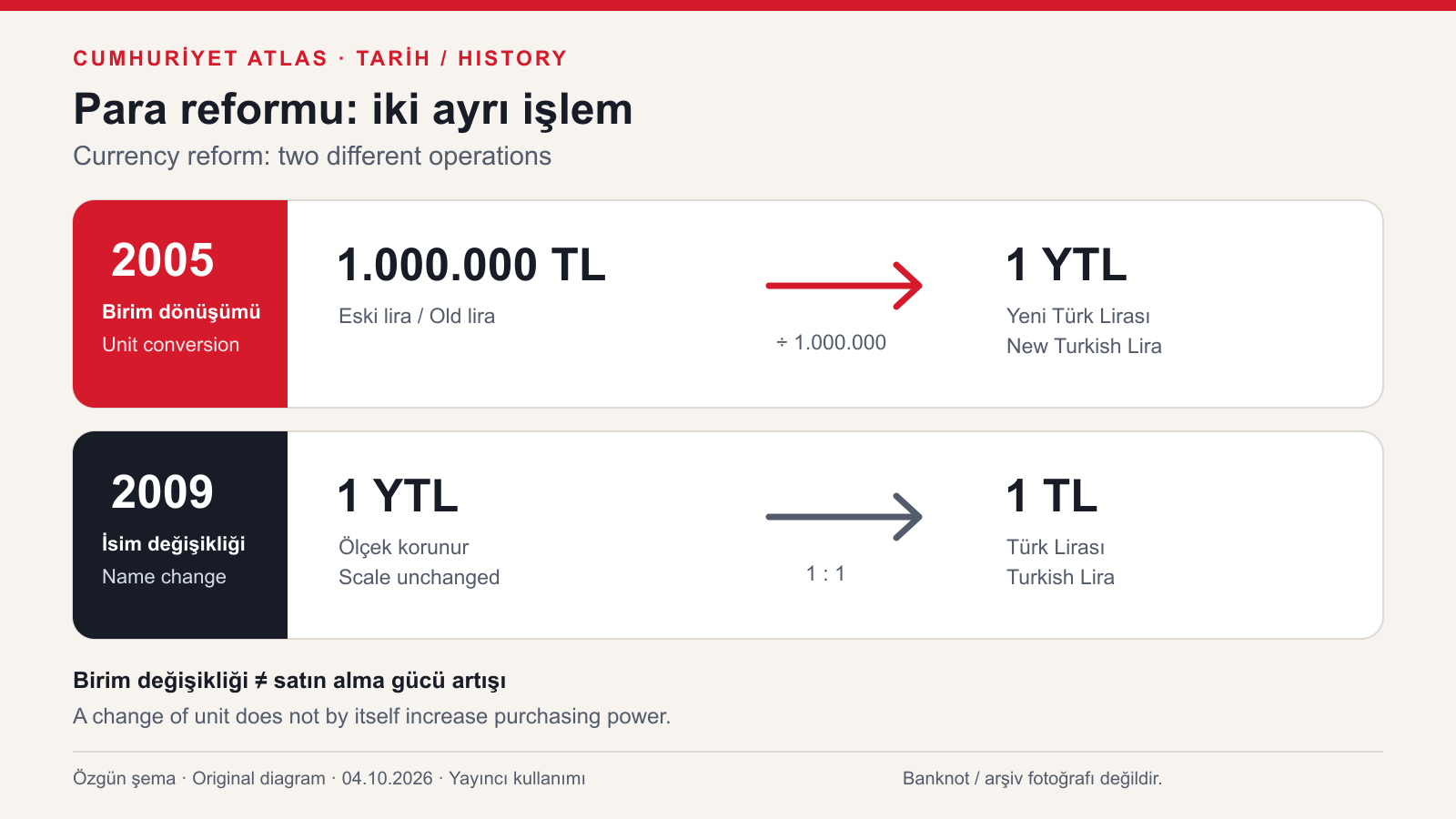
Transformation, 1980–2001 · currency reform, 2005/2009
Economic transformation, 1980–2001, and currency reform, 2005/2009
Financial opening, crisis, bank repair and a change of currency unit are not the same process. Explore selected turning points through an original conversion diagram and explanations that help make sense of archival documents.
Explore →Documents and sources16 sources
Official reference points used to verify the chronology and interpretive frame on this page.
- Düzce's record of the 1999 earthquakes ↗Düzce Valiliği
Two events and the scope of a local record.
- The exercise of 17 August 2020 ↗Afyonkarahisar AFAD
Institutional preparation at the commemorative hour.
- ISMEP evaluation · 2018 ↗Dünya Bankası · IEG
Reconstruction and risk reduction compared.
- DASK education record · 2019 ↗Düzce AFAD
The insurance system's historical start.
- AFAD institutional history ↗AFAD
Establishment and administrative affiliation.
- TAMP · 2022 ↗AFAD
Response responsibilities and levels.
- An early response bulletin ↗AFAD
Earthquakes and early response.
- Early damage estimate · 2023 ↗Dünya Bankası
The scope of direct physical damage.
- Resilient schools project · 2023 ↗Dünya Bankası
The result for a specific project group.
- Situation report · January–March 2024 ↗UNICEF
Work supporting children and education.
- Education needs · May 2024 ↗UNICEF · ESWG
Access barriers in household research.
- Local labour-market study · 2023 ↗ILO
Housing, services and workers' return.
- Seasonal agricultural workers study ↗UNICEF
Findings from March 2023 fieldwork.
- Initial heritage statement · 2023 ↗UNESCO
Confirmed damage versus initial concern.
- Arslantepe conservation report · 2023 ↗UNESCO · 45.COM
Temporary roof, adobe and urgent repairs.
- The exercise of 12 November 2022 ↗Antalya AFAD
Remembrance and nationwide preparedness.