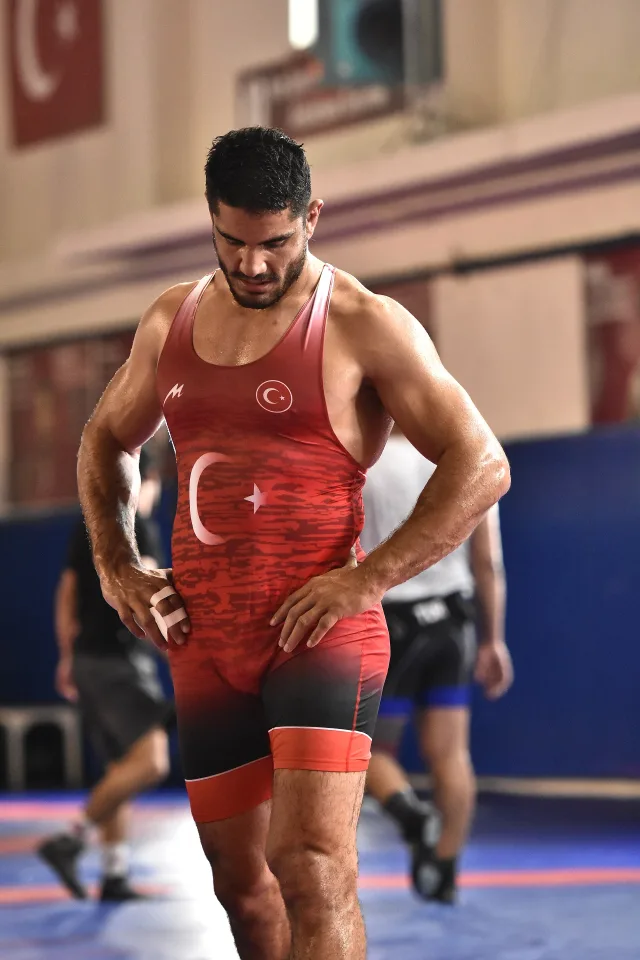
Hamza Yerlikaya’s sporting career can be read through the challenge of reproducing an achievement first made at a very young age. A world title at seventeen and gold at two separate Olympic Games are different competitions. This dossier explains Greco-Roman wrestling’s distinctive movement possibilities so that the titles retain their technical context.
- Style
- Greco-Roman
- Olympic golds
- Atlanta 1996 · Sydney 2000
- First world title
- Stockholm 1993 · senior · 82kg
Stockholm 1993: an early senior breakthrough
UWW’s historical assessment records Yerlikaya winning the senior 82kg world title in Stockholm in 1993 at seventeen. This was not a junior-category medal. Keeping age separate from competition category makes clear the field in which he competed and the precise scope of the achievement.
Early success is not a prediction of an inevitable future. After a first senior title, opponents know an athlete better and expectations change. Later chapters deserve their own attention as the same skills are performed under greater scrutiny and adapted to new competitive circumstances, rather than merely repeated unchanged.
Back to contentsDistinguishing Greco-Roman from freestyle
Greco-Roman does not permit direct attacks on the legs and leg-assisted trips as freestyle does. Upper-body gripping, breaking balance and moving the opponent’s torso consequently become more prominent. A shared mat and similar clothing should not lead viewers to treat the two styles as one identical technical system.
Follow the hands first, then the balance established through the feet. Securing a grip does not mean that a throw has begun: the opponent’s weight must be moved in the useful direction. Tracking this preparation offers a clearer technical reading than watching only the fast finishing movement at the end of the exchange.
Back to contentsAtlanta 1996 and Sydney 2000
A second world title followed in 1995. Yerlikaya then won Olympic gold at 82kg in Atlanta in 1996. At Sydney 2000 he carried Türkiye’s flag during the opening ceremony and won his second Olympic title. World and Olympic honours can share a career list, but their competition names should remain visible.
Winning again four years later measures continuity differently from a sequence of victories inside one tournament. Preparation starts again, the opponent pool changes and expectations grow. Describing the Games as the same final repeated obscures the years of renewed preparation required between the two successful appearances.
Back to contentsScore, control and match rhythm
A wrestling result cannot be judged only by the visual beauty of a throw. Decisions, points and boundary situations also shape the contest. Applying present rules to historical footage creates another problem: scoring values, passivity procedures and match formats can change across the years covered by an athlete’s career.
In Yerlikaya’s footage, examine the relationship between maintaining a grip and completing an action. Control may begin with a small positional adjustment before a large movement. Observation does not establish that we know an athlete’s intention: describing what is visible differs from asserting an unpublished coaching plan behind it.
Back to contentsFrom an individual career to wrestling history
He won a third world title at 96kg in 2005, a different weight category from the early 82kg results. The category change must remain visible in a career table. UWW places his sustained achievements within Türkiye’s strong wrestling tradition. That tradition belongs neither to one style nor exclusively to male competitors. Yasemin Adar’s women’s freestyle dossier opens another technical and institutional development route from the same national sporting landscape.
Read the Olympic history before this biography, then continue to Adar. Match TRT’s 2001 European footage to its actual competition title. Using a European championship archive without calling it an Olympic final does not diminish its value; it demonstrates that the career extended across different competitive stages.
Back to contentsA timeline of life, work and history
- 1993
First senior world gold
At seventeen he won the 82kg Greco-Roman competition in Stockholm.
- 1995
A second world title
Another world championship in Prague established continuity after the first breakthrough.
- 1996
Atlanta Olympic gold
He became Olympic champion in the 82kg event.
- 2000
A second Olympic title in Sydney
After carrying the flag at the opening ceremony, he won his second Olympic gold.
- 2005
World champion at 96kg
His third world gold came in a different weight category from the earlier 82kg titles.
Watch and listen: a visual reading path
Use this selection alongside the analysis above. Supported YouTube publications can be watched on this page after you choose to load their player. The publisher’s rights and availability conditions apply; the player does not load or start automatically. Official publication links remain available as an alternative.
TRT SPOR Arşiv
Archive: Hamza Yerlikaya’s 2001 European title
Watch gripping and upper-body exchanges through the official broadcaster archive; this is the 2001 European competition, not an Olympic final.
Choosing to load the player connects to YouTube and shares technical data such as your IP address with Google. Autoplay is off. This choice does not change your cookie preferences. The publisher may restrict regional access or embedding; the official link below provides an alternative.
Questions and explanations
Was the 1993 medal a junior championship?
No. UWW records a senior world title. The athlete was young, but the competition was senior; age and event category are different pieces of information.
Are freestyle and Greco-Roman technically identical?
No. The limits on attacking and using the legs differ. Understanding upper-body grips provides an essential starting point for reading a Greco-Roman match.
Can today’s rules be applied to an archive video?
Not automatically. A recording belongs to its competition year and the rules then in force. A current rulebook does not explain every historical decision without further context.
Sources, image rights and research method
This is original explanatory and analytical writing informed by the sources below. AI assisted research and drafting. Awards for people, teams and institutions are distinguished; dated results are not current rankings. Media links do not claim a licence to republish a video here. Use the publisher’s correction process if a fact is wrong.
- United World Wrestling · Official historical results database ↗ Source check: 2026-10-03
- United World Wrestling · Top wrestlers of the 1990s ↗ Source check: 2026-10-03
- United World Wrestling · Youngest and oldest Greco-Roman Olympic gold medallists ↗ Source check: 2026-10-03
- TRT SPOR Arşiv · Hamza Yerlikaya, European title in 2001 ↗ Source check: 2026-10-03