Remembering Adile Naşit only as a beloved screen mother leaves much of her working life out of the picture. The inheritance of a theatrical family, comedy before a live audience, acting within a large film cast and telling stories to children on television involve different skills. This dossier approaches them as connected but distinct parts of one career. Her warm screen image is not a complete documentary record of her private personality. Biography, a fictional role and an audience's affectionate memory need to remain distinguishable if we are to understand the professional achievement behind the familiarity.
- Life
- 1930–1987 · Istanbul
- Fields
- Theatre, cinema, television and storytelling
- Documented stage work
- Etnan Bey Duymasın · inaugural Muammer Karaca Theatre cast · 1955
- Individual acting prize
- 1976 Antalya Best Actress · İşte Hayat
- Familiar screen roles
- Hafize Ana in Hababam Sınıfı; Masalcı Teyze in Uykudan Önce
- Her own voice in the archive
- İşte Hayatınız · TRT · 1984
Growing up within a theatrical family
Born in Istanbul in 1930, Naşit encountered theatre through her family. Her father, Naşit Özcan, worked in the tuluat tradition; her mother, Amelya, also belonged to the stage world, and her brother Selim Naşit Özcan became an actor. TRT's professional portrait recalls these roots. Early familiarity and a sustained career are not the same thing, however. Explaining an actor's achievement entirely through family connections makes her own years of work disappear.
Tuluat should not be reduced to the assumption that every scene was spontaneously improvised without preparation. Audience relations, verbal comedy, recognisable character types and interplay are important parts of its culture. Watching how Naşit leaves room for another performer can offer a useful bridge between this background and her screen work. That is an interpretive connection, not proof that a particular film scene was improvised. The distinction lets us appreciate continuity without inventing a production history.
Back to contentsMuammer Karaca Theatre and a working stage culture
The Istanbul municipality's history of Muammer Karaca Theatre lists Naşit in Etnan Bey Duymasın, the play with which the venue opened in 1955. It anchors her professional stage work before her widest screen recognition in a specific production and place. It does not prove that she appeared in every play there, or worked there without interruption throughout the theatre's entire history. Individual productions need individual evidence.
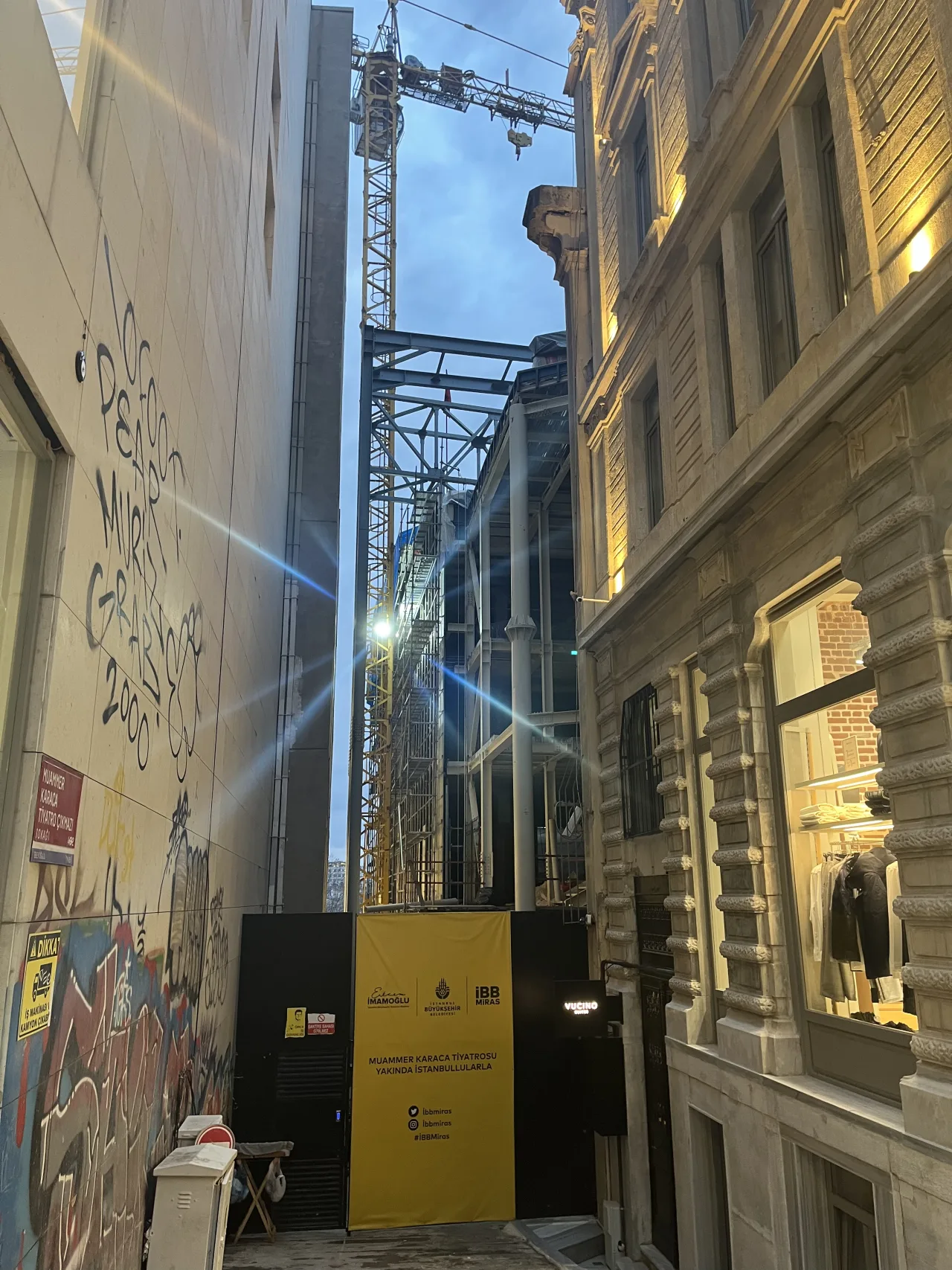
The photograph on this page shows restoration works at the same theatre on 13 December 2024. The actress is not in it. Preserving a venue reminds us that performance history consists of more than posters and celebrity portraits: entrances, auditoriums, working spaces and their surrounding streets help shape a profession. Without equating today's structure with its earlier stage arrangements, we can connect Naşit's career to the theatre life of Beyoğlu. The later photograph is explicitly contextual evidence, not a record of her performing.
Back to contentsMavi Boncuk: a distinct presence inside an ensemble
Ertem Eğilmez's Mavi Boncuk, dated 1974, allows Naşit to be seen within an ensemble of contrasting acting styles. İKSV's credits document her participation alongside Emel Sayın, Tarık Akan, Kemal Sunal, Münir Özkul and other performers. In this kind of comedy, impact is not measured solely by the size of a role. A short reply, glance or entrance can redirect a scene's rhythm and leave a lasting impression.
In her scenes, follow the flow of the conversation rather than only the volume of her voice. Interrupting with a quick reaction and leaving someone space to answer produce different effects. Our viewing suggestion is to watch her while another actor speaks as carefully as when she has the line. Supporting the narrative need not mean being passive. The film emerges as a network of interactions, with each performer helping determine how the others are understood. That is a useful way of seeing the craft beneath apparent ease.
Back to contentsHafize Ana: another kind of authority within the school
Hafize Ana in the Hababam Sınıfı films is among Naşit's strongest associations in audience memory. Rather than confusing her with an actual mother or schoolteacher, consider the character's place within the fictional institution. Discipline, the students' evasions and their attachment to one another form the surrounding world. Hafize Ana introduces a language of care and familiarity into it. Showing concern and overlooking a rule do not necessarily mean the same thing in every scene.
The performance's appeal cannot be reduced to a gentle voice. Responses to a student's behaviour can emphasise complicity, a warning or emotional support. The school story, with its crowded cast of adult performers, is a constructed comic world rather than documentary evidence of real childhood. Examining how Hafize Ana operates inside that world is a productive starting point for asking why audiences from different generations remember her. It also keeps the actress's craft distinct from the character's affectionate reputation.
Back to contentsNeşeli Günler: conflict as well as warmth
Watching Naşit alongside Münir Özkul in Neşeli Günler tests the idea that family comedy is simply a picture of cosy nostalgia. The parents' separation, the children's relationships and the possibility of renewed closeness occupy the same story. Her character is not merely a patient mediator. Decisions, anger and the determination to have her own say also create the film's emotional movement.
Arzu Film's official upload makes it possible to follow what happens before and after a comic exchange rather than rely on a compilation of famous lines. Notice where the children stand after an argument and how the music accompanies a change in feeling. This approach does not deny the warmth of the performance; it brings its conflicts into view. Present-day viewers can discuss the film's expectations of women and family life critically. Loving a character does not require treating every action as a model to follow.
Back to contentsİşte Hayat: an individual achievement in the right category
Antalya's official Golden Orange archive records Naşit's 1976 Best Actress award for İşte Hayat. This is neither a supporting-actress prize nor an award for Hababam Sınıfı. Identifying the correct work and category helps prevent her career being overshadowed by one very famous supporting role. The festival's award year should also be kept separate from production or release years that can differ between film catalogues.
An award is not a final measure of an entire artistic life; it records a particular jury's recognition of a particular performance. Work in theatre or children's television cannot be measured by the same cinema competition. This dossier highlights a verified individual prize without adding undocumented international acting victories. National popularity, influence across television generations and competitive recognition are separate subjects. Distinguishing them does not diminish the artist's importance; it describes that importance more accurately and leaves room for contributions that prizes cannot count.
Back to contentsUykudan Önce: addressing a child directly
In memories of 1980s television, Naşit also appears as the storyteller of Uykudan Önce. TRT Dinle's programme archive and artist record preserve institutional traces of the presence remembered as Masalcı Teyze, the storytelling aunt. Conflicting dates circulated for its beginning are not forced into a false certainty here: the programme and its broader period are identified. Her television narrator and her cinema characters are not the same role.
When telling a story, the performer addresses the child beyond the screen rather than another character within a film. Clear phrasing, pauses that create curiosity and changes in vocal rhythm are some of the tools through which narration works. Intimacy with a young audience should not be mistaken for a patronising simplification. TRT's 1984 İşte Hayatınız programme provides a different encounter: the opportunity to hear Naşit speak about her work, alongside recollections from people around her. Its later archive upload preserves a historical programme rather than a new interview.
Back to contentsRemembering a career: a later biopic and a viewing route
Naşit died in 1987, but films and archived voices continue to provide encounters with her work. The Culture and Tourism Ministry's record dates the release of Çağan Irmak's biographical film Adile Naşit to 5 December 2025, with a screenplay by Nermin Yıldırım and production by BKM. A later biopic can renew interest in an artist. Its dramatised scenes should not, however, be treated as independent documentary proof of events in her life.
For a viewing route, begin with her own conversation in the 1984 programme, then compare the ensemble work of Mavi Boncuk, Hafize Ana in Hababam Sınıfı and the family conflicts of Neşeli Günler. Finally, TRT's Uykudan Önce audio archive invites attention to storytelling without the image. This is not a claim to provide a complete filmography. It brings together different ways in which one artist communicated across stage, cinema and television, and makes the act of listening part of the study of performance.
Back to contentsA timeline of life, work and history
- 1930
Born into a theatrical family
Born in Istanbul, she grew up with the stage world of Naşit Özcan and Amelya, an early context for her professional life.
- 1955
The opening of Muammer Karaca Theatre
The municipality lists her in the inaugural Etnan Bey Duymasın cast, documenting a specific stage production.
- 1974
Mavi Boncuk
She appeared in Eğilmez's ensemble film; İKSV's archive preserves the shared cast credits.
- 1970s
Hafize Ana
Her role in the Hababam Sınıfı films contributed a distinctive language of care, closeness and solidarity to the school comedy.
- 1976
Golden Orange for İşte Hayat
She received Best Actress, an individual acting award rather than a supporting-actress category.
- 1978
Neşeli Günler
Alongside Münir Özkul she inhabited a family comedy shaped by conflict as well as affection.
- 1980s
Uykudan Önce
She addressed children as Masalcı Teyze. TRT's audio archive offers a way to hear that storytelling again.
- 1984
İşte Hayatınız
TRT recorded her conversation and memories from her professional circle. The present-day archive upload dates from later.
- 1987
Death
Her life ended; films and children's television became continuing routes through which later generations encountered her.
- 2025
A later biographical drama
The ministry records a 5 December release for Adile Naşit, a subsequent film dramatising her life.
Watch and listen: a visual reading path
Use this selection alongside the analysis above. Supported YouTube publications can be watched on this page after you choose to load their player. The publisher’s rights and availability conditions apply; the player does not load or start automatically. Official publication links remain available as an alternative.
TRT Arşiv
İşte Hayatınız · Adile Naşit · 1984
The 1984 programme hosted by Uğur Dündar preserves the artist's own conversation and recollections from people close to her. TRT's 2022 archive upload is not the recording year; personal memories should be read alongside independent film and festival records.
Choosing to load the player connects to YouTube and shares technical data such as your IP address with Google. Autoplay is off. This choice does not change your cookie preferences. The publisher may restrict regional access or embedding; the official link below provides an alternative.
ARZU FİLM
Neşeli Günler · Arzu Film's official upload
Follow Naşit and Münir Özkul's interplay and the changing emotional rhythm of the family comedy in the full film. This is the producer's official upload; availability and regional restrictions may change. The link does not provide a licence to copy stills or film files.
Choosing to load the player connects to YouTube and shares technical data such as your IP address with Google. Autoplay is off. This choice does not change your cookie preferences. The publisher may restrict regional access or embedding; the official link below provides an alternative.
Questions and explanations
Should Naşit be remembered only for mother roles?
No. Beloved maternal and caring roles matter, but theatre, ensemble comedy and television storytelling require different professional skills. A familiar role is not identical to the artist's whole life or career.
Which film and category brought her the Golden Orange?
Antalya's official archive records the 1976 Best Actress award for İşte Hayat. Attributing it to Hababam Sınıfı or the Best Supporting Actress category would be incorrect.
Are Uykudan Önce and the 1984 İşte Hayatınız the same programme?
No. Uykudan Önce featured her storytelling for children. İşte Hayatınız was a separate conversation and life-retrospective format. Archive upload dates are not the original broadcast dates of either historical programme.
How should the theatre photograph and the 2025 biopic be understood?
The 2024 photograph shows later restoration of a place associated with her working life, not the actress or a performance. The 2025 film is a biographical drama. Both can open routes into cultural memory, but neither alone establishes exactly how a historical event unfolded.
Sources, image rights and research method
This is original explanatory and analytical writing informed by the sources below. AI assisted research and drafting. Awards for people, teams and institutions are distinguished; dated results are not current rankings. Media links do not claim a licence to republish a video here. Use the publisher’s correction process if a fact is wrong.
- TRT Vizyon · Aralık 2019: Adile Naşit'in tiyatro kökleri ↗ Source check: 2026-10-03
- İBB Kültür Sanat · Muammer Karaca Tiyatrosu: 1955 açılış kadrosu ↗ Source check: 2026-10-03
- İKSV · 2014 festival arşivi: Mavi Boncuk künyesi ↗ Source check: 2026-10-03
- Antalya Altın Portakal · Geçmiş ödüller: 1976 İşte Hayat ↗ Source check: 2026-10-03
- TRT Dinle · Adile Naşit: Hafize Ana ve Masalcı Teyze ↗ Source check: 2026-10-03
- TRT Dinle · Uykudan Önce arşivi ↗ Source check: 2026-10-03
- TRT Arşiv · İşte Hayatınız: Adile Naşit, 1984 ↗ Source check: 2026-10-03
- Arzu Film · Neşeli Günler: resmi film yayını ↗ Source check: 2026-10-03
- Kültür ve Turizm Bakanlığı Sinema Genel Müdürlüğü · 2025 Adile Naşit filmi künyesi ↗ Source check: 2026-10-03