This dossier begins by refusing to reduce an actor to one beloved character. Rather than remembering a line alone, we can ask whom a character addresses and what responsibility he carries within a scene. The connecting question for the selected productions is this: how does a story's balance change when a figure of authority begins to listen?
- Life
- 15 August 1925 – 5 January 2018
- Professional beginning
- 1948 · Ses Theatre
- Approach
- Comparative reading across roles, companies and genres
Bakırköy and beginnings
Born in Istanbul on 15 August 1925, he attended Istanbul Erkek Lisesi and performed at the Bakırköy community centre in 1940.
Aşk Köprüsü at the Ses Theatre marked his professional beginning in 1948. Küçük Sahne's repertoire included Of Mice and Men, The Playboy of the Western World and The Teahouse of the August Moon.
Back to contents1951: an ensemble at Küçük Sahne
Supported by Yapı Kredi, Küçük Sahne opened in 1951 with Muhsin Ertuğrul's Of Mice and Men. Şükran Güngör and Nuri Altınok played the leads; Özkul was in the cast. Sadri Alışık and Haldun Dormen also appear in the company list.
Lectures, poetry evenings, exhibitions and screenings made this a working environment beyond one play. The focus is not just a star's rise, but actors working in the same institution. The Muhsin Ertuğrul dossier develops that institutional connection.
Back to contentsTwo films: 1953, 1967
Özkul appeared in Muhsin Ertuğrul's Halıcı Kız (1953), premiered at Atlas on 13 April, and in Tunç Başaran's Elveda (1967), alongside Selda Alkor and Kartal Tibet: two productions beyond family comedy.
Halıcı Kız was scripted by Mebrure Sami Alevok, with music by Ferit Alnar. Elveda is the melodrama of Selda Alkor's Mine and Kartal Tibet's Kemal; its 2019 screening honoured Alkor. Family comedy is not Özkul's whole career.
Back to contentsTuluat, the kavuk and written drama
Tuluat means more than making jokes. The ministry describes a form in which a broadly outlined play develops through improvisation shaped by the audience and setting, and includes Özkul among its practitioners. Thinking about the audience in this way reveals the difference between memorising a sentence and responding to a play as it unfolds.
Kanlı Nigâr brought the 1968 İlhan İskender Award; Dümbüllü passed him the kavuk. Sersem Kocanın Kurnaz Karısı brought the 1978 Avni Dilligil award.
Back to contents1975: Mahmut Hoca's position
In the 1975 Rıfat Ilgaz adaptation Hababam Sınıfı, Mahmut Hoca is deputy head and history teacher. Facing cheating and truancy, he brings the consequences of pupils' behaviour into the story.
Ask not only who fools whom, but how one pupil's experience affects the class. This reading brings discipline and solidarity together.
Back to contents1977: Yaşar and Nezaket's household
In Gülen Gözler (1977), Özkul's Yaşar Usta and Adile Naşit's Nezaket have five daughters. Wedding expenses, debt and a secret mortgage make conflict material: calling Yaşar merely stubborn overlooks financial pressure.
Consider Yaşar and Nezaket together: protecting the same family allows different methods. The Adile Naşit dossier helps read the home beyond the father's perspective.
Back to contentsTelevision and the archived voice
İbiş'in Rüyası is Sırrı Gültekin's 1979 television series.
TRT Arşiv's page dated 2022 presents Özkul reading a monologue associated with Tomas Fasulyeciyan. Alongside the films, this short reading offers a separate route into voice: follow where sentences pause and whether the address seems directed towards one person or a group. The page does not identify the original recording date, so no stage season is assigned to it here.
Back to contents2014: career recognition and legacy
At the Afife ceremony on 28 April 2014, Özkul received the Muhsin Ertuğrul Special Award; his daughter Güner accepted it. This was not a film's prize or a competitive result for a single role performed that season. Named after the theatre director with whom he had worked, the award makes the relationship between institution and actor visible again.
Özkul died on 5 January 2018.
Back to contentsAn actor within an ensemble
In his Halit Akçatepe portrait for IKSV, Agâh Özgüç recalls Özkul and Ertem Eğilmez as Akçatepe's masters in cinema, naming Kemal Sunal and Adile Naşit among his colleagues. This reveals a critic's account of relationships between actors, not an official teaching appointment.
Özgüç's emphasis on team acting places the ensemble against a solitary-hero model. Return to the same film environment through friendships and casts in the connected dossiers, without separating a character's weight from the other actors.
Back to contentsA timeline of life, work and history
- 1925
Istanbul
Born on 15 August.
- 1948
Professional stage
Ses Theatre: Aşk Köprüsü.
- 1951
Küçük Sahne
A member of its opening repertoire's cast.
- 1953
Halıcı Kız
Atlas premiere: 13 April.
- 1968
Kanlı Nigâr
İlhan İskender Award; kavuk handover.
- 1975
Hababam Sınıfı
Mahmut Hoca role.
- 1977
Gülen Gözler
Yaşar Usta role.
- 1979
İbiş'in Rüyası
Television series.
- 2014
Afife
28 April: Muhsin Ertuğrul Special Award.
- 2018
Death
Died on 5 January.
Watch and listen: a visual reading path
Use this selection alongside the analysis above. Supported YouTube publications can be watched on this page after you choose to load their player. The publisher’s rights and availability conditions apply; the player does not load or start automatically. Official publication links remain available as an alternative.
ARZU FİLM
Hababam Sınıfı
The producer's official publication of the 1975 film.
Choosing to load the player connects to YouTube and shares technical data such as your IP address with Google. Autoplay is off. This choice does not change your cookie preferences. The publisher may restrict regional access or embedding; the official link below provides an alternative.
ARZU FİLM
Gülen Gözler
The producer's publication of the 1977 film, accompanying the household chapter.
Choosing to load the player connects to YouTube and shares technical data such as your IP address with Google. Autoplay is off. This choice does not change your cookie preferences. The publisher may restrict regional access or embedding; the official link below provides an alternative.
TRT Arşiv
Monologue
The reading linked by TRT's 2022 archive page. That page does not identify the original performance date; this is not a new stage performance from 2022.
Choosing to load the player connects to YouTube and shares technical data such as your IP address with Google. Autoplay is off. This choice does not change your cookie preferences. The publisher may restrict regional access or embedding; the official link below provides an alternative.
Questions and explanations
Is the kavuk a play's prize?
No; it symbolically transmits a tradition, rather than awarding a particular play.
What is Mahmut Hoca's job?
Deputy head and history teacher, not the head of the school.
Which medium for İbiş'in Rüyası?
The work discussed here is the 1979 television series, not a cinema film.
Where can I begin the viewing selection?
Read the school and household chapters first, then compare the two productions as complete works. Leaving the archive reading until afterwards gives a separate opportunity to concentrate on the rhythm of speech.
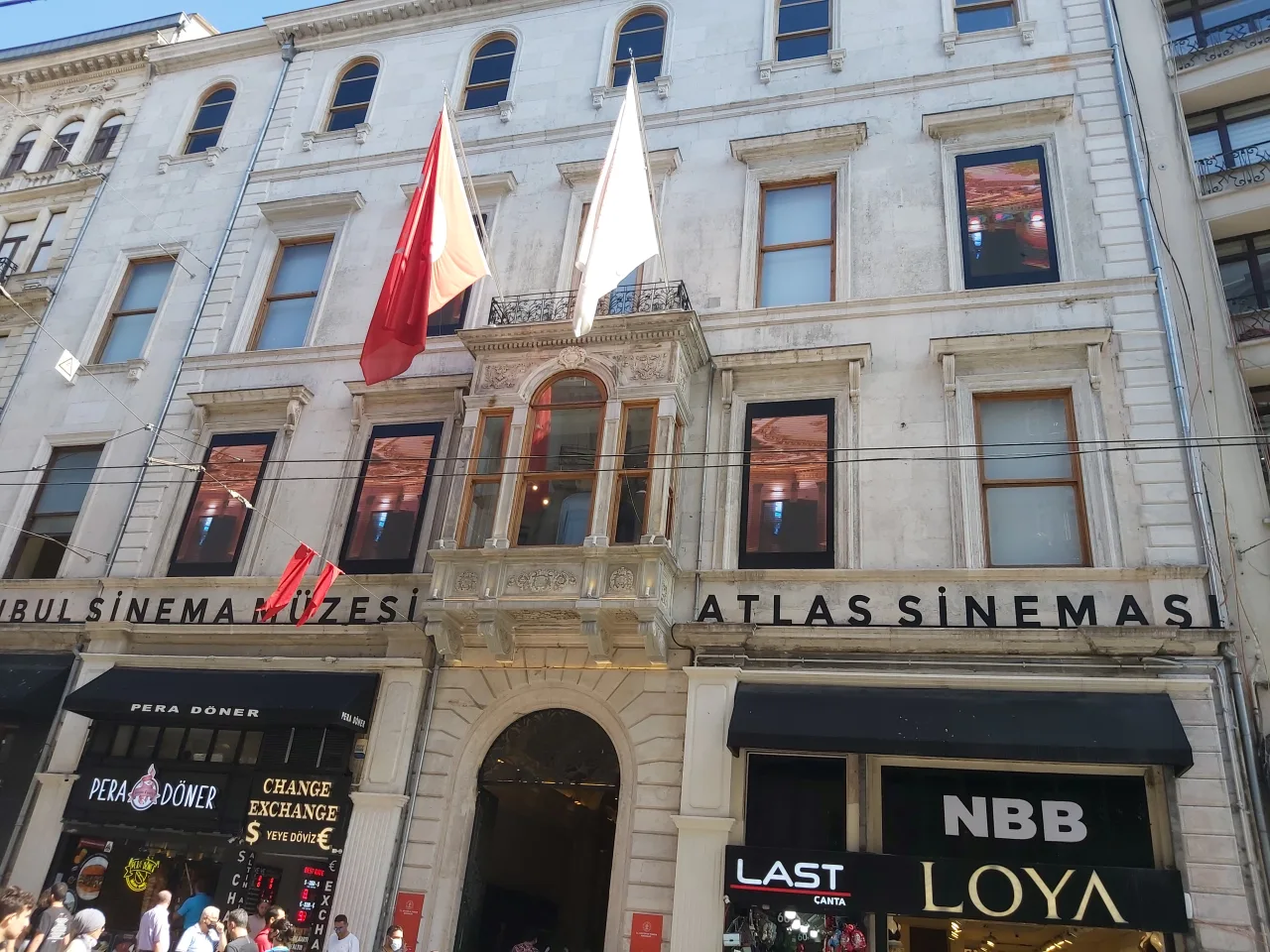
Does the cover photograph show Özkul?
No. It shows Atlas's exterior in 2021. A later venue image is not presented as an actor's portrait or a moment from the earlier premiere.
Sources, image rights and research method
This is original explanatory and analytical writing informed by the sources below. AI assisted research and drafting. Awards for people, teams and institutions are distinguished; dated results are not current rankings. Media links do not claim a licence to republish a video here. Use the publisher’s correction process if a fact is wrong.
- İKSV · Münir Özkul ↗ Source check: 2026-10-04
- Yapı Kredi · Küçük Sahne ↗ Source check: 2026-10-04
- İKSV · Halıcı Kız ↗ Source check: 2026-10-04
- İKSV · Elveda ↗ Source check: 2026-10-04
- Kültür Bakanlığı · Tuluat ↗ Source check: 2026-10-04
- Arzu Film · Hababam Sınıfı ↗ Source check: 2026-10-04
- Arzu Film · Gülen Gözler ↗ Source check: 2026-10-04
- Afife · 2014 ödül töreni ↗ Source check: 2026-10-04
- TRT Haber · Münir Özkul ↗ Source check: 2026-10-04
- TRT Arşiv · Tirad ↗ Source check: 2026-10-04
- İKSV · Agâh Özgüç: Halit Akçatepe ↗ Source check: 2026-10-04