Priene and Miletus explain how an ancient city now inland could once depend on the coast. Explore Aydın through changing geography and urban design as well as its seaside destinations.
An AI-assisted synthesis of the sources below, with Atlas planning suggestions. This is not a first-hand visit report. Admission, transport and access conditions must be checked with operators before travel.
In this guide
Follow the plan at Priene
Near Söke, Priene adapts a regular street layout to sloping ground. Read the temple, agora and residential areas as connected parts of a city rather than isolated monuments. Stepped streets also make a useful practical point: an orderly plan does not necessarily mean an easy, level walk.
Where was Miletus’s harbour?
Understand Miletus near Balat through its former maritime role and the sediment carried by the Menderes. The theatre and other major ruins are only part of the story; later buildings reveal continued occupation and changing uses. Do not project today’s shoreline unchanged into antiquity.
Compare the two sites
At Priene, concentrate on slope and street organisation; at Miletus, on spatial scale and the changing coast. Allow for transfers and exposure to the sun, splitting the visits across days if that gives you time to look properly. Confirm opening arrangements and physical access with the current official operator rather than relying on old travel schedules.
Aphrodisias connects marble, sculpture and an urban economy
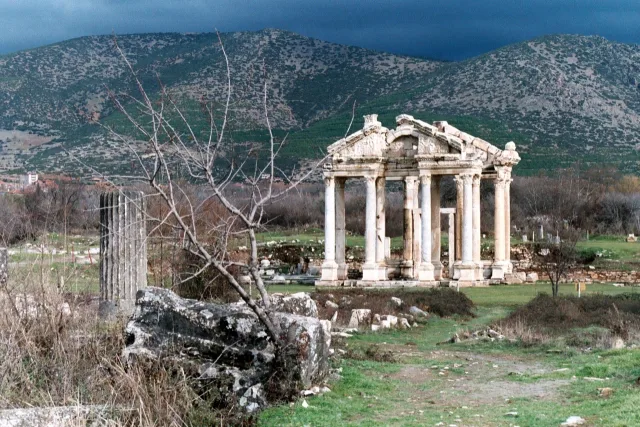
Around Geyre in Karacasu district, Aphrodisias was inscribed on the World Heritage List in 2017. Identifying it only with Aphrodite's name or a few monumental entrances leaves the significance of sculpture production unexplored. Nearby marble resources, stoneworking and the city's artistic environment belong together. Compare the surface of one museum sculpture with architecture outside, asking how a shared material could be shaped for different functions.
An object displayed indoors did not begin its entire history in the gallery. Findspot, use and later changes need attention on the label. Check the museum and archaeological site's currently accessible sections independently. A day organised around marble workmanship can allow close study of several examples rather than a hurried attempt to photograph every detail. Questions about production give a familiar monument a wider social setting.
At Nysa, a streambed divides the city plan
Nysa in Sultanhisar is distinguished by a deep streambed crossing its settlement. Ancient bridges linked the sides, while the theatre, library, gymnasium and public buildings were arranged in relation to the terrain. Instead of visiting only for a theatre photograph, investigate how a valley could create both difficulty and connection within a city. Today's visitor paths are not necessarily the routes used in antiquity.
Find the permitted route before comparing structures on either side. Site explanations can help distinguish ancient remains from later protection arrangements. The library offers a way to think about intellectual life; its existence does not prove identical education for the entire population. An archaeological day also calls for different outdoor preparation from a beach holiday. Give the terrain time to become understandable rather than making every building another isolated stop.
Understand Karacasu pottery through its making
Karacasu's handmade pottery tradition takes Aydın's cultural story from ancient sites to present production. During a workshop visit, ask about clay preparation, shaping, drying and firing as well as finished vessels. A brief demonstration at a spinning wheel does not represent the entire process. Labour, time and materials can explain why two objects of similar colour are not interchangeable. A question about making may be more rewarding than asking only for the lowest price.
Before buying, find out where the product was made and what use it is intended for. A decorative vessel does not automatically carry the same assurances as one produced for food contact; request clear information from its maker or seller. Ask permission before photographing a workshop and do not presume work will stop for a lengthy demonstration. Archaeology around Geyre and contemporary production in Karacasu offer two different readings of one district.
Choose distinct bases for Efeler, the coast and the interior
Central Aydın, the Kuşadası and Didim coasts, Sultanhisar and Karacasu are not a single visitor location. Tralleis is a historical focus in the provincial centre, while Nysa opens onto another district and Aphrodisias occupies the inland Geyre area. Using a province name as though it were a hotel address can distort distance assumptions. Decide first whether your priority is the coast, urban history, or production and archaeology.
For a short visit, choose one principal site and its nearby context, such as Nysa with Sultanhisar or Aphrodisias with Karacasu. Avoid attempting to connect every district on the first day. Midday exposure, meals and return connections are not minor details outside the itinerary. For a coast-to-interior journey, consider the actual departure point and where the day ends. Consecutive scenes in a promotional film may represent widely separated places, not neighbouring stops.
Choose the visit that fits your question
Urban design
Trace the relationship between public and domestic space at Priene.
Landscape change
Compare Miletus’s former harbour with its present setting.
A shared question
Ask how terrain shaped each city’s plan.
Visual exploration before you travel
Go&Visit · Aydın, 2024
Recognise coastal, urban and inland settings; do not read the film's edited sequence as a one-day transport itinerary.
Practical questions before your visit
Is Aphrodisias in central Aydın?
No. It is around Geyre in Karacasu district. Being within Aydın province does not place it in the city centre or beside the Kuşadası coast; the journey needs its own planning.
Is Nysa another name for Miletus?
No. Nysa in Sultanhisar is distinct from Miletus around Balat. The relationship between a streambed and the city plan is a particularly useful question for a Nysa visit.
Can every Karacasu pottery product be used in a kitchen?
Do not assume so. Ask the producer or seller about intended use, materials and food-contact suitability. Appearance alone does not turn a decorative piece into a suitable kitchen vessel.
Sources and scope of this guide
These primary sources support the historical and heritage background. Comparisons and suggested ways to organise a visit are Atlas editorial analysis, not instructions from the source institutions.