For a one-day archaeological excursion in İzmir province, choose the question you want to explore first. Ephesus offers a way into ports and changing coastlines; Pergamon invites attention to a monumental city built on demanding terrain. Putting both into one day does not automatically produce a richer visit. If you also want time in the modern city, give archaeology its own day rather than allowing every possible excursion to compete for the same hours.
An AI-assisted synthesis of the sources below, with Atlas planning suggestions. This is not a first-hand visit report. Admission, transport and access conditions must be checked with operators before travel.
In this guide
Follow the idea of a port at Ephesus
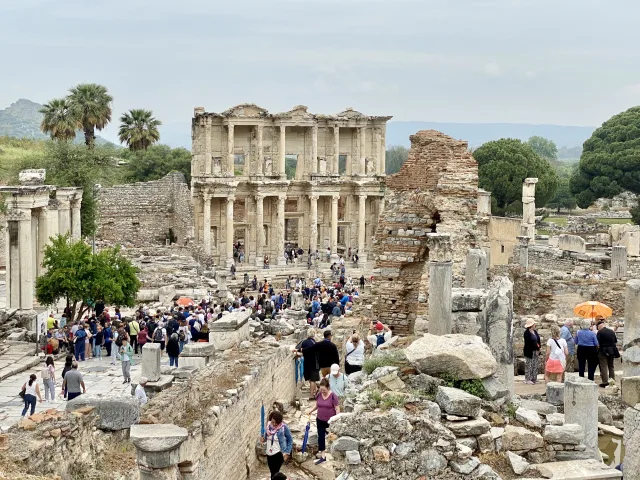
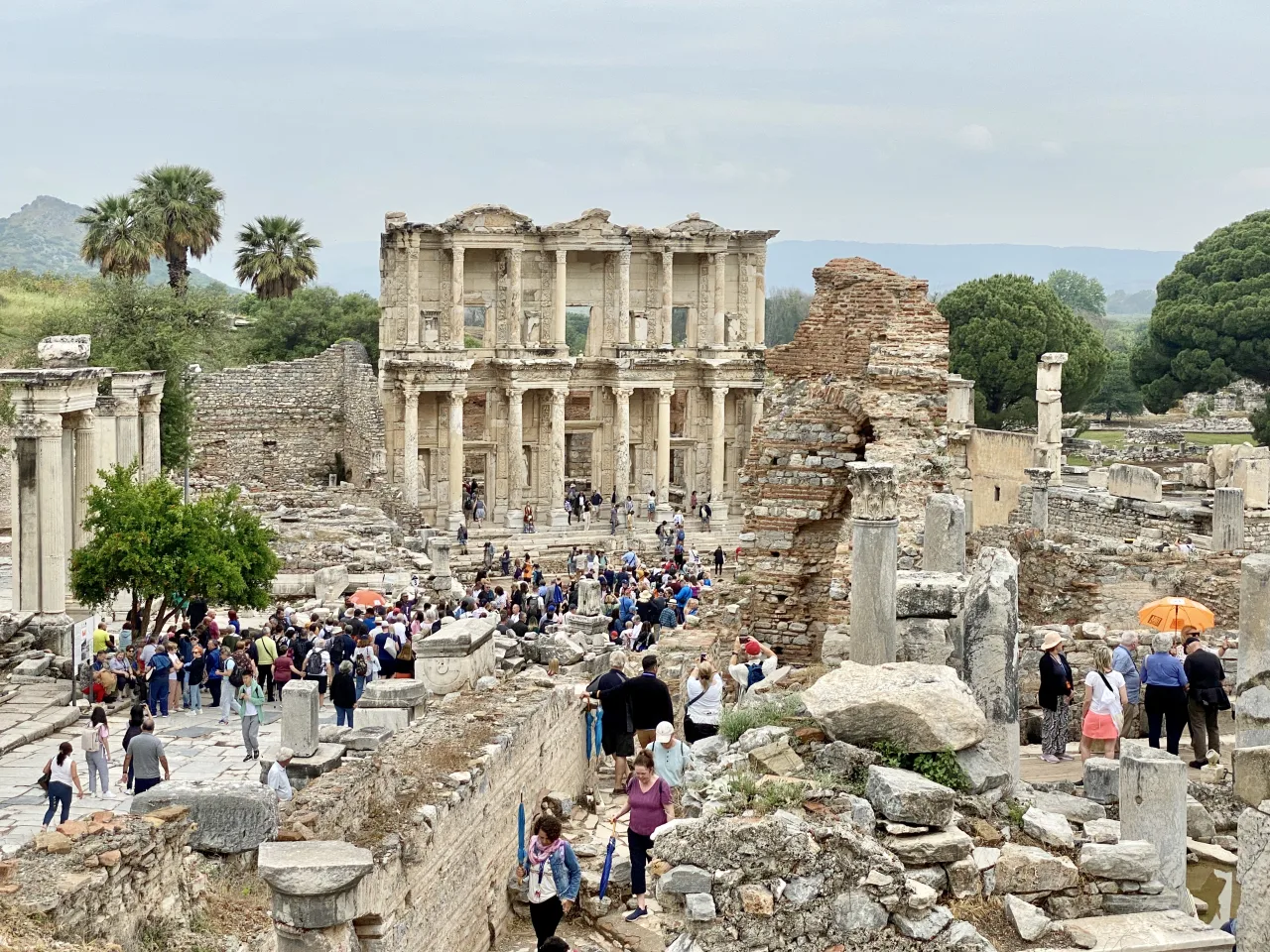
The UNESCO account of Ephesus connects successive settlements with a shifting shoreline. The Library of Celsus and the great theatre are prominent Roman-period landmarks, but size need not be your only question. Look for relationships between routes, public spaces and the idea of a port. Do not assume that the coast remained in the same position throughout antiquity simply because you are looking at today's landscape. Asking how a settlement responded to environmental change can give familiar photographs a different meaning and turn separate monuments into parts of a city.
Ask what height does at Pergamon
Pergamon's monumental arrangement relates Kale Hill to the Bakırçay Plain. Consider the positioning of the theatre, terraces and other structures within that terrain. A useful comparison with Ephesus is not which place is prettier, but how public architecture responds to different ground conditions. The property's multi-layered history also encourages attention to later settlements instead of isolating antiquity from everything that followed. You can focus on one period without imagining that the other layers were absent. That distinction makes a comparative visit more precise without requiring specialist architectural vocabulary.
Reduce the programme with a decision, not a ranking
If the library façade and a former port interest you, begin with Ephesus. If hillside planning and architecture draw your attention, begin with Pergamon. Neither choice ranks one site above the other. Confirm transport, admission arrangements and your return for one principal destination before adding a second. Add the other only when you can give it a separate day and budget. Consider surfaces, slopes and time outdoors in relation to your own mobility needs. Ask the operator about specific access requirements rather than relying on a general statement that an archaeological site is easy to visit.
Read Smyrna through an archaeological space inside the city
Alongside separate Ephesus and Pergamon excursions, the Agora in Konak introduces İzmir's own ancient city. Important surviving sections belong to the Roman period, particularly the second century. Its position between Kemeraltı and Kadifekale lets you consider ancient public life within today's dense urban fabric. Do not merge it with the earlier Smyrna settlement at Bayraklı: different periods of a city can become visible in different places.
Examine arches, columns and circulation together. Ask which level an impressive photograph represents and what the spaces in the structure were intended to do. A short subsequent walk in Kemeraltı can compare the scale of archaeology with a living commercial neighbourhood. Their proximity does not establish an identical foundation date or historical function. The contrast is more revealing than assuming every old-looking place belongs to one continuous scene.
Birgi and Tire deserve a separate Küçük Menderes excursion
Birgi belongs to Ödemiş district and occupies a historic setting between the Bozdağ foothills and Küçük Menderes plain. Its role as an Aydınoğulları capital is an important layer. Inclusion on UNESCO's Tentative List differs from World Heritage inscription. Read streets, homes, places of worship and courtyards as connected elements of settlement, not merely a picturesque backdrop. Confirm Ödemiş district when locating a place called Birgi.
Tire opens onto the same fertile valley from the slopes of Güme Mountain. A useful comparison asks how slopes, markets and domestic fabric are organised differently, not which settlement is more authentic. Avoid forcing a market visit and lengthy architectural exploration into an overpacked itinerary. House entrances, courtyards and times of worship are not unrestricted visitor space. A living town offers more than a collection of façades available for photography.
Distinguish a bay day from a coastal-district holiday
A day around Kordon and Karşıyaka differs from staying in Urla, Foça or Karaburun. Within the city, the sea can be part of transport and everyday life. A coastal-district day requires other choices about accommodation, coves and return connections. Points beside the sea on a provincial map are not automatically short outings from the same hotel. Choose the experience you want before connecting names on the map.
For ferry travel, confirm both piers, the last suitable return and weather-related changes with the current operator. A sightseeing boat trip is not the same service as regular urban transport. Time for swimming, a meal and children's rest may be more useful than collecting additional cove names. A city museum day need not become a compulsory interval in a beach holiday, nor should a coastal holiday consume the time you intended for architecture.
Build an İzmir visit around three themes
A first visit might combine an Agora and Kemeraltı city day, a separate major archaeological site, and either the Küçük Menderes hinterland or one coastal district. This is not a promise to finish the province. It makes room for deeper observations about public space, domestic life or the sea's effect on settlement. Adapt the order to your arrival arrangements and interests rather than treating one sequence as compulsory.
Select accommodation around the itinerary's backbone rather than the most recognisable photograph. City nights may support urban exploration; staying by the coast serves another priority. A plan without a lengthy coastal transfer immediately after a Birgi walk may be more balanced. Conservation rules and residents' ordinary routines are real boundaries, not interruptions to the experience. These choices give the province's variety a clear shape while leaving space to return for places not included this time.
Bayraklı: earlier settlement layers of Smyrna
Bayraklı Mound is not another name or entrance for the Agora in Konak; it is a different archaeological settlement known as Old Smyrna. A 2024 study by Ege University researchers evaluates third-millennium BC layers at the mound using stratigraphy and radiocarbon evidence. It offers a useful model for discussing early settlement through excavated layers and method instead of reducing the chronology to one precise founding moment. It also broadens İzmir's ancient story beyond the better-known Roman remains in the city centre.
Keep clear that the name Smyrna can refer to places in different periods. Do not merge the mound evidence at Bayraklı with the visible Roman-period fabric at the Konak Agora; Ephesus in Selçuk is a third, separate ancient city. A 2026 university field report says excavation continues and identifies work in the Bronze Age sector and Classical-period structures/defences. That report does not establish public entry rights, excavation-site access or that interpretations are final. Place archaeological claims in their research context, and consult the responsible institution separately for dated visitor information.
Selçuk: Ephesus is more than one façade
UNESCO describes Ephesus as a serial property of four components rather than a single monument: Çukuriçi Mound, the ancient city of Ephesus, Ayasuluk Hill and the House of the Virgin Mary. Together they reveal different periods and settlement settings; the Library of Celsus and Great Theatre are only the best-known parts of a wider story. The UNESCO account also connects settlement changes with the shifting shoreline and harbour environment. Instead of projecting today's coastline unchanged onto every ancient period, make environmental change part of the question you bring to the site.
Do not treat Selçuk/Ephesus as if it were another neighbourhood in central İzmir. Review the component names and their geography, then choose a principal focus that fits your interests; this guide does not promise that every component can be seen in one day. Archaeological areas, museums and distinct religious or historic sites may have separate operators, entry arrangements, conservation rules and visiting conditions. Those cannot be inferred from historical description; confirm them with the responsible official institution near your travel date. Any image caption should identify the Library of Celsus as Ephesus in Selçuk, not the Smyrna Agora in Konak.
Bergama: Pergamon's nine-component landscape
UNESCO's Pergamon World Heritage property comprises nine registered components, not the Acropolis alone. Its geographical table lists the multi-layered city, the Kybele sanctuary at Kapıkaya and seven tumulus components. The Acropolis, Asklepion and Red Hall are sites within the wider city component, not each a separate entry among the nine. The relationship between the monumental hill city and the Bakırçay Plain invites you to read theatres and terraces as decisions made within a particular terrain rather than as isolated structures. Choosing which site answers your historical question makes a more useful itinerary than lining up famous names without a connection.
Do not make Pergamon compete with Ephesus: the properties describe different landscapes and relationships to terrain. The name Bergama can also refer to the modern town and wider district, so write the particular place you mean into your plan. Do not assume that nine components form one compact walking route or share the same visiting arrangements. Avoid general promises about ease or physical access; consider surfaces, slopes and time outdoors in relation to your own needs, then check current entry and conservation information with each responsible operator. That keeps the historical scope accurate without creating unsupported mobility claims.
Choose the visit that fits your question
Port and city
Ephesus: build a question around the relationships between buildings, routes and a changing coast.
Terrain and architecture
Pergamon: compare the effects of height on layout and views.
Both sites
Allow two archaeological days and use the first visit to sharpen your questions for the second.
Visual exploration before you travel
İzmir promotional film · Ministry archive, 2015
Compare archive views of the city and coastal setting; this 2015 film is not a record of current transport or visitor arrangements.
T.C. Kültür ve Turizm Bakanlığı WebTV · Watch the official publication ↗
Practical questions before your visit
Is Birgi inscribed as a World Heritage property?
The official source describes Birgi as a UNESCO World Heritage Tentative List settlement. Tentative listing and final inscription are different stages and are not presented as interchangeable here.
Is the city Agora a part of Ephesus?
No. The Konak site is Smyrna's agora. Ephesus in Selçuk is a separate ancient city requiring a separate journey; a shared regional history does not merge their identities.
Is central İzmir always the best base for every excursion?
No single base fits all priorities. City exploration, archaeology, the Küçük Menderes hinterland and the coast may favour different arrangements. Make the choice around your actual departures, returns and principal theme.
Does the Pergamon World Heritage property consist only of the Acropolis?
No. The nine registered components are the multi-layered city, the Kybele sanctuary at Kapıkaya and seven tumulus components. The Acropolis and Asklepion are sites within the city component, not separate registered components themselves. Check visiting arrangements for each site separately.
Sources and scope of this guide
These primary sources support the historical and heritage background. Comparisons and suggested ways to organise a visit are Atlas editorial analysis, not instructions from the source institutions.
- UNESCO · Ephesus ↗
- UNESCO · Pergamon ↗
- Kültür Portalı · Smyrna Agora ↗
- Ödemiş Kaymakamlığı · Birgi ↗
- Tire Kaymakamlığı · Tire'nin tarihçesi ↗
- GoTürkiye · İzmir city and district geography ↗
- UNESCO World Heritage Centre · Ephesus maps ↗
- UNESCO World Heritage Centre · Pergamon maps ↗
- UNESCO Tentative List · Historical Port City of İzmir ↗
- Ege University İzmir Research Journal · Bayraklı Mound / Old Smyrna (2024) ↗
- Ege University · Old Smyrna excavation report (2026) ↗
- İzmir Metropolitan Municipality · Kemeraltı History Project ↗