
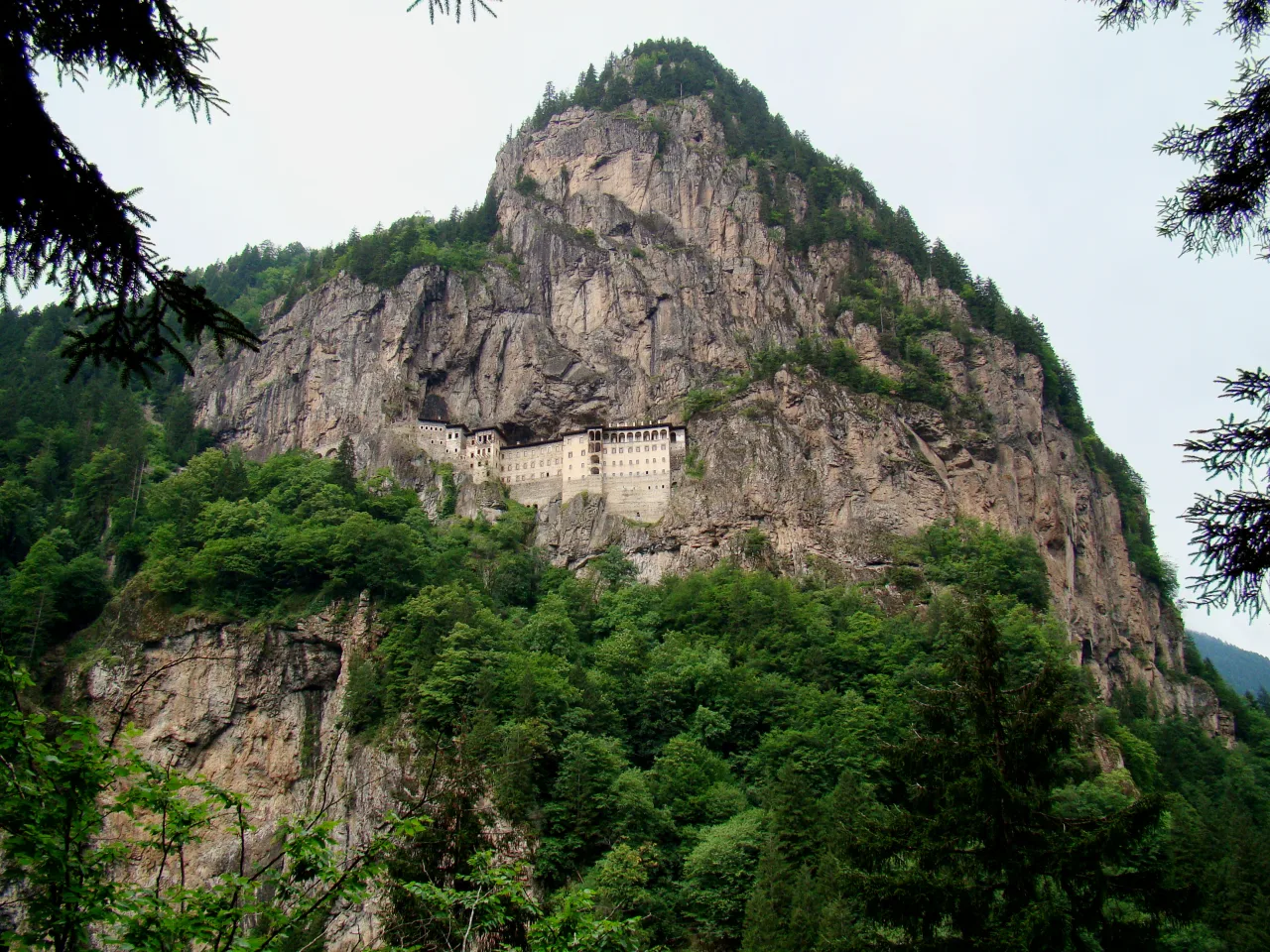
Sümela Monastery and Atatürk’s Mansion compare different periods and scales. The valley journey through Maçka and the urban visit to Soğuksu need separate transport planning.
An AI-assisted synthesis of the sources below, with Atlas planning suggestions. This is not a first-hand visit report. Admission, transport and access conditions must be checked with operators before travel.
In this guide
Rock and architecture at Sümela
The cliff setting is integral to the monastery. Distinguish foundation traditions from the building phases visible today. Look beyond the exterior view to circulation and religious spaces adapted to the rock, without touching painted surfaces.
A home becomes a place of memory
The former private residence acquired a museum identity associated with Atatürk’s Trabzon visits. Room layouts, garden and documents offer different kinds of evidence. A present display should not automatically be read as an untouched period interior.
Current arrangements determine the visit
Check official information on transport, steps and open areas at Sümela. Fog and rain can change the valley programme. Confirm mansion hours separately and consider different days for the two visits. Allowing time to read each building is more useful than treating them as obligatory photographs on a single circuit.
Reading a port city through historical layers
Treating Trabzon merely as a departure point for Sümela leaves the city’s own story unexplored. Maritime trade and routes to the interior help explain the relationship between its fortified core, commercial streets and architecture commissioned by different communities. On a city walk, notice how walls use the terrain, how streets connect with the coast and how buildings acquired new functions. A monument’s present use does not make every part of its history belong to one period.
Hagia Sophia offers a particularly rewarding introduction through its late Byzantine church architecture, carved stone and Christian imagery. Kostaki Mansion presents a different architectural language associated with the urban elite of the early twentieth century. Rather than treating both as interchangeable “old buildings”, compare their scale, decoration and relationship with the city. Check the operator’s present visitor arrangements before setting out; older tourism descriptions may preserve superseded institutional labels.
City neighbourhoods, coastal districts and inland valleys
Begin with the centre and Ortahisar to understand Trabzon’s scale before committing to long drives. A subsequent day can follow the coast west towards Akçaabat or east towards Sürmene and Of. The food traditions associated with Akçaabat and Sürmene offer a more local perspective than ordering an undifferentiated “Black Sea menu” throughout the trip.
Maçka and Sümela occupy one inland valley corridor; Uzungöl lies towards Çaykara on another. Trying to combine both in a compressed day misunderstands a landscape whose mountains divide routes rather than connect them. For a short stay, choose one inland excursion and retain time for the city. With more days available, compare the two separately. Plan meals and resting places along the route actually being travelled, not simply around a collection of famous names.
A lakeside visit is not a high-mountain expedition
Uzungöl combines lakeside walking, a settlement and tourism services. Continuing towards high pastures or mountain trails changes the demands on equipment, weather assessment and transport. Having a hotel reservation near the lake does not establish that every higher road is open or that every trail is suitable for beginners.
Avoid making the entire trip dependent on a single photograph at a specific hour. In low cloud, an architectural walk, a cultural institution or a food-focused day in town can be more rewarding than a long drive with little visibility. Do not stop across narrow roads or enter working fields without permission. Visitors with mobility requirements should ask individual operators about gradients, steps, drop-off arrangements and toilets rather than assuming that a destination-wide accessibility label describes every site.
District identities at the table and in music
Akçaabat meatballs, Sürmene pide, Hamsiköy rice pudding, Vakfıkebir bread and Tonya butter illustrate how district identities survive in the province’s cuisine. Instead of attempting every speciality in one meal, choose something connected with the area being visited and ask about preparation. Fish availability varies with season and supply, so a menu described in a guide is not a promise that every dish will be offered.
Horon likewise is not a single unchanging choreography. The provincial cultural records show that dances sharing a name can differ in rhythm and movement between districts. Listen to the instrument, changes in tempo and coordination within the group. Weddings and local celebrations are social occasions, not automatically performances for visitors; obtain permission before photographing people or joining in. This approach places living culture alongside monuments without turning residents into scenery.
Choose the visit that fits your question
Monastery
See how rock directs architecture.
Museum
Separate domestic history from commemoration.
Route
Plan Maçka and Soğuksu independently.
Visual exploration before you travel
Evliya Çelebi: Trabzon
A visual introduction to the city’s cultural landscape, not a current transport or opening-hours guide.
Practical questions before your visit
What is a sensible starting point for two days in Trabzon?
Use the first day for a layered city walk and one cultural institution, then devote the second to one inland valley or coastal district. Choosing between Sümela and Uzungöl according to your interests usually produces a better visit than racing to both.
Do Hagia Sophia and Sümela offer the same historical experience?
No. Hagia Sophia helps explain monumental church architecture within a city and changing functions; Sümela reveals a monastery complex in a steep valley. Their histories, spatial arrangements and visiting conditions need separate interpretation.
Can a coastal weather forecast be used for every highland trip?
No. Conditions at sea level do not establish visibility, temperatures or road access higher up. Check the particular valley and elevation being visited and retain a lower-level or city alternative.
Sources and scope of this guide
These primary sources support the historical and heritage background. Comparisons and suggested ways to organise a visit are Atlas editorial analysis, not instructions from the source institutions.
- Kültür Portalı · SÜMELA MANASTIRI ↗
- Kültür Portalı · ATATÜRK KÖŞKÜ ↗
- GoTürkiye — Trabzon, tarihi yapılar ve ilçe coğrafyası ↗
- Trabzon İl Kültür ve Turizm Müdürlüğü — Ayasofya mimarisi ↗
- Trabzon İl Kültür ve Turizm Müdürlüğü — Gastronomi ↗
- Trabzon İl Kültür ve Turizm Müdürlüğü — Horon ↗
- TRT 2 — Evliya Çelebi, Trabzon ↗
