
← Back to History of the Republic
Matson Photographic Collection / Library of Congress / Wikimedia Commons · No known restrictions on publication · Library of Congress Matson collection ↗ Finance · from savings to investment
National banks, credit and monetary sovereignty
There was no single state-bank formula. Separate institutions served commerce, monetary policy, industry, mining, tradespeople and agriculture, directing savings toward production and credit toward defined development aims.
26 August 1924—1938Ankara · nationwide
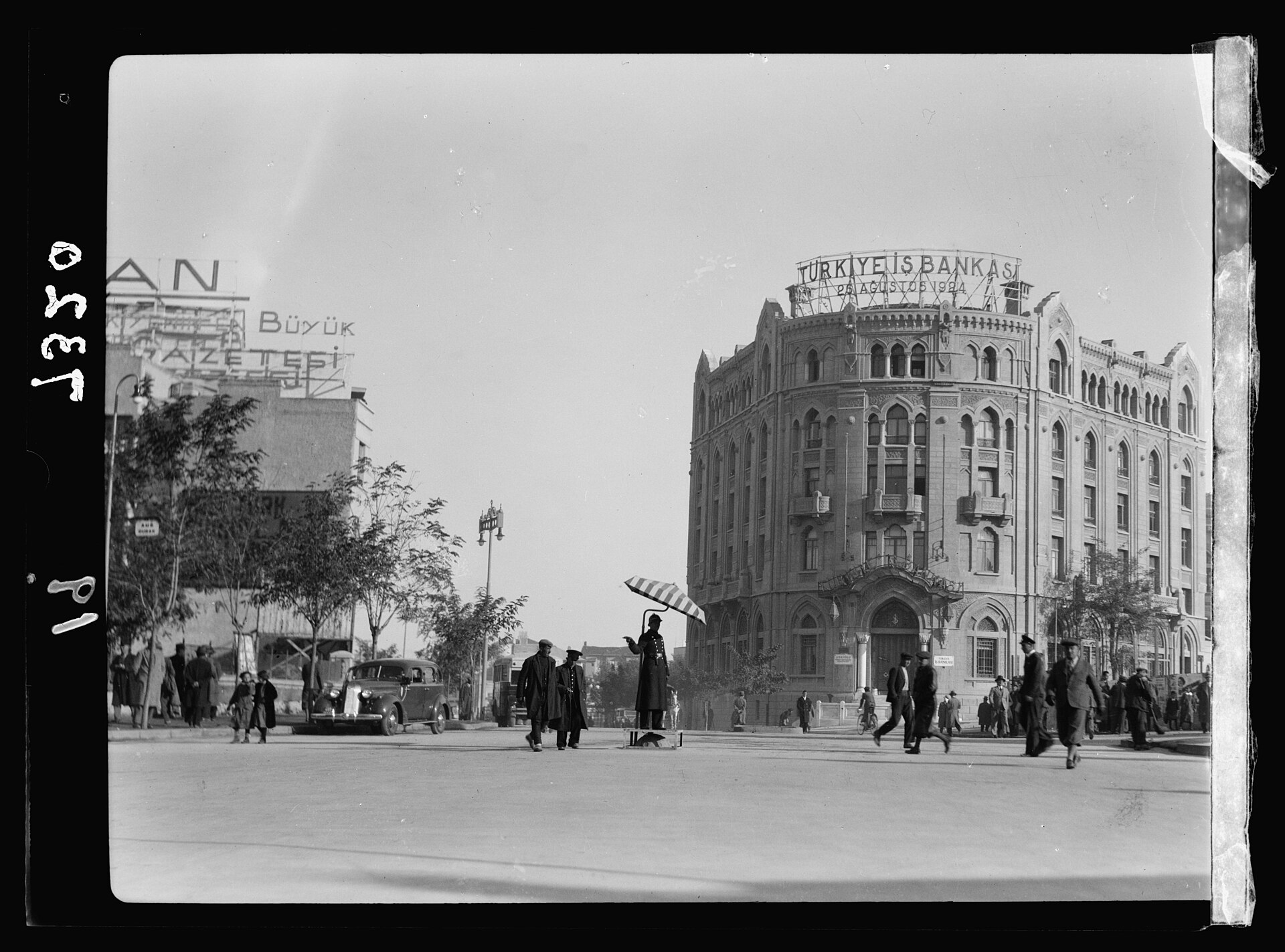
This Ankara bank building photograph is catalogued as 1935 in the Matson Photographic Collection. The date 26 August 1924 on the façade marks the bank's founding, not the photograph's date. The existing archive file has been preserved unchanged.
At a glance
- İş Bankası
- 1924
- Central Bank
- 1930
- Sümerbank
- 1933
- Etibank
- 1935
National banking was not one kind of bank
The Republic's banking programme cannot be understood by listing new institutions alone. Financing everyday commerce, establishing a major industrial plant, meeting a farmer's seasonal needs and managing monetary circulation were different problems. National banking expressed an ambition to mobilise resources within the country and strengthen economic decision-making. National capital, state ownership and central-bank status, however, are not synonyms. The distinction explains why İş Bankası, Ziraat, Sümerbank and the Central Bank fulfilled different purposes.
Banking did not begin from nothing in 1923. Institutions and experience survived from the Ottoman period, with Ziraat providing a particularly clear example. The new period involved reorganisations as well as new foundations. Separating Atatürk's political priorities, Parliament's legislative work, government implementation and professional banking makes the history concrete. The appearance of a bank's name, the collection of capital and the opening of functioning branches could be separate stages rather than a single moment.
↑ Back to dossier contentsİş Bankası: commercial credit, saving and enterprise
Türkiye İş Bankası was founded on 26 August 1924, with Celal Bayar as its first general manager. Its initially limited branch and staff structure indicates the scale of a new financial institution. The initiative supported by Atatürk belonged to the development of national commercial banking. Its purpose should not be confused with issuing banknotes as a central bank. Collecting deposits and participating in business finance belonged to a different part of the economic system.
Consider the expenses incurred before production generates a sale: materials are purchased, transport arranged and wages paid, while income arrives later. Finance helps manage this difference in timing. The glass investment at Paşabahçe makes İş Bankası's connection with industry visible. A deposit account, an enterprise and a factory occupy different points on the same economic map. Seen this way, independence was not only a slogan: it involved constructing workable arrangements for production and payment.
↑ Back to dossier contentsThe Central Bank: legislation and operation were separate
Law No. 1715 establishing the Türkiye Cumhuriyet Merkez Bankası was adopted on 11 June 1930; operations began on 3 October 1931. Preparatory work involving Abdülhalik Renda and legal contributions by Leon Morf illustrate the technical dimension of institution-building. Banknote issuance and monetary-market responsibilities were different from a commercial bank's customer lending. The foundation aimed to establish an institutional basis for decisions and implementation in monetary affairs.
A central bank's existence does not mean it directly solves every production problem. Operating a textile machine and exercising powers concerning monetary circulation are different activities. When reading an institution's history, avoid automatically carrying its present-day mandate backwards. The law, economic circumstances and relationship with government in the 1930s should be studied separately from subsequent arrangements. This distinction gives central banking and industrial management their respective scale in an account of economic development.
↑ Back to dossier contentsSümerbank and Etibank connected finance with production
Sümerbank was established in 1933 for banking and industrial operation. Textile investments such as Kayseri and Nazilli demonstrate the connection between finance and running a plant within one framework. Purchasing machinery, developing technical personnel and maintaining production created separate expenses and responsibilities. Sümerbank's place in that chain extended beyond an ordinary loan contract: establishing and sustaining industrial enterprises were also part of its role.
Etibank, created by Law No. 2805 of 14 June 1935, was associated with mining and energy. Mineral deposits underground are not yet usable industrial inputs. Extraction, processing, power and transport require investment. Its connection between banking and production makes sense in this context. Sümerbank and Etibank were not simply two names for the same institution or sector. They were different development instruments, linked respectively with manufacturing and with mineral and energy activity.
↑ Back to dossier contentsZiraat: an older institution changed under the Republic
Ziraat Bankası's roots extend to the Memleket Sandıkları established through Mithat Paşa's initiative in 1863. Describing it as an entirely new bank founded by Atatürk is therefore incorrect. It was reorganised during the Republic, with Law No. 3202 in 1937 marking one stage. Agricultural credit addressed the financing needs of a major sphere of production. This institution is a case in which continuity and innovation should be explained together.
A farmer's production calendar differs from a shop's daily sales. Seeds, livestock and equipment are needed before harvest, while repayment capacity is often connected with the crop. Agricultural credit must address that timing. Relationships between cooperatives and a bank provide a bridge between individual producers' needs and collective organisation. Lending does not, however, remove rainfall, disease or crop-price risks. Finance was an important component of agricultural policy, not the whole policy by itself.
↑ Back to dossier contentsHalkbank: a law in 1933, operation in 1938
Law No. 2284 adopted in 1933 provided a framework for Halk Bankası and Halk Sandıkları. The bank began operating in 1938. The interval clearly demonstrates the difference between a legal foundation and a working financial network. Small traders and craftspeople did not have the same financial scale or needs as a large industrial campus. A banking history concerned only with financing big factories would exclude everyday producers.
A repairer acquiring tools, a craft worker obtaining materials and a shop assembling working capital all need appropriate funding. Small-business organisation and access to credit form an economy's local dimension. Rather than treating Halkbank as functionally equivalent to Sümerbank or the Central Bank, examine the producer groups it addressed and the stages of its establishment. Continuity in small workplaces may be less visually dramatic than a steelworks, but remains important to understanding the Republican economy.
↑ Back to dossier contentsReading banking through documents and everyday objects
The Matson photograph of the İş Bankası building in Ankara used here is catalogued as 1935. The façade's date, 26 August 1924, refers to the bank's foundation and should not be read as the photograph's date. Architecture records an institution's presence in the city. Account books, cheques, receipts and correspondence reveal less visible processes. Each document has a date and a purpose that should be distinguished from a bank's general founding story.
The Economic Independence Museum's collections of typewriters, calculating machines, seals, savings boxes and documents make banking's office work tangible. A culture of saving and an investment policy were not identical, although flows of resources connected them. When comparing banks, ask four questions: what need did each address, where did its resources come from, whom did it serve, and how did it relate to production or money? These questions offer a more explanatory reading of Republican economic history than memorising establishment years.
↑ Back to dossier contentsRead the turning points together
- 1863
Memleket Sandıkları
Mithat Paşa's initiative established roots of Ziraat that predate the Republic.
- 1924
İş Bankası
The foundation on 26 August began a national commercial-banking initiative, with Celal Bayar as the first general manager.
- 1930–1931
Two stages of the Central Bank's foundation
The law was adopted on 11 June 1930; the bank began operating on 3 October 1931.
- 1933
Different frameworks for Sümerbank and Halkbank
Sümerbank entered operation as a production-and-finance institution while legislation for Halk Bankası and Halk Sandıkları was adopted.
- 1935
Etibank
Law No. 2805 established the legal framework for a development institution associated with mining and energy.
- 1937
Ziraat is reorganised
Law No. 3202 formed part of the older bank's structural transformation in the Republican period.
- 1938
Halkbank starts operating
The legal framework of 1933 was followed five years later by an operating bank.
Explore the archive and documentary context
Türkiye Cumhuriyet Merkez Bankası
Central Bank employees explain: what is a central bank?
The CBRT's official video of 21 August 2017 helps distinguish central banking from everyday banking services. It is modern educational material, not evidence that every power exercised in the 1930s has remained unchanged.
Choosing to load the player connects to YouTube and shares technical data such as your IP address with Google. Autoplay is off. This choice does not change your cookie preferences. The publisher may restrict regional access or embedding; the official link below provides an alternative.
Supported YouTube publications can be watched here by choosing to load their player. Videos are not copied onto our server. Interpret archive images alongside their production date and the narrator’s perspective; the official publication link remains as an alternative.
Questions and historical distinctions
Are a national bank, a state bank and a central bank the same?
No. National banking concerns capital and economic orientation; state banking concerns ownership and administration; central banking involves particular monetary functions. Those characteristics can sometimes overlap, but are not synonyms. Each bank's legislation, ownership and activity should be examined separately.
Was İş Bankası an earlier name for the Central Bank?
No. İş Bankası's commercial banking and investment functions were distinct from the Central Bank's monetary responsibilities. Financing a business's purchases and managing banknote circulation are different tasks. Their common Republican context does not make them one institution or alternate names for the same bank.
In which year was Halkbank established?
Giving both the 1933 legislation and the start of operation in 1938 is the clearest answer. A single date often hides the stages between a legal foundation and an institution capable of serving customers. The same distinction matters to the Central Bank's 1930–1931 sequence.
Did Atatürk establish Ziraat Bankası?
Ziraat's roots lie in the Memleket Sandıkları of 1863. Its Atatürk-period history concerns developing agricultural finance and reorganising the institution under Republican conditions. Presenting an older institution as newly born conceals both its Ottoman background and the actual character of the later changes.
Archive note
Archive images for wider context
Cumhuriyet Atlas
Continue the story here
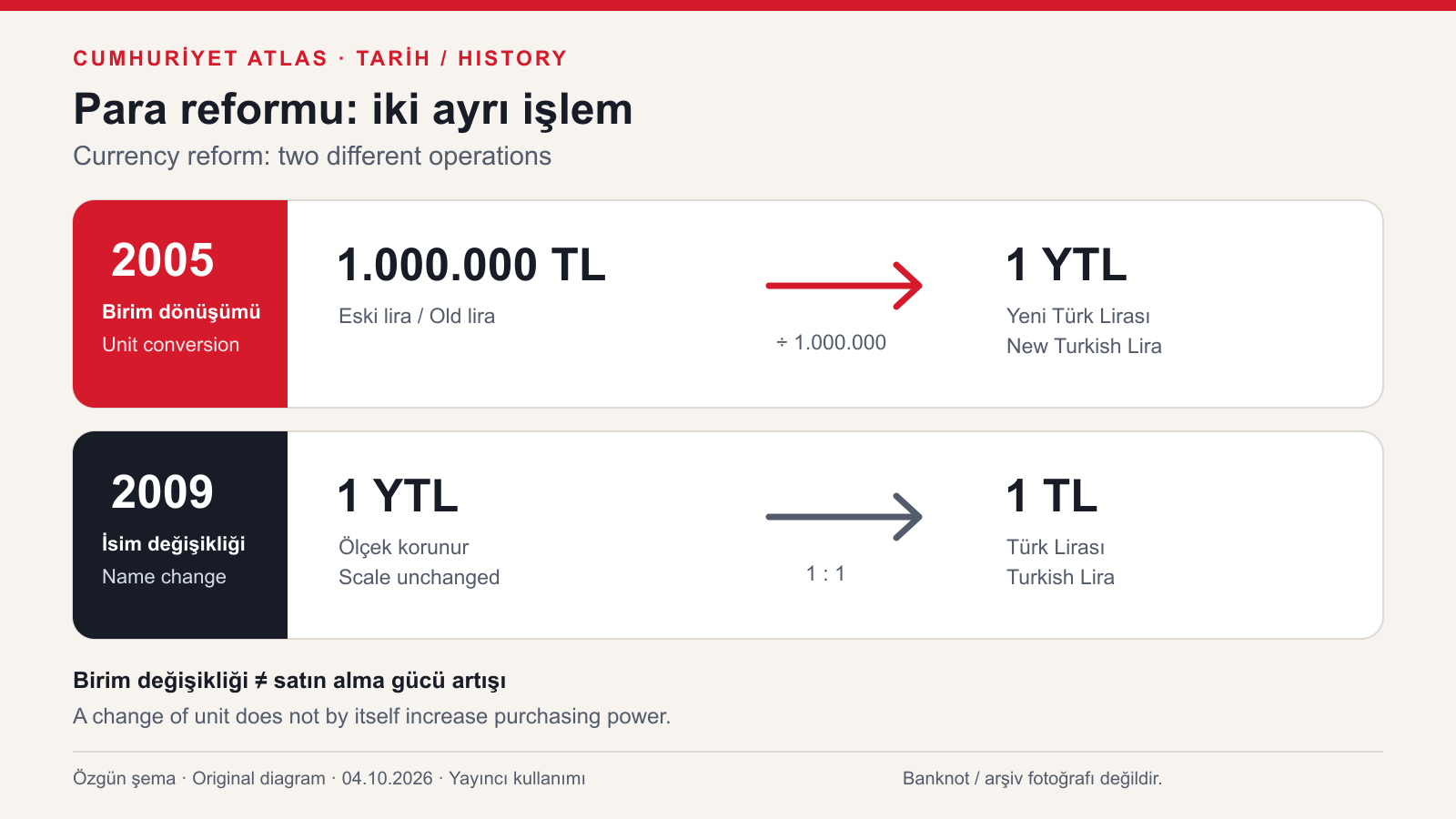
Transformation, 1980–2001 · currency reform, 2005/2009
Economic transformation, 1980–2001, and currency reform, 2005/2009
Financial opening, crisis, bank repair and a change of currency unit are not the same process. Explore selected turning points through an original conversion diagram and explanations that help make sense of archival documents.
Explore →
17 February 1925—1937
Agriculture: tax, science, farms and cooperatives
Abolition of the tithe, model farms, scientific education, seed and animal breeding, and the search for credit.
Explore → 17 February—4 March 1923
The İzmir Economic Congress and economic sovereignty
Farmers, merchants, industrialists and workers debated the new state’s economic aims while Lausanne negotiations continued.
Explore →Cumhuriyet
See the story in motion
Selections from our channel. Watch, open a related dossier and keep exploring.
Explore the video library → 11:38
Industry & science
Sugar factories: the memory of production
A channel publication on the establishment of sugar factories, paired with our industry, agriculture and banking dossiers.
Watch & explore →Documents and sources19 sources
Official reference points used to verify the chronology and interpretive frame on this page.
- Türkiye İş Bankası ↗ATATÜRK ANSİKLOPEDİSİ
The purpose and development of the national private bank founded in 1924.
- Central Bank of the Republic of Türkiye ↗ATATÜRK ANSİKLOPEDİSİ
The founding law of 11 June 1930 and formation of a monetary authority.
- Sümerbank ↗ATATÜRK ANSİKLOPEDİSİ
The industrial bank founded in 1933, its factories and social campuses.
- Etibank ↗ATATÜRK ANSİKLOPEDİSİ
The bank founded in 1935 to finance mining and energy investment.
- İş Bankası history ↗Türkiye İş Bankası
Reference for founding dates, institutional functions and period context.
- Central Bank history ↗Türkiye Cumhuriyet Merkez Bankası
Reference for founding dates, institutional functions and period context.
- Halkbank: legal foundation and operations ↗Halkbank
Reference for founding dates, institutional functions and period context.
- Historical origins of Ziraat Bank ↗Ziraat Bankası
Reference for founding dates, institutional functions and period context.
- From Etibank to Eti Maden ↗Eti Maden
Reference for founding dates, institutional functions and period context.
- İş Bankası · O günlerden bugünlere ↗www.isbank.com
- TCMB · Merkez Bankası tarihçesi ↗www.tcmb.gov.tr
- TCMB · Herkes İçin Ekonomi: çalışanların kurum anlatımı ↗www.tcmb.gov.tr
- Sümer Holding · Kuruluş ve tarihçe ↗sumerholding.gov.tr
- Eti Maden · Tarihçe ↗www.etimaden.gov.tr
- TBMM · 2805 sayılı Etibank Kanunu ↗www5.tbmm.gov.tr
- Ziraat Bankası · Bankamız tarihçesi ↗www.ziraatbank.com.tr
- Ticaret Bakanlığı · Türkiye'de kooperatifçilik tarihçesi ↗ticaret.gov.tr
- İş Sanat · İktisadi Bağımsızlık Müzesi ↗issanat.com.tr
- Library of Congress · Ankara Turkish bank building, Matson Collection ↗www.loc.gov