
← Back to History of the Republic
Resimli Gazete / Wikimedia Commons · Public domain ↗ Republic · form of government
Proclamation of the Republic
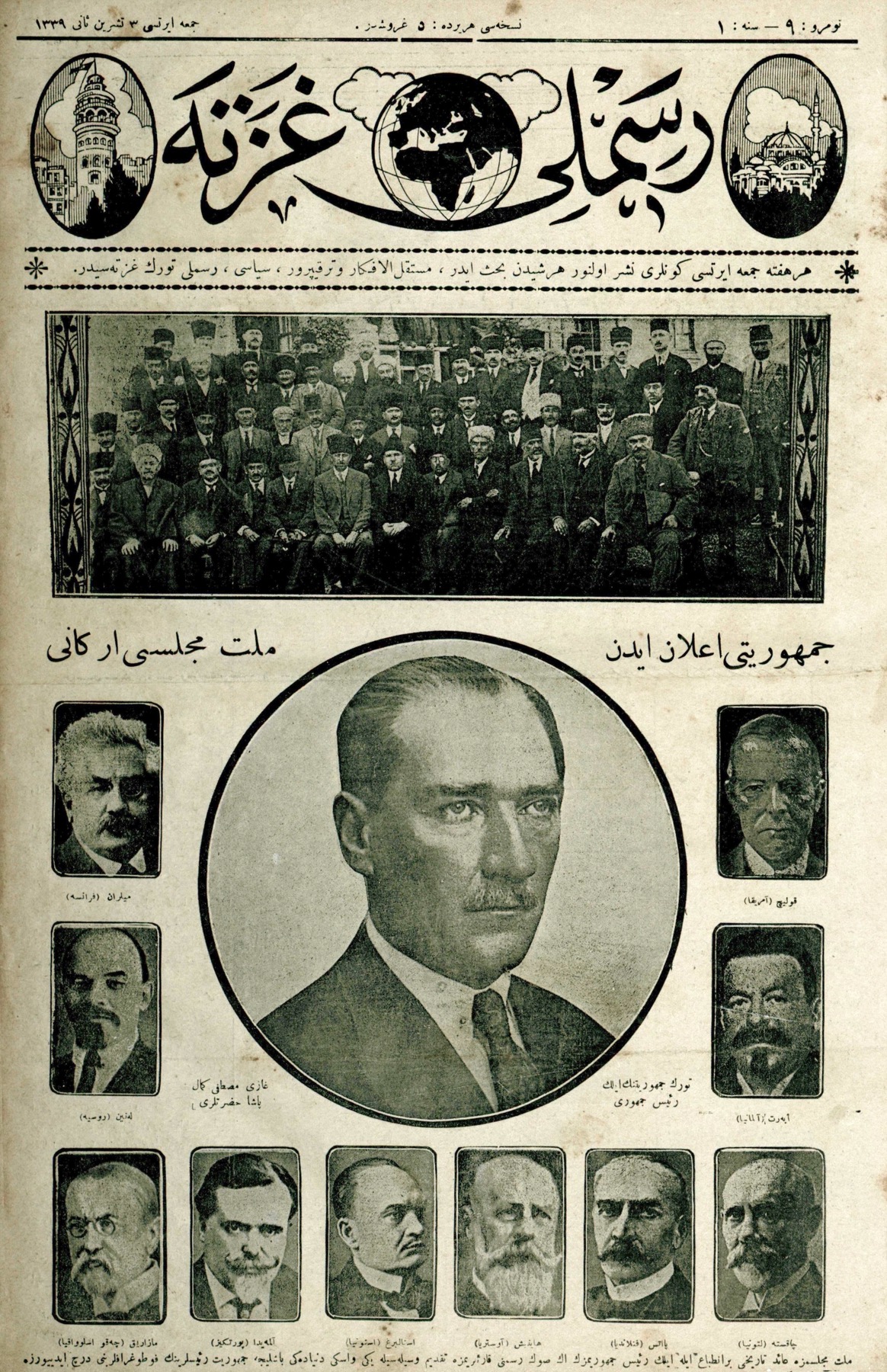
29 October was both a beginning and the outcome of four years of institutional transformation. A constitutional amendment named the form of government as a republic and created the presidency.
29 October 1923Grand National Assembly · Ankara
The 3 November 1923 issue of Resimli Gazete reporting the proclamation of the Republic.
At a glance
- Date
- 29 October 1923
- Decision
- Grand National Assembly
- First president
- Mustafa Kemal
- Sovereignty
- Belongs to the nation
The foundation of 1920 and the definition of 1923
The proclamation on 29 October 1923 does not mean that national sovereignty first appeared that day. The Grand National Assembly had directed the independence struggle and government since 1920, and the 1921 Constitution declared sovereignty to belong to the nation. Abolition of the sultanate in 1922 marked a major change in dynastic authority. Questions including the head of state and the formation of government nevertheless still required clearer arrangements. On 29 October the republican name and revised institutional structure were added to that development. The event was both a beginning and the result of earlier work. Calling it only a sudden declaration overlooks continuity; treating it merely as a new label overlooks the constitutional changes.
↑ Back to dossier contentsWhy forming a government had become a problem
Under assembly government, ministers were elected individually. In autumn 1923 this made forming a new administration difficult. The issue involved more than deciding who should occupy particular offices: it concerned how a government capable of working together would be assembled and how the head of state's position would be defined. Arrangements developed during war were being reconsidered against the requirements of peace. The difference between forming a cabinet and electing separate ministers concerns responsibility and political coherence. The republican amendment addressed that practical problem while making a wider choice of regime explicit. This context helps explain the proclamation through the everyday requirements of government, not only through ceremonies and commemorative accounts.
↑ Back to dossier contentsWhat the Assembly changed on 29 October
The proposal prepared by Mustafa Kemal and colleagues was considered on 29 October in the People's Party group and in the Assembly. The existing Fundamental Law was amended to identify the governmental form of the state as a republic. This was not the drafting and adoption of an entirely new, detailed constitution in one day; it was a change to the constitution then in force. The presidency and arrangements for forming government belonged within that change. Attention to the legal mechanism explains how a political decision became institutional form. Beyond photographs or accounts of an evening meal were a proposal, deliberation and adopted provisions. The Assembly's role was to enact the change, not simply listen to an announcement.
↑ Back to dossier contentsThe first president and a new allocation of responsibilities
Following the amendment, the Assembly elected Mustafa Kemal as the first president. İsmet Pasha was entrusted with forming the new government. The clearer distinction between the head of state and the government's daily administration shows the institutional dimension of the new order. Leadership involves personal biographies, but the definition of offices matters as much as the names occupying them. Authority was now organised within a framework different from a dynastic headship of state. That does not make the earliest republican period identical to a contemporary system possessing all its present democratic institutions. Participation, opposition and the implementation of rights followed complicated subsequent paths. The significance of the founding decision can be explained without erasing that history.
↑ Back to dossier contentsFrom a republican form to everyday public life
Defining the state on 29 October did not solve every social problem overnight. Institutions and services still had to be developed in law, education, health, production and transport. The 1924 Constitution and subsequent reforms formed separate stages of that work. Republican history is therefore not only remembrance of a founding day; it also asks how a political principle was carried into social life through practice. A school's need for teachers, a railway connection or a citizen's position before the law makes the relationship between governmental form and everyday experience concrete. Reading the proclamation in this wider setting allows the achievement of independence and the long institutional work required during peace to be considered together.
↑ Back to dossier contentsArchive note
Archive images for wider context


Cumhuriyet Atlas
Continue the story here
13 October 1923
Ankara becomes the capital
The operational centre of the National Struggle became the constitutional capital of the new state.
Explore →
10—11 November 1938
The death of Atatürk
The founding president’s death, nationwide mourning and a constitutional presidential succession.
Explore → 29 October 1923—10 November 1938
Reforms during Atatürk’s presidency
New institutions in law, education, script, citizenship and everyday life.
Explore →Documents and sources4 sources
Official reference points used to verify the chronology and interpretive frame on this page.
- Proclamation of the Republic ↗Atatürk Ansiklopedisi
Government crisis, constitutional amendment and election of the first president.
- The 1921 Constitution ↗Anayasa Mahkemesi
Constitutional text establishing national sovereignty and assembly government.
- Chronology of 1923 ↗Kültür ve Turizm Bakanlığı
Separate dates for peace, the capital decision and proclamation.
- War of Independence Museum ↗TBMM
The Assembly’s opening, constitutional steps and the 1919–1923 chronology.