Ferhat Arıcan's parallel-bars career offers more than a medal story: it provides a practical introduction to the way artistic gymnastics is judged. Born in Konak, İzmir, in 1993, he became the first male artistic gymnast to represent Türkiye at an Olympic Games at Rio 2016. His bronze at the Tokyo 2020 Games, held in 2021, was Türkiye's first Olympic gymnastics medal. Those are different historical milestones. Men's participation cannot be used to erase the earlier history of women's participation.
- Discipline
- Men's artistic gymnastics · parallel-bars specialist
- Tokyo final
- 3 August 2021 · D 7.000 + E 8.633 = 15.633
- Olympic breakthrough
- Türkiye's first gymnastics medal · bronze, Tokyo 2020
Recognition at school and the route to international competition
The FIG biography describes a start at roughly nine or ten years old, after a physical-education teacher noticed his handstands. This small detail is a useful starting point because sporting development does not begin with an anthem or a podium. School can connect an emerging ability with the structured practice needed to turn it into a competitive skill.
Rio was first a threshold of access. Taking part at an Olympics, qualifying for an apparatus final and winning a medal are separate steps. Starting the story only in Tokyo hides the preceding years of qualification and work across different apparatuses. Reading a career through those stages also avoids treating a single unsuccessful routine as a verdict on an entire athlete.
Back to contentsMersin and Basel: continuity beyond one outstanding day
A parallel-bars European title in Mersin in 2020 was followed by another in Basel in 2021. European Gymnastics specifically identifies them as consecutive titles. These results belong within a broader development in Turkish gymnastics, alongside specialists such as rings champion İbrahim Çolak, rather than as evidence that one athlete single-handedly created a whole sporting programme.
Competition names matter. A European Championship, a World Championship and a World Cup meeting are different events. Calling all international victories 'world titles' exaggerates an achievement instead of explaining it. The chronology here keeps the original event category attached to every result, allowing readers to appreciate the work without inflating the title.
Back to contentsThe Tokyo final: why the hardest routine did not win
On 3 August 2021 Arıcan scored 15.633, made up of 7.000 for difficulty and 8.633 for execution. His difficulty value was the highest in the final. Zou Jingyuan nevertheless won with 16.233, combining 6.900 difficulty and 9.333 execution; Lukas Dauser took silver with 15.700. The table is an especially clear answer to the assumption that the most difficult routine must automatically win.
When watching parallel bars, look beyond the largest airborne skills. Control in handstand, the rhythm of transitions and balance on the landing help make a routine intelligible. Difficulty evaluates the planned content; execution evaluates how cleanly it is performed. Arıcan's bronze is a concrete example of both elements meeting in one result. This is an invitation to understand the broadcast, not a training prescription or a replacement for the judging code.
Back to contentsParis 2024 and the circuit: a career is not a straight ascent
At Paris 2024 he placed fifth in the parallel-bars final with 15.100. Türkiye's men's team was ninth in qualification. An individual apparatus final and a team final are not interchangeable outcomes: success in the first does not mean qualification for the second. Nor does a medal won in Tokyo carry points into the next Olympic final.
FIG's 2025 review lists Arıcan as the overall parallel-bars winner of the World Challenge Cup series. That is a season-level circuit result, not the final of a single World Championship. At the Paris World Challenge Cup on 26–27 September 2026, the FIG athlete results list records victory in the parallel-bars final with 14.633. This recent result was checked on 3 October 2026; it is a dated observation, not a prediction about an upcoming competition.
Back to contentsRead the photograph as carefully as the score
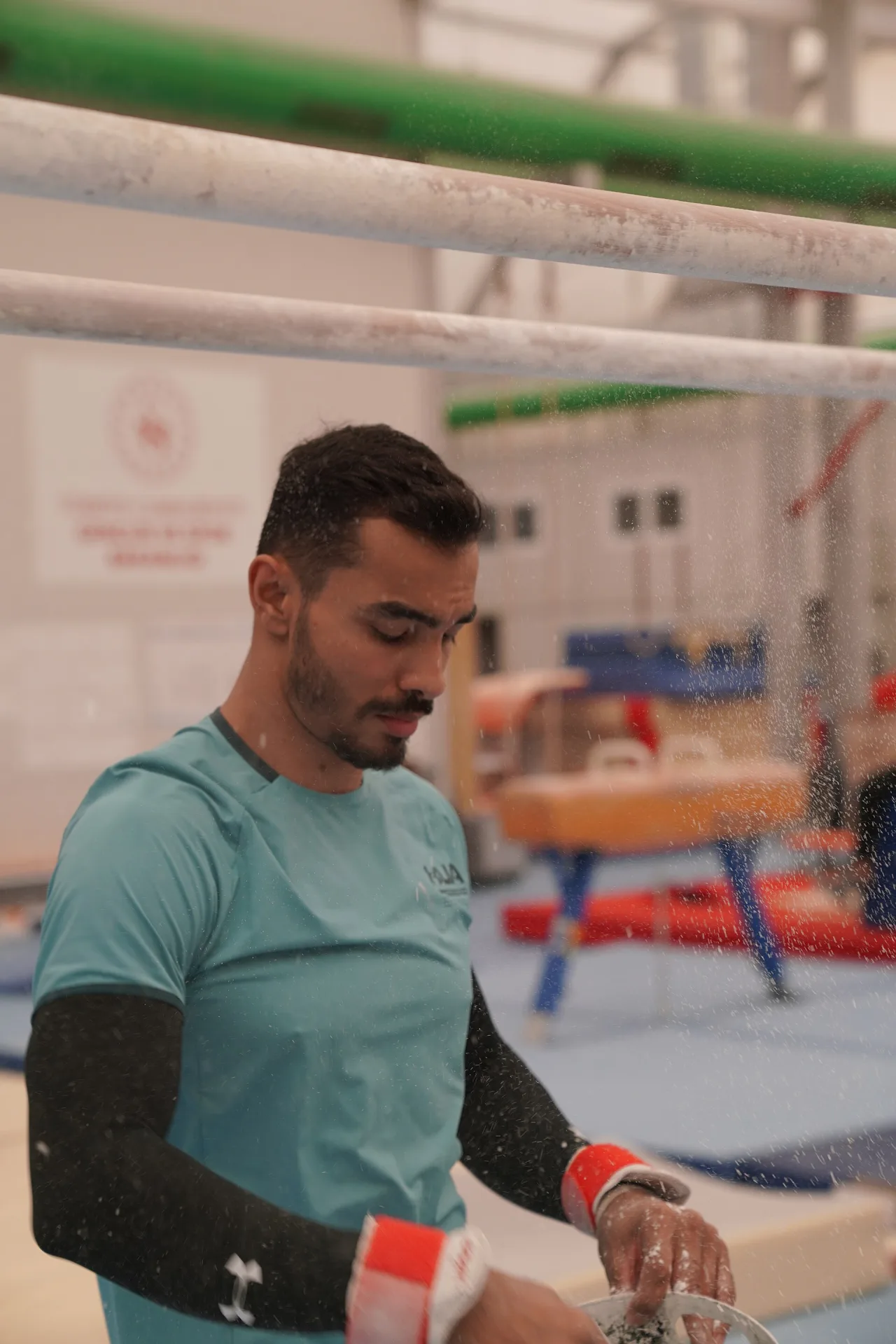
The photograph on this page shows chalk preparation in a gymnastics hall. Although the existing local archive filename contains 2019, the source dates the image to 1 June 2021. It is not a photograph of a skill being performed in the Tokyo final. Distinguishing an image's actual context from the story it accompanies is part of documenting sport accurately.
For a useful viewing route, watch one complete routine in the official Tokyo replay before opening the difficulty and execution columns in the results book. Then read Çolak's rings biography to compare how different apparatuses reward different skills. This approach introduces Turkish gymnastics through its specialists and technical decisions, rather than reducing it to a handful of medal colours.
Back to contentsA timeline of life, work and history
- 1993
Born in Konak
The FIG identity record gives 1993 as his birth year and Konak as his birthplace.
- 2016
Rio participation milestone
He became Türkiye's first male Olympic artistic gymnast, a claim specifically about the men's category.
- 2020–2021
Consecutive European titles
Parallel-bars gold in Mersin was followed by another European title in Basel.
- 2021
3 August: Tokyo bronze
His 15.633 earned Türkiye's first Olympic medal in gymnastics.
- 2024
Paris apparatus final
Fifth on parallel bars with 15.100; Türkiye was ninth in men's team qualification.
- 2025
World Challenge Cup series
FIG's season review listed him as the overall parallel-bars circuit winner.
- 2026
26–27 September: Paris tournament
The FIG results record lists first place on parallel bars with 14.633. This was a World Challenge Cup meeting, not an Olympic or World Championship title.
Watch and listen: a visual reading path
Use this selection alongside the analysis above. Supported YouTube publications can be watched on this page after you choose to load their player. The publisher’s rights and availability conditions apply; the player does not load or start automatically. Official publication links remain available as an alternative.
Olympics Gymnastics
Tokyo 2020 men's parallel bars final: full replay
The official Olympic replay includes Arıcan's final routine on 3 August 2021 alongside the other finalists. Compare the running order, difficulty and execution scores with the results book.
Choosing to load the player connects to YouTube and shares technical data such as your IP address with Google. Autoplay is off. This choice does not change your cookie preferences. The publisher may restrict regional access or embedding; the official link below provides an alternative.
Questions and explanations
Why specify 'first male Olympic gymnast'?
The Rio 2016 participation milestone belongs to men's artistic gymnastics. Describing him as Türkiye's first Olympic gymnast without qualification would overlook the earlier women's participation history. The Tokyo bronze is a separate milestone: the country's first Olympic gymnastics medal.
Why did a 7.000 difficulty score not produce gold?
Difficulty is only one component. Arıcan's 8.633 execution brought his total to 15.633. Zou Jingyuan combined slightly lower difficulty of 6.900 with 9.333 execution for 16.233. The same final table demonstrates why both columns must be read together.
Are the 2025 circuit title and 2026 Paris gold the same event?
No. The 2025 result is the World Challenge Cup season ranking; the September 2026 result is the parallel-bars final at the Paris meeting. Neither should be presented as an Olympic gold medal or a World Championship title.
Sources, image rights and research method
This is original explanatory and analytical writing informed by the sources below. AI assisted research and drafting. Awards for people, teams and institutions are distinguished; dated results are not current rankings. Media links do not claim a licence to republish a video here. Use the publisher’s correction process if a fact is wrong.
- FIG: Ferhat Arıcan kimlik ve yarışma kayıtları ↗ Source check: 2026-10-03
- Tokyo 2020 resmî sonuç kitabı: paralel bar finali ↗ Source check: 2026-10-03
- FIG: Tokyo 2020 erkekler artistik cimnastik raporu ↗ Source check: 2026-10-03
- European Gymnastics: Basel 2021 ve art arda Avrupa şampiyonlukları ↗ Source check: 2026-10-03
- European Gymnastics: Mersin 2020 yarışma kayıtları ↗ Source check: 2026-10-03
- FIG: 2025 World Challenge Cup seri şampiyonları ↗ Source check: 2026-10-03
- FIG: 26–27 Eylül 2026 Paris World Challenge Cup takvimi ↗ Source check: 2026-10-03